
Commander blueprint · Lorwyn Eclipsed
How to build Ashling, Rekindled // Ashling, Rimebound
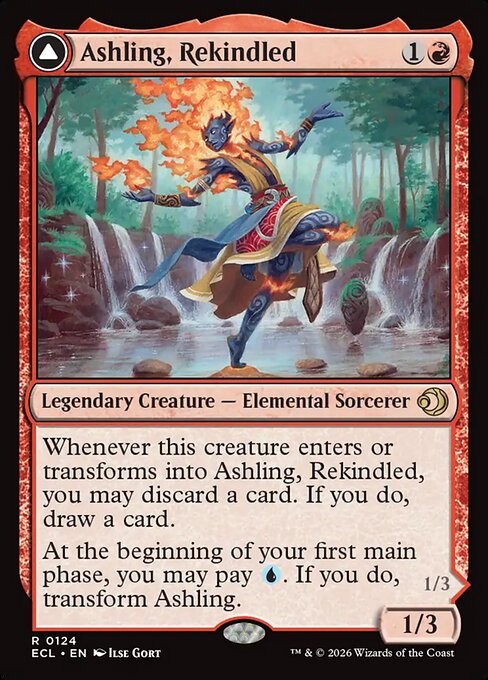
Each turn, Ashling, Rimebound adds two mana at the start of your first main phase that only a spell of mana value 4 or more can spend. Thirty eight of the sixty five spells here can spend it, and they are cast before combat, because that is when the mana runs out.
Art by Ilse Gort
Affiliate links: we may earn a commission on purchases.
 31
 28
Prices as of 23 October 2026.
The core list: 100 cards, 34 lands (17 basic), 22 creatures, average mana value 3.8. Mana sources: 31 blue, 28 red. Bracket floor 3 (Upgraded). How brackets work →
What the deck is doing. Ashling, Rekindled costs  for a 1/3, and when she enters you may discard a card to draw one. At the start of your first main phase you may pay to transform her into Ashling, Rimebound, and from then on she adds two mana of one color at the start of each of your first main phases. Only a spell of mana value 4 or more can spend it. Paying at that same moment turns her back, and the flip back loots again. So every turn asks one question: which four or more will the two mana pay for. Thirty three of the sixty five nonland cards here cost four or more, five more are X spells that reach four, and the other twenty seven are the mana rocks, the cantrips and the interaction, which your lands pay for.
The two mana is gone by combat, so the big spell comes first
Mana empties at the end of every step and phase. Ashling, Rimebound adds hers at the beginning of your precombat main phase, and it is gone the moment that phase ends. Nothing it pays for can wait for combat, for an opponent's turn or for your second main phase, so each turn is planned before you attack: cast the four or more, then attack with whatever was already on the table.
That decided which big creatures made the list. Glorybringer, Thundermaw Hellkite, Goldspan Dragon and Shivan Devastator all have haste, so a dragon paid for with the two mana attacks the turn it lands. Lightning Greaves does the same for Inferno Titan and Niv-Mizzet, Parun, at an equip cost of zero. Flash is mostly wasted here, because a creature flashed in on an opponent's turn gets none of Ashling's mana. That is why Hullbreaker Horror is not in the list, and why Thryx, the Sudden Storm and Torrential Gearhulk are in for what they do when they arrive rather than for the ambush.
Treasure is the only way to carry the mana past combat
Five cards turn the restricted two into Treasure, which pays for anything and keeps until you want it. Big Score, Unexpected Windfall and Pirate's Pillage each cost four, take a discard as part of the cost, and return two cards and two Treasures. Paid with Ashling's two and two of your lands, each one hands those lands back as Treasure, so the whole trade is a discard for two cards, and the Treasures can pay for Counterspell on someone else's turn. Ashling's Command costs five and can pick its draw two and its two Treasures together. Brass's Bounty costs seven and makes a Treasure for every land you control.
The big mana rocks do the same job for good. Thran Dynamo costs four and Gilded Lotus five, so Ashling pays for most of either, and each then adds three a turn that spends on anything. On turn three, two lands plus the two mana is exactly a Thran Dynamo, and turn four is then four lands, three from the Dynamo and two from Ashling: nine mana.
Leave her on Rimebound, and flip back only for a card you cannot use
Both faces carry a pay to transform trigger at the start of your first main phase, and the arithmetic says to leave her alone. Staying on Rimebound adds two mana every turn and costs nothing. Flipping back and forth also adds two every turn, because paying to transform her into Rimebound adds the two as she turns over. But the round trip costs one red and one blue from your lands across two turns, and what it buys is one loot. That is two real mana for one card filtered.
So the loot is for a hand holding something the deck cannot use: the sixth land on turn seven, a counterspell at a table with nothing to counter, a second board wipe. Early on it is worth more. She loots as she enters on turn two and flips on turn three for the first four drop, and the first flip back can wait until a land is dead. If she dies, she returns as Ashling, Rekindled and loots on the way in, so removal costs you the commander tax and one turn without the two mana.
Harmonic Prodigy reads Rimebound as a Wizard and ignores Rekindled

Ashling, Rekindled is an Elemental Sorcerer and Ashling, Rimebound is an Elemental Wizard, and the three cards here that make her triggers happen twice each read her differently. Harmonic Prodigy doubles the triggered abilities of your Wizards, so it doubles the mana side and never the loot. Wizard's Staff doubles whatever the equipped creature triggers, and its cheap equip cost is for Wizards, so it goes onto Rimebound for and stays on through every flip, doubling the loot as well. Twinflame Travelers doubles your other Elementals, which is both faces, and it costs four, so Ashling's mana pays for it.
Each of the three adds one more copy of the trigger, so with all three out the mana ability resolves four times for eight mana, and each copy picks its own color. The pay to transform triggers are doubled too, and the extra copy does nothing: once she has turned over, a second payment cannot turn her again, so pay once. Tanufel Rimespeaker is an Elemental Wizard as well, which means Harmonic Prodigy and Twinflame Travelers both add to its trigger, and with both on the table every spell of four or more draws three cards.
None of the three doubles Ashling on the turn it arrives. Ashling's triggers go on the stack the instant your first main phase begins, before you can cast or equip anything, so a doubler cast or equipped that turn starts working on the next one. That makes Twinflame Travelers the right thing to spend the two mana on when nothing in hand is urgent, and it is why Wizard's Staff goes on the turn before you plan a big one.
Mana value is the printed cost, so Treasure Cruise counts as an eight

Ashling, Rimebound checks a spell's mana value, and mana value comes from the cost printed in the corner, whatever you actually pay. Delve and cost reduction leave it alone. Treasure Cruise and Dig Through Time are eights, Murktide Regent and Tolarian Terror are sevens, Blasphemous Act and Sunderflock are nines, and each of them is usually cast for a fraction of that. The restricted two can pay for most of a Treasure Cruise that costs three, and the loot fills the graveyard that delve eats and that Tolarian Terror counts.
The rule cuts the other way on Cyclonic Rift. Its overload costs seven, but its mana value stays two, so your lands pay all seven. Deep Analysis is the kind case: discard it to the loot, and its flashback of and 3 life is paid with the two mana, because the card in your graveyard is still a four. The same rule is why Tanufel Rimespeaker draws, and Enraged Flamecaster deals 2 damage to each opponent, off a Treasure Cruise that cost you one blue.
Four of those cards want the same graveyard. Tolarian Terror gets cheaper for every instant and sorcery card in it, while Treasure Cruise, Dig Through Time and Murktide Regent exile cards from it to pay, and Murktide Regent only grows from the instants and sorceries it exiles. So cast Tolarian Terror before a delve spell rather than after, and let the loot and the cheap cantrips refill the graveyard between them.
Five X spells cover the turns with nothing else to cast
Some turns the hand holds nothing that costs four, and the two mana would empty unspent. The X spells are the answer, because the X you choose counts toward mana value. Walking Ballista with X of 2 is a four, and so is Starstorm with X of 2, Stroke of Genius with X of 1 and Shivan Devastator with X of 3. Crackle with Power with X of 1 is a five. Each of them grows when you have more mana, and none of them ever sits in hand waiting for a bigger turn.
Counterspell is the one double pip Ashling cannot pay for
Twenty one cards in the list need two red or two blue. With 28 red sources and 31 blue, the chance of two of a color by turn three is 78.5% for red and 83.9% for blue, which would be a real problem in most decks. It is not one here, because Ashling, Rimebound adds two mana of one color: the on Inferno Titan, the on Murktide Regent. Of the twenty one, eighteen cost four or more and two are X spells, which leaves Counterspell as the only one your lands have to cover alone. Niv-Mizzet, Parun wants three of each and gets there once a doubler is out, since each copy of the trigger chooses its own color.
The mana base is thirty four lands, seventeen of them basics, beside eight mana rocks. Izzet Boilerworks is the only land that always enters tapped, and it returns a land to your hand, so it counts as two. An average mana value of 3.8 is high for thirty four lands, and the commander is why it works: from turn three she is two extra mana for exactly the half of the deck that costs the most.
Lorwyn Eclipsed printed the payoffs for casting a four
Ashling's own set has a small blue and red theme built on spells of mana value 4 or more, and five of its cards are here. Tanufel Rimespeaker draws a card whenever you cast one, Enraged Flamecaster deals 2 damage to each opponent, and Flaring Cinder lets you discard a card and draw one. Thryx, the Sudden Storm makes spells of five or more cost one less and stops them being countered, and Twinflame Travelers doubles the triggers of your other Elementals, which covers Ashling and the first three. With thirty eight cards that can trigger them, a Flamecaster that survives two turns is a real clock, and Tanufel Rimespeaker is the card draw that keeps the four drops coming.
The core list
Point at any name and the card shows up. Every price on this page belongs to the cheapest paper printing of that card, and the card that shows up is that printing, so the picture and the number always agree.
“Load into the deck builder” opens this list in your account, ready to edit or save. “Copy decklist” gives you plain text for Moxfield, Archidekt or Arena, with no account needed.
Both open all 100 cards in the store’s own deck tool, where you choose the printings. TCGplayer links are affiliate links, so we may earn a commission on purchases.
Commander 1
- Ashling, Rekindled // Ashling, Rimebound
Creatures 21
- Archmage of Runes
- Enraged Flamecaster
- Flaring Cinder
- Glorybringer
- Goldspan Dragon
- Harmonic Prodigy
- Inferno Titan
- Murktide Regent
- Niv-Mizzet, Parun
- Shivan Devastator
- Spark Double
- Sunderflock
- Tanufel Rimespeaker
- Terror of the Peaks
- The Locust God
- Thryx, the Sudden Storm
- Thundermaw Hellkite
- Tolarian Terror
- Torrential Gearhulk
- Twinflame Travelers
- Walking Ballista








Instants 22
- Abrade
- Arcane Denial
- Ashling's Command
- Big Score
- Brainstorm
- Chaos Warp
- Counterspell
- Cyclonic Rift
- Dig Through Time
- Fact or Fiction
- Fierce Guardianship
- Frantic Search
- Lightning Bolt
- Mystic Confluence
- Pongify
- Rapid Hybridization
- Sear
- Starstorm
- Stroke of Genius
- Sublime Epiphany
- Swan Song
- Unexpected Windfall
Sorceries 11
- Apex of Power
- Blasphemous Act
- Brass's Bounty
- Crackle with Power
- Deep Analysis
- Fiery Confluence
- Improvisation Capstone
- Pirate's Pillage
- Ponder
- Preordain
- Treasure Cruise

Artifacts 10
- Arcane Signet
- Fellwar Stone
- Gilded Lotus
- Izzet Signet
- Lightning Greaves
- Mind Stone
- Sol Ring
- Talisman of Creativity
- Thran Dynamo
- Wizard's Staff
Enchantments 1
- Rhystic Study
Lands 34
- Cascade Bluffs
- Castle Vantress
- Command Tower
- Exotic Orchard
- Fabled Passage
- Fiery Islet
- Frostboil Snarl
- 9× Island
- Izzet Boilerworks
- 8× Mountain
- Mystic Sanctuary
- Otawara, Soaring City
- Riverglide Pathway // Lavaglide Pathway
- Shivan Reef
- Sokenzan, Crucible of Defiance
- Spirebluff Canal
- Steam Vents
- Sulfur Falls
- Training Center
The budget rung keeps all three doublers, and bracket 4 casts The One Ring on turn three
Neither rung touches the engine. Ashling, Harmonic Prodigy, Wizard's Staff, Twinflame Travelers, Big Score, Unexpected Windfall and the six cards whose printed cost is far above what you pay for them are in all three lists, so every version spends its first main phase on a four or more and attacks after. What holds the core list at bracket 3 is three Game Changers: Cyclonic Rift, Rhystic Study and Fierce Guardianship.
Eleven swaps take the list from $381 to $108, and those three go first, which leaves no Game Changer at all. After them the biggest savings are Terror of the Peaks, Otawara, Soaring City and Training Center. Two of the swaps are worth a sentence. Mulldrifter takes Rhystic Study's slot, and evoke does not change its mana value of five, so Ashling's two pays most of the evoke cost and the two cards cost one mana from your lands. Banefire takes over from Crackle with Power as the X finisher, with one target instead of several, and it cannot be countered once X is 5 or more.
The budget list plays the same turns. What it loses is insurance: Fierce Guardianship is a counterspell you cast for nothing while Ashling is out, Cyclonic Rift resets the other boards at instant speed, and Terror of the Peaks becoming Flamekin Gildweaver trades a finisher for a Treasure. Disdainful Stroke in Swan Song's place only counters spells of four or more, which at a table of big decks is most of what matters.
Nine swaps take it to bracket 4 at $835. The One Ring, Consecrated Sphinx, Jeska's Will, Mana Vault and Force of Will are Game Changers, which makes eight in the list. Two of the adds are there for Ashling in particular. The One Ring costs four, so on turn three it is two lands plus her two mana, and the turn it lands it gives you protection from everything while it starts drawing. Roaming Throne costs four as well, and named for Elementals it is a fourth doubler that reads both faces, so with everything out the mana trigger resolves five times. Mana Drain's mana arrives at the beginning of your next main phase, the same moment as Ashling's, and unlike hers it spends on anything.
So the cheap list plays the same game with less margin, and the expensive one lands its first four a turn earlier and keeps a free counterspell up while it does.
Budget / bracket 2 11 swaps
- Rhystic Study becomes Mulldrifter−$67.01
- Fierce Guardianship becomes Negate−$61.01
- Cyclonic Rift becomes Into the Roil−$29.04
- Terror of the Peaks becomes Flamekin Gildweaver−$28.71
- Otawara, Soaring City becomes Stormcarved Coast−$24.94
- Training Center becomes Swiftwater Cliffs−$17.70
- Goldspan Dragon becomes Kulrath Zealot−$11.50
- Swan Song becomes Disdainful Stroke−$10.91
- Improvisation Capstone becomes Charmbreaker Devils−$9.55
- Crackle with Power becomes Banefire−$7.92
- Spark Double becomes Etherium Spinner−$5.29
This rung: 100 cards, 34 lands, average mana value 3.78, no bracket floor (no Game Changers, no mass land denial). Whole deck $107.62. Prices as of 23 October 2026. How brackets work →
TCGplayer links are affiliate links, so we may earn a commission on purchases.
Up to bracket 4 9 swaps
- Lightning Greaves becomes The One Ring+$99.97
- Sear becomes Mana Drain+$47.61
- Flaring Cinder becomes Roaming Throne+$47.92
- Deep Analysis becomes Consecrated Sphinx+$26.23
- Pirate's Pillage becomes Jeska's Will+$38.43
- Fellwar Stone becomes Mana Vault+$93.85
- Izzet Boilerworks becomes Scalding Tarn+$34.95
- Apex of Power becomes Force of Will+$54.54
- Enraged Flamecaster becomes Mystic Remora+$10.70
This rung: 100 cards, 34 lands, average mana value 3.74, bracket floor 4 (Optimized). Whole deck $835.40. Prices as of 23 October 2026. How brackets work →
TCGplayer links are affiliate links, so we may earn a commission on purchases.
FAQ
Can Ashling, Rimebound's mana pay for an X spell?
Yes, as long as the X you choose brings the spell to mana value 4 or more. X counts toward mana value while the spell is on the stack, so Walking Ballista with X of 2 or Stroke of Genius with X of 1 can be paid for with it. With X of 0 neither can, and the mana empties unused.
What bracket is the Ashling, Rekindled deck?
Bracket 3, set by its three Game Changers: Cyclonic Rift, Rhystic Study and Fierce Guardianship. It runs no extra turns and no mass land destruction. The budget rung cuts all three and fits bracket 2, and the bracket 4 rung runs eight Game Changers.
Does Ashling, Rimebound's mana last until combat?
No. It is added at the beginning of your first main phase and empties when that phase ends, like any mana. Cast whatever it pays for before you move to combat. A Treasure made during that main phase does keep, which is why Big Score, Unexpected Windfall and Pirate's Pillage are in the list.
Can Ashling, Rimebound's mana pay for Treasure Cruise or another delve spell?
Yes. Mana value is the cost printed on the card, and delve or a cost reduction does not change it. Treasure Cruise is mana value 8 even when you pay a single blue for it, so the two mana can pay for it. Overload works the other way: Cyclonic Rift stays mana value 2 when you pay seven, so none of that can come from Ashling.
Is this the same Ashling as the Dance of the Elements precon?
No. Dance of the Elements is led by Ashling, the Limitless, a five color Elemental commander from Lorwyn Eclipsed Commander that gives your Elementals evoke for four. Ashling, Rekindled is the two mana blue and red card from the main Lorwyn Eclipsed set, and of the five legendary Ashlings it alone has two faces. The Dance of the Elements upgrade guide covers the precon.
How much does it cost to build Ashling, Rekindled?
Buying the cheapest version of every card, the core list costs $381, the budget rung $108 and the bracket 4 rung $835. Cyclonic Rift, Rhystic Study and Fierce Guardianship are more than a third of the core list's money, and the budget rung drops all three without losing any of the three cards that double her triggers.