
Commander blueprint · Lorwyn Eclipsed
How to build Eirdu, Carrier of Dawn // Isilu, Carrier of Twilight
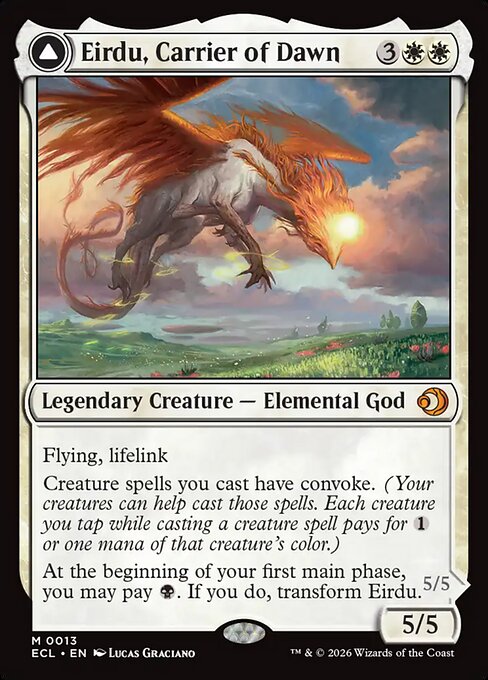
Eirdu makes your creatures pay for the next one, Isilu brings each of them back once, and you pick a face at the start of every turn. This build is 38 creature cards, because a token can tap for convoke but Isilu never returns one.
Art by Lucas Graciano
Affiliate links: we may earn a commission on purchases.
 26
 27
Prices as of 23 October 2026.
The core list: 100 cards, 35 lands (21 basic), 39 creatures, average mana value 3.22. Mana sources: 26 white, 27 black. Bracket floor 3 (Upgraded). How brackets work →
Each face does one job, and only one is ever face up. Eirdu, Carrier of Dawn is a 5/5 flier with lifelink for  , and while it is up every creature spell you cast has convoke, so each creature you control can tap to pay
 or one mana of its own color. Turn the card over and Isilu, Carrier of Twilight is the same 5/5 body, and while it is up every other nontoken creature you control has persist, so the first time one dies it returns with a -1/-1 counter on it. The card turns over at the start of your first main phase for a single mana, one way and the other. The ninety-nine is built to be worth something to both faces. It holds 38 creature cards, because a creature card is the only thing that taps for convoke and also comes back under persist. Most of them do something as they enter or as they die, which Isilu makes happen twice. Three cards sacrifice creatures for nothing, and six more make opponents lose life whenever a creature of yours dies, so the deck wins mostly by dying a great deal.
The face you leave up is the one the table plays against
The card can only turn over at the start of your own first main phase. Nothing flips it during anyone else's turn, so the face you choose there is the face every opponent plays against until your next main phase. That makes it a trade every time. Stay on Eirdu and this turn's creatures are cheap, but a wrath before your next turn takes the board for good. Pay for Isilu and your creature cards come back from anything that destroys them, but every creature you cast this turn costs what is printed on it.
So the deck plays two kinds of turn. An Eirdu turn spends. Cast the first creature, tap it to help pay for the second, and keep going while the hand holds creatures. An Isilu turn holds. Sacrifice what is worth sacrificing, attack if it is safe, and pass with every creature card on the table carrying a second life. A hand full of creatures says Eirdu. A board you cannot afford to lose says Isilu, and an opponent with a wrath in their colors and the mana open for it says so louder.
There is one way to get a little of both. When the trigger goes on the stack Eirdu is still face up, so a creature cast at instant speed in response still has convoke. Restoration Angel is the one in this list. Flash it in off the trigger with creatures paying for it, then pay and play the rest of the turn as Isilu. Lethal Scheme, Conclave Tribunal, Hour of Reckoning and Return to the Ranks have convoke printed on them, so they cost the same on either face.
The Angel also carries the commander's worst trap. It can target your commander, because Isilu is an Elemental God and not an Angel, and a double faced card always comes back front face up. Blink Isilu in response to a wrath and it returns as Eirdu, which switches off persist for the whole board at the moment it mattered. The same happens when the commander dies and you cast it again. It always arrives as Eirdu, and the waits for your next turn.
A 2/1 comes back as a 1/0, and six of them want to
Persist returns a creature with a -1/-1 counter on it, and eleven creatures in the ninety-nine have 1 toughness. Each of those comes back at 0 toughness and goes straight to the graveyard again, this time for good, since it now carries the counter. The second trip still counts. The creature entered and it died, so everything that watches for either one fires twice.
For six of the eleven that is the point. Doomed Traveler, Tithe Taker, Imperious Oligarch and Ministrant of Obligation leave flying Spirits when they die, so each of them pays out twice in a row, and Ministrant of Obligation turns three mana into four Spirits. Fleshbag Marauder and Merciless Executioner make every player sacrifice a creature as they enter. Sacrifice the Marauder to its own first trigger. It returns as a 2/0, dies on the spot, and its second enter trigger resolves anyway, so each opponent loses two creatures to it while you lose the Marauder and one other creature, ideally a token.
The other five need to stay on the battlefield: Viscera Seer, Carrion Feeder, Blood Artist, Zulaport Cutthroat and Luminarch Aspirant. Always Watching is in the list for them. It gives +1/+1 to nontoken creatures you control, which is exactly the group Isilu covers, so anything that persists comes back at the size printed on it and stays. Its vigilance does a job for the other face as well. A creature with vigilance attacks without tapping, so on an Eirdu turn the whole team can swing and still pay for the creature you cast after combat. Elesh Norn, Grand Cenobite makes the same repair at +2/+2 and shrinks every creature the other players control by as much.
Isilu brings back cards, so tokens are what you spend
Isilu skips tokens, and four more cards in the list draw the line with the same word. Pawn of Ulamog, Midnight Reaper and Grim Haruspex each pay out when a nontoken creature of yours dies, and Always Watching only pumps nontoken ones. So a creature card that persists draws two cards from Grim Haruspex and two from Midnight Reaper, and leaves two Spawn from Pawn of Ulamog, before it is gone. A token dying draws nothing from any of them.
The tokens arrive anyway, as the leftovers of creature cards dying: the Spawn, the afterlife Spirits, Grave Titan's Zombies, Sengir Autocrat's Serfs and Insects from Nest of Scarabs. Nest of Scarabs counts the -1/-1 counter persist puts on a returning creature, because a counter a creature enters with is one its controller put there, so every return also makes an Insect. That gives the tokens two jobs, and neither costs a creature card its second life. On an Eirdu turn they pay for creatures, and an afterlife Spirit can pay or as well as , since it is both colors. On an Isilu turn they are what you feed Viscera Seer or Carrion Feeder when you want the sacrifice without spending anyone's persist.
Sengir Autocrat needs one line of care. When it leaves the battlefield it exiles every Serf, so sacrifice the Serfs before the Autocrat goes. Persist returns it, and it makes three more.
Venerated Loxodon reloads persist on an Eirdu turn

Once a creature has persisted it carries a -1/-1 counter, and the next time it dies it stays dead. A +1/+1 counter takes that away, since one of each on the same creature cancel out, and a creature with no -1/-1 counter on it persists again. The front face is where this deck finds those counters. Venerated Loxodon has convoke and puts a +1/+1 counter on each creature that convoked it. With five creatures to tap it costs no mana at all, only the attacks those five would have made. Cast it on an Eirdu turn by tapping the creatures that came back last time, and each of them is ready to persist again once you pay the following turn.
Three more cards do it one creature or one cast at a time. Lethal Scheme carries its own convoke and makes each creature that paid for it connive, so a creature that taps for it draws, discards, and takes a +1/+1 counter when the discard is not a land. Luminarch Aspirant puts a +1/+1 counter on a creature of yours as each of your combats begins. Restoration Angel clears the counter by blinking the creature, since a creature that leaves and comes back is a new one with nothing on it. None of the four can do it again without being cast again or waiting a turn, which is what keeps them out of the loops further down.
Kaya's Wrath gains a life for every creature it gives back
A wrath only clears the other side of the table if Isilu is face up when it resolves, and that includes the commander. Isilu dies to the wrath with everything else, and the creatures dying beside it still persist, because whether a creature had persist is judged as it stood just before it died, and Isilu was on the battlefield then. So the order never changes. Pay at the start of the main phase, then cast the wrath.
Kaya's Wrath is the one built for it. You gain a life for each creature of yours it destroys, and on an Isilu turn you keep the creatures as well as the life. Hour of Reckoning destroys only nontoken creatures, so it takes every creature card an opponent has on the battlefield, leaves every token you have, and hands your own creature cards back. Its convoke means the creatures it is about to destroy can pay for it, and they return untapped, as new creatures.
Both wipes cost you the commander. It goes to the command zone two mana dearer and comes back as Eirdu, which happens to be the right face for the turn after. Every creature you own just returned with a -1/-1 counter, and the next job is casting more of them with those creatures paying.
Two cards in this list let a creature persist forever
Persist only fires for a creature with no -1/-1 counter, and the counter it adds is what stops it firing twice. Remove that counter every time, or stop it going on at all, and the creature returns from every death. Give it a sacrifice outlet that costs nothing and Isilu turns it into an infinite loop, and with Blood Artist or Zulaport Cutthroat out that loop drains the table to zero.
The core list holds two cards that do this. Cathars' Crusade puts a +1/+1 counter on every creature you control whenever one enters, the returning creature included, so its -1/-1 counter cancels the moment it arrives. Marionette Apprentice has fabricate 1, which offers it a +1/+1 counter every time it enters, so it can cancel its own. The free outlets are Viscera Seer, Carrion Feeder and Ashnod's Altar. Either of the first two with any one of the outlets is a loop while Isilu is up, and Cathars' Crusade with Ashnod's Altar also makes infinite colorless mana and grows every other creature you control by one each time round.
Marionette Apprentice's half is a choice you make every time. Fabricate can make a 1/1 Servo instead of the counter, and with the Servo the Apprentice persists once like anything else. At a table that has asked for no infinite combos, take the Servo.
By the letter these are three card combos, because the commander is one of the pieces, and the official bracket rules only restrict two card ones. The commander is never really missing, though, so this page counts them as two cards from the ninety-nine, and that is the honest reason the core list belongs at bracket 3. Tergrid is its one Game Changer, and with Tergrid gone the loops would still keep it out of bracket 2. What bracket 3 asks of a combo is that it not win early, and these cannot. Each needs the commander cast, then a full turn cycle before the that turns it over, then two named cards out of ninety-nine.
The core list
One Game Changer, Tergrid, God of Fright, and $141 for all hundred cards. Hover a card name to see the card.
“Load into the deck builder” opens this list in your account, ready to edit or save. “Copy decklist” gives you plain text for Moxfield, Archidekt or Arena, with no account needed.
Both open all 100 cards in the store’s own deck tool, where you choose the printings. TCGplayer links are affiliate links, so we may earn a commission on purchases.
Commander 1
- Eirdu, Carrier of Dawn // Isilu, Carrier of Twilight
Creatures 38
- Archon of Cruelty
- Blood Artist
- Butcher of Malakir
- Carrion Feeder
- Cruel Celebrant
- Doomed Traveler
- Elas il-Kor, Sadistic Pilgrim
- Elesh Norn, Grand Cenobite
- Fleshbag Marauder
- Grave Titan
- Gravedigger
- Gray Merchant of Asphodel
- Grim Haruspex
- Imperious Oligarch
- Luminarch Aspirant
- Lurrus of the Dream-Den
- Marionette Apprentice
- Massacre Wurm
- Mentor of the Meek
- Merciless Executioner
- Midnight Reaper
- Ministrant of Obligation
- Pawn of Ulamog
- Pitiless Plunderer
- Ravenous Chupacabra
- Restoration Angel
- Reveillark
- Sengir Autocrat
- Seraph of the Scales
- Skyclave Apparition
- Solemn Simulacrum
- Sun Titan
- Tergrid, God of Fright // Tergrid's Lantern
- Tithe Taker
- Venerated Loxodon
- Viscera Seer
- Welcoming Vampire
- Zulaport Cutthroat





Instants 7
- Anguished Unmaking
- Generous Gift
- Infernal Grasp
- Lethal Scheme
- Path to Exile
- Swords to Plowshares
- Village Rites
Sorceries 4
- Hour of Reckoning
- Kaya's Wrath
- Return to the Ranks
- Vindicate

Artifacts 8
- Arcane Signet
- Ashnod's Altar
- Fellwar Stone
- Mind Stone
- Orzhov Signet
- Skullclamp
- Sol Ring
- Talisman of Hierarchy
Enchantments 7
- Always Watching
- Animate Dead
- Bastion of Remembrance
- Cathars' Crusade
- Conclave Tribunal
- Nest of Scarabs
- Phyrexian Arena
Lands 35
- Brightclimb Pathway // Grimclimb Pathway
- Castle Ardenvale
- Castle Locthwain
- Caves of Koilos
- Command Tower
- Concealed Courtyard
- Fabled Passage
- Fetid Heath
- Godless Shrine
- Isolated Chapel
- 10× Plains
- Scoured Barrens
- Shineshadow Snarl
- Silent Clearing
- 11× Swamp
- Vault of the Archangel
The double pips are paid by creatures as much as by lands
The 35 lands make 27 black sources and 26 white. Counting lands alone, two black mana by turn three comes up 76.4% of the time and two white 74.2%, both short of the 90% a deck wants, and each color has ten or more cards asking for the pair. Most of those cards are creatures, though, and convoke pays colored mana as readily as generic. A black creature tapped for a creature spell pays and a white one pays . Twenty five of the creature cards in the list are black and seventeen are white, counting the gold ones twice, and Eirdu is a white creature that can tap to pay as well. On an Eirdu turn, the on Massacre Wurm can be three black creatures and three of anything.
What convoke cannot reach is the commander itself, which has to be cast with mana because its convoke only exists once it is on the battlefield, plus the one mana each turn to turn it over, plus four noncreature cards that ask for a color twice: Kaya's Wrath at , Phyrexian Arena, Cathars' Crusade and Always Watching. That is why the list still carries 35 lands, six mana rocks and Solemn Simulacrum against an average mana value of 3.22.
Bracket 2 is two cards out, and the budget rung takes ten
Take out Cathars' Crusade and Marionette Apprentice and nothing left in the list can bring a creature back twice, so the loops leave with them. The budget rung does that and swaps eight more cards besides, which brings the price from $141 to $63 with no Game Changers left.
The core's one Game Changer is Tergrid, God of Fright, and it is there for the four cards that make opponents sacrifice: Fleshbag Marauder, Merciless Executioner, Archon of Cruelty and Butcher of Malakir. The first three each enter twice, and Butcher of Malakir fires on every death of yours, so with Tergrid out a lot of opposing creatures change sides. A creature taken that way gets persist too, since it is a nontoken creature you control, but persist returns a card to its owner, so its second life is spent across the table. Liesa, Forgotten Archangel replaces it, and the two could never share a list. Liesa exiles any creature an opponent controls that would die, so what they sacrifice never reaches the graveyard Tergrid takes it from. What Liesa does here is catch your creatures on their second death. One that dies carrying its -1/-1 counter goes to your hand at the next end step, ready to be cast again with convoke.
Benalish Marshal takes over from Elesh Norn as the anthem that keeps 1 toughness creatures alive after they persist, at +1/+1 instead of +2/+2, and its is easy on an Eirdu turn when three white creatures can pay it. Bartolomé del Presidio replaces Ashnod's Altar as a free outlet. The +1/+1 counter it takes goes on itself, so it can clear its own -1/-1 counter and nobody else's, which is well short of a loop. Phyrexian Rebirth fills the slot Cathars' Crusade leaves as a third wrath, and with Isilu up it leaves you a Horror token as big as the number of creatures it destroyed, yours included, with all of yours on their way back. Two of the three new lands always enter tapped, which costs a little speed.
At bracket 4 the loops stop being a hazard to remove and become the plan. Triskelion is the plainest one this commander has. It enters with three +1/+1 counters, so when persist returns it the -1/-1 counter cancels one and two are left. Spend one to deal 1 damage to an opponent and the other to deal 1 damage to Triskelion itself, and it dies with no counters on it, so persist returns it again. That is Isilu and one card, with no outlet needed, and it repeats as often as you like. Vizier of Remedies stops the -1/-1 counter going on at all, which makes every creature in the list a loop with any free outlet. Demonic Tutor, Vampiric Tutor and Enlightened Tutor fetch whichever piece is missing, and Enlightened Tutor can find Triskelion, because it is an artifact.
Yawgmoth, Thran Physician and Phyrexian Altar are outlets that pay you for each sacrifice, a card from one and a mana of any color from the other. Teferi's Protection covers the one thing persist cannot. A creature that is exiled never dies, so Swords to Plowshares or Farewell gets around Isilu completely, and Teferi's Protection is the answer to a Farewell that persist is not. Smothering Tithe is the sixth Game Changer, and the rung comes to $438.
Budget / bracket 2 10 swaps
- Tergrid, God of Fright becomes Liesa, Forgotten Archangel−$17.18
- Elesh Norn, Grand Cenobite becomes Benalish Marshal−$15.13
- Ashnod's Altar becomes Bartolomé del Presidio−$13.76
- Cathars' Crusade becomes Phyrexian Rebirth−$3.95
- Marionette Apprentice becomes Plaguecrafter−$1.82
- Animate Dead becomes Unearth−$6.71
- Phyrexian Arena becomes Night's Whisper−$2.60
- Godless Shrine becomes Tainted Field−$7.78
- Silent Clearing becomes Orzhov Basilica−$5.42
- Brightclimb Pathway becomes Silverquill Campus−$4.08
This rung: 100 cards, 35 lands, average mana value 3.14, no bracket floor (no Game Changers, no mass land denial). Whole deck $62.98. Prices as of 23 October 2026. How brackets work →
TCGplayer links are affiliate links, so we may earn a commission on purchases.
Up to bracket 4 9 swaps
- Doomed Traveler becomes Demonic Tutor+$60.47
- Mentor of the Meek becomes Vampiric Tutor+$48.50
- Sengir Autocrat becomes Enlightened Tutor+$32.34
- Gravedigger becomes Smothering Tithe+$53.54
- Animate Dead becomes Teferi's Protection+$27.70
- Generous Gift becomes Vizier of Remedies−$0.76
- Fellwar Stone becomes Triskelion−$0.53
- Luminarch Aspirant becomes Yawgmoth, Thran Physician+$24.06
- Phyrexian Arena becomes Phyrexian Altar+$51.52
This rung: 100 cards, 35 lands, average mana value 3.25, bracket floor 4 (Optimized). Whole deck $438.25. Prices as of 23 October 2026. How brackets work →
TCGplayer links are affiliate links, so we may earn a commission on purchases.
FAQ
Does Isilu, Carrier of Twilight give itself persist?
No. Isilu gives persist to each other nontoken creature you control, so the commander is the one creature on your side it never brings back. If it dies it goes to the command zone like any commander, and it is cast again as Eirdu.
When can you transform Eirdu, Carrier of Dawn?
At the beginning of your first main phase on your own turn, and only then. Pay to turn Eirdu into Isilu or to turn Isilu back. It is optional, it happens at most once a turn, and the face you end on stays up through every other player's turn.
Do tokens get persist from Isilu?
No, only nontoken creatures do. A token can still tap to help pay for a creature spell while Eirdu is face up, which is why this list uses its tokens as the part of the board it spends.
Do creatures still persist if Isilu dies in the same board wipe?
Yes. Whether a dying creature had persist is checked as it was just before it died, and Isilu was still on the battlefield giving it persist then. The creatures return with a -1/-1 counter, and the commander goes to the command zone.
Does Eirdu give convoke to noncreature spells?
No, creature spells only. Lethal Scheme, Conclave Tribunal, Hour of Reckoning and Return to the Ranks have convoke printed on them, so this list can pay for those four with creatures whichever face is up.
What infinite combos does Isilu have?
Any creature that returns without a -1/-1 counter, plus a sacrifice outlet that costs nothing. In this core list that means Cathars' Crusade or Marionette Apprentice with Viscera Seer, Carrion Feeder or Ashnod's Altar. Triskelion needs no outlet at all and is on the bracket 4 rung only.
What bracket is this Eirdu deck?
Bracket 3, for two reasons: Tergrid, God of Fright is a Game Changer, and Isilu loops with two cards in the ninety-nine. The budget rung removes both and fits bracket 2. Six Game Changers and Triskelion lift the top rung to bracket 4.
How much does an Eirdu, Carrier of Dawn deck cost?
$141 for the core list, $63 for the budget rung and $438 for the bracket 4 rung. Every card is costed at whichever paper copy is cheapest, so no total includes a foil or a collector printing that a plain copy undercuts.