
Commander blueprint · Lorwyn Eclipsed
How to build High Perfect Morcant
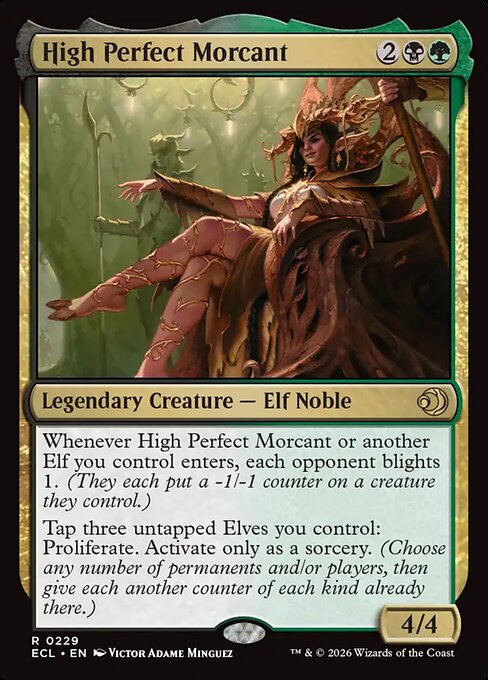
High Perfect Morcant makes every opponent put a -1/-1 counter on a creature of their choosing each time an Elf of yours enters, and lets any three Elves proliferate. So this build is about Elves that arrive in groups, and about the few cards that pay you for a counter somebody else placed.
Art by Victor Adame Minguez
Affiliate links: we may earn a commission on purchases.
 24
 36
Prices as of 24 October 2026.
The core list: 100 cards, 34 lands (18 basic), 42 creatures, average mana value 3.02. Mana sources: 24 black, 36 green. No Game Changers and no mass land denial, so the deck sets no bracket floor. How brackets work →
How the deck works. High Perfect Morcant costs four and is an Elf itself, so it triggers on its own arrival: every opponent who controls a creature puts a -1/-1 counter on one. After that, each Elf you put onto the battlefield does the same, tokens included, and Elves that arrive together trigger once each. Tapping three untapped Elves proliferates at sorcery speed, growing whichever counters on the table you choose. Thirty-nine of the forty-two creatures in the list are Elves, thirteen cards make Elf tokens, and most of the rest are here because they profit from a counter on an opponent's creature however it got there.
Your opponents pick the creature, so the payoffs cannot care who placed the counter
To blight 1 is to put a -1/-1 counter on a creature you control, and every other card in Lorwyn Eclipsed that says it asks you to do it to your own creature in return for something. Morcant is the one that hands it to the other players. Each of them chooses where their own counter goes, and because nothing targets, a hexproof commander standing alone still takes it. A player with three Saprolings can put it on a Saproling. A player with no creatures does nothing at all, since there is no creature to blight.
That choice is why the familiar -1/-1 cards are a trap here. Nest of Scarabs and Hapatra, Vizier of Poisons both trigger when you put a -1/-1 counter on a creature, and when an opponent blights, the opponent is the one putting it there. They only ever see your proliferates. The cards that made this list read the counter another way. Flourishing Defenses triggers when a -1/-1 counter is put on any creature by anyone. Hunter of Eyeblights destroys any creature with a counter on it. Necroskitter takes an opponent's creature that dies with a -1/-1 counter on it, whatever killed it. Blowfly Infestation sends a fresh counter out whenever a creature carrying one dies. None of the four asks who placed the counter, so all of them start working the turn Morcant lands.
Flourishing Defenses turns one Elf into a sweep of the other side

Flourishing Defenses makes a 1/1 Elf Warrior whenever a -1/-1 counter is put on a creature, once for every counter. With Morcant out, that token is an Elf entering, so every opponent blights again, and each of their counters makes another token. The chain stops only when no opponent has a creature left to take a counter, or when you decline a token, since the enchantment says may. The other players lose every creature, and you end up with roughly one Elf for each point of toughness they had between them.
It is not an infinite combo, and that matters for the bracket. It runs out when their creatures do, and a table with nothing on board gives it nothing to start from. Poison-Tip Archer turns the same chain into life loss, since every creature that dies costs each opponent a life. Creakwood Safewright can start it on its own: it enters with three -1/-1 counters, the enchantment counts each of them, and the three tokens are three more Elves entering. Blowfly Infestation is the one link that never asks. Its counter is not optional, so on a board where only you have creatures it lands on one of yours.
The Elves it makes cannot attack until your next turn, but they can pay costs at once, because a cost that taps other creatures ignores summoning sickness. Lathril, Blade of the Elves taps itself and ten Elves to take ten life from each opponent, so a Lathril that was already out when the turn began ends many games the moment the chain finishes. Without it, the new tokens pay for proliferates, and the board you pass with is one that Ezuri, Renegade Leader or Craterhoof Behemoth can send at an empty table on your next turn.
Elves cast this turn can already pay for proliferate
Morcant's second ability has no tap symbol of its own. You tap three Elves as the cost, the same wording Heritage Druid uses, and that is why creatures that came down this turn can pay it. Summoning sickness only stops a creature from using its own tap abilities. Morcant can tap itself the turn it is cast, so Morcant plus two Elves already on the table is a proliferate on turn four.
It is not limited to once a turn either. Six untapped Elves are two proliferates and nine are three, so the trigger and the activation want the same thing, which is lots of small Elves at once. The real cost is that the cheapest Elves here are mana Elves, and a Llanowar Elves that tapped for mana this turn cannot help pay. So cast first with your lands and the older Elves, then tap the new arrivals. Heritage Druid wants the same three Elves and pays for them, so on the turn you have six you are choosing between mana and counters, and Wirewood Lodge untaps one Elf for when you are a single Elf short.
Proliferate lets you pick, so your counters grow and only theirs shrink
Proliferate lets you choose each permanent and player, and you leave out anything you would rather not grow. Marwyn, the Nurturer gets a +1/+1 counter whenever another Elf enters and taps for mana equal to her power, so each proliferate is one more green from her. Rishkar, Peema Renegade gives every creature you control with a counter on it a way to tap for , and that includes Creakwood Safewright with its -1/-1 counters, which you never pick. Tyvar Kell and Freyalise, Llanowar's Fury each gain a loyalty. On the other side you pick every opposing creature that already carries a -1/-1 counter, and none of the ones that do not.
One rule is worth knowing before your opponents use it against you: a +1/+1 counter and a -1/-1 counter on the same creature are removed in pairs. A player whose creature carries +1/+1 counters will put the blight there, because it costs them only a counter they had spare. The same rule decides where Hunter of Eyeblights' enter trigger goes. It has to put a +1/+1 counter on a creature you do not control, so aim it at one with no counters at all. On a creature that already carries a blight it would cancel that blight, while on a clean one it gives the Hunter a fresh target to destroy later.
One Elf spell is often two Elves, and each body is its own trigger
Morcant counts bodies, not spells. Lys Alana Huntmaster makes a token whenever you cast an Elf spell, so every Elf cast after it is two triggers, and Elvish Warmaster adds a third once a turn. Elvish Promenade puts down one token for each Elf you control, all at the same moment, and every one of them makes each opponent blight separately. Eyeblight Cullers leaves three tokens when it dies, Prowess of the Fair replaces any nontoken Elf that dies, and Skemfar Elderhall gives two when you sacrifice it. Skullclamp turns the surplus into cards: a 1/1 Elf wearing it dies at once and draws two.
Necroskitter keeps what the counters kill, and Ruthless Winnower feeds it

Ruthless Winnower makes every player sacrifice a non-Elf creature in their own upkeep. When an opponent's creature that took a blight goes to the graveyard that way, Necroskitter returns it under your control, because all it asks is that the creature had a -1/-1 counter when it died. The catch is that Winnower asks you too. Necroskitter, Wirewood Symbiote and Craterhoof Behemoth are the only creatures here that are not Elves, so keep Wirewood Symbiote around as the one you give up. Necroskitter has wither too, so a creature it blocks takes its damage as -1/-1 counters. If that kills the attacker, it joins your side, and if it survives, it now carries a counter, so whatever kills it later hands it to you.
Crippling Fear and Selfless Safewright each make you choose a creature type, and the answer for both is Elf. Crippling Fear then gives -3/-3 to everything else, on a board the blights have already been shrinking, so a 4/4 that took one blight dies to it as surely as a 3/3. Necroskitter survives it on its four toughness while Wirewood Symbiote does not. Selfless Safewright gives your other Elves hexproof and indestructible until end of turn, and with flash and convoke it can be paid for by tapping the same Elves it is about to save.
The core list
Ninety-nine cards behind High Perfect Morcant, and 39 of them are Elf creatures. Rest the pointer on any name and the card comes up beside it.
“Load into the deck builder” opens this list in your account, ready to edit or save. “Copy decklist” gives you plain text for Moxfield, Archidekt or Arena, with no account needed.
Both open all 100 cards in the store’s own deck tool, where you choose the printings. TCGplayer links are affiliate links, so we may earn a commission on purchases.
Commander 1
- High Perfect Morcant

Creatures 41
- Beast Whisperer
- Champions of the Perfect
- Craterhoof Behemoth
- Creakwood Safewright
- Dwynen's Elite
- Eclipsed Elf
- Elderfang Ritualist
- Elves of Deep Shadow
- Elvish Archdruid
- Elvish Harbinger
- Elvish Mystic
- Elvish Visionary
- Elvish Warmaster
- Evolution Sage
- Eyeblight Cullers
- Ezuri, Renegade Leader
- Formidable Speaker
- Fyndhorn Elves
- Gnarlroot Trapper
- Harald, King of Skemfar
- Heritage Druid
- Hunter of Eyeblights
- Imperious Perfect
- Lathril, Blade of the Elves
- Leaf-Crowned Visionary
- Llanowar Elves
- Llanowar Visionary
- Lys Alana Huntmaster
- Marwyn, the Nurturer
- Morcant's Loyalist
- Necroskitter
- Poison-Tip Archer
- Priest of Titania
- Rishkar, Peema Renegade
- Ruthless Winnower
- Selfless Safewright
- Shaman of the Pack
- Skemfar Avenger
- Skemfar Shadowsage
- Wirewood Symbiote
- Wood Elves





Planeswalkers 2
- Freyalise, Llanowar's Fury
- Tyvar Kell
Instants 8
- Abrupt Decay
- Assassin's Trophy
- Beast Within
- Grim Affliction
- Heroic Intervention
- Infernal Grasp
- Putrefy
- Return of the Wildspeaker
Sorceries 4
- Crippling Fear
- Elvish Promenade
- Feed the Swarm
- Trystan's Command
Artifacts 3
- Contagion Clasp
- Skullclamp
- Sol Ring
Enchantments 7
- Binding the Old Gods
- Blowfly Infestation
- Elderfang Venom
- Flourishing Defenses
- Guardian Project
- Prowess of the Fair
- Sylvan Library
Lands 34
- Command Tower
- Darkbore Pathway // Slitherbore Pathway
- Deathcap Glade
- Fabled Passage
- 10× Forest
- Golgari Rot Farm
- Karn's Bastion
- Llanowar Wastes
- Nurturing Peatland
- Overgrown Tomb
- Path of Ancestry
- Skemfar Elderhall
- 8× Swamp
- Twilight Mire
- Verdant Catacombs
- Vernal Fen
- Wirewood Lodge
- Woodland Cemetery
Twenty-four black sources, and Tyvar Kell turns every Elf into one more
Green carries this list, with 36 sources against 24 black from 34 lands, 10 Forests and 8 Swamps among them. Of the five cards that want two black, Necroskitter is the only one that wants it on turn three. Eclipsed Elf is also a three, but its hybrid symbols take green as readily as black, and the other three cost four or five. A hand with one black source therefore holds Necroskitter for a turn or two, which costs little, since it does nothing until counters are already down. Tyvar Kell covers the rest by giving every Elf you control a tap for . The count of 34 lands sits under an average mana value of 3.02 because seventeen other cards ramp, and most of those are Elves that also count toward the next proliferate.
Both rungs keep Flourishing Defenses, and only the bracket 4 rung tutors for it
The budget rung makes twelve swaps and brings the deck to $97.23. Everything the counter plan depends on was already cheap, so Flourishing Defenses, Necroskitter, Hunter of Eyeblights and all thirteen Elf token makers stay where they are. What goes is the money, and Verdant Catacombs, Sylvan Library, Craterhoof Behemoth, Ezuri, Renegade Leader and Guardian Project are most of it. Losing Craterhoof Behemoth and Ezuri, Renegade Leader is also what makes this a bracket 2 list in practice, since Overwhelming Stampede is the only mass pump left and it gives no haste. You feel the cut most in the lands: seven of them come into play tapped, against three in the main list, and a tapped land on turn three is a Morcant that arrives a turn later.
The bracket 4 rung makes eight swaps and comes to $441.37. Four of its additions are Game Changers, Worldly Tutor, Natural Order, Demonic Tutor and Vampiric Tutor, and between them they have two jobs. They find Flourishing Defenses while Morcant is on the table, or they find Craterhoof Behemoth, which Natural Order puts straight onto the battlefield for the price of one green Elf token. Yawgmoth, Thran Physician is the other big addition. Sacrificing an Elf token to it puts a -1/-1 counter wherever you aim it and draws a card, and with Flourishing Defenses out that counter brings a token back, which then makes every opponent blight again. That is a stack of cards for a few points of life, and it is why this version belongs at a table that expects the game to end quickly. Freyalise, Llanowar's Fury and Trystan's Command are the slowest of the cards that make room.
Budget / bracket 2 12 swaps
- Verdant Catacombs becomes Evolving Wilds−$28.94
- Sylvan Library becomes Shamanic Revelation−$26.10
- Craterhoof Behemoth becomes Dawnhand Eulogist−$23.57
- Ezuri, Renegade Leader becomes Overwhelming Stampede−$13.56
- Guardian Project becomes Moonglove Extractor−$12.31
- Wirewood Lodge becomes Jungle Hollow−$10.36
- Heroic Intervention becomes Wrap in Vigor−$7.85
- Overgrown Tomb becomes Golgari Guildgate−$7.47
- Formidable Speaker becomes Lys Alana Informant−$7.06
- Nurturing Peatland becomes Festering Thicket−$6.17
- Darkbore Pathway // Slitherbore Pathway becomes Temple of Malady−$5.82
- Elderfang Venom becomes Nadier's Nightblade−$6.07
This rung: 100 cards, 34 lands, average mana value 2.98, no bracket floor (no Game Changers, no mass land denial). Whole deck $97.23. Prices as of 24 October 2026. How brackets work →
TCGplayer links are affiliate links, so we may earn a commission on purchases.
Up to bracket 4 8 swaps
- Contagion Clasp becomes Worldly Tutor+$25.52
- Dwynen's Elite becomes Natural Order+$14.61
- Grim Affliction becomes Demonic Tutor+$60.24
- Trystan's Command becomes Vampiric Tutor+$48.30
- Eyeblight Cullers becomes Yawgmoth, Thran Physician+$24.22
- Eclipsed Elf becomes Glimpse of Nature+$0.91
- Gnarlroot Trapper becomes Bloom Tender+$12.97
- Freyalise, Llanowar's Fury becomes Chord of Calling+$2.09
This rung: 100 cards, 34 lands, average mana value 2.88, bracket floor 4 (Optimized). Whole deck $441.37. Prices as of 24 October 2026. How brackets work →
TCGplayer links are affiliate links, so we may earn a commission on purchases.
FAQ
Who chooses where High Perfect Morcant's -1/-1 counters go?
Each opponent picks one of their own creatures for their counter. Nothing is targeted, so hexproof, shroud and protection do not help them, but they can put it on a token, or on a creature carrying +1/+1 counters, where it cancels one of them. A player who controls no creature cannot blight, so that player is simply skipped.
Can summoning-sick Elves pay for High Perfect Morcant's proliferate?
Yes. The cost is tapping three untapped Elves you control, and none of them is using a tap ability of its own, so an Elf that entered this turn can be one of the three. Morcant counts too, on the turn it is cast. The ability works only at sorcery speed, so it happens in one of your main phases with nothing on the stack, and you can activate it again for every further three untapped Elves.
How much does a High Perfect Morcant deck cost?
The list on this page totals $252.51 with every card bought in its cheapest paper version. Twelve budget swaps bring it to $97.23, and the three biggest savings are Verdant Catacombs, Sylvan Library and Craterhoof Behemoth. The eight bracket 4 swaps raise it to $441.37, and Demonic Tutor and Vampiric Tutor account for more than half of that rise.
Is High Perfect Morcant with Flourishing Defenses an infinite combo?
No. Each -1/-1 counter makes an Elf token, and each token makes every opponent put down one more counter, but the chain ends when the last opposing creature has died or when you stop taking tokens. It works as a sweep that only hits the other side and leaves you a wide board. It needs your opponents to control creatures before it can begin.
Does Nest of Scarabs work with High Perfect Morcant?
Only when you proliferate. Nest of Scarabs counts counters that you put on a creature, and when an opponent blights, that opponent is the one putting the counter down. Flourishing Defenses has no such clause, which is why it made this list and Nest of Scarabs did not.
What bracket is this High Perfect Morcant deck?
Nothing in the ninety-nine is a Game Changer, so on paper it qualifies for bracket 2. I would still sit down at a bracket 3 table with it, because Craterhoof Behemoth and the Flourishing Defenses chain can each turn an ordinary board into a won game inside one main phase. The budget rung takes Craterhoof Behemoth out, and the top rung adds four tutors from the Game Changers list, which makes it a bracket 4 deck.