The Ruinous Powers precon upgrade guide
Thirty of this box’s sixty-one nonland cards cost four or five mana, and not one of them cascades until your opponents have lost that much life on your turn.
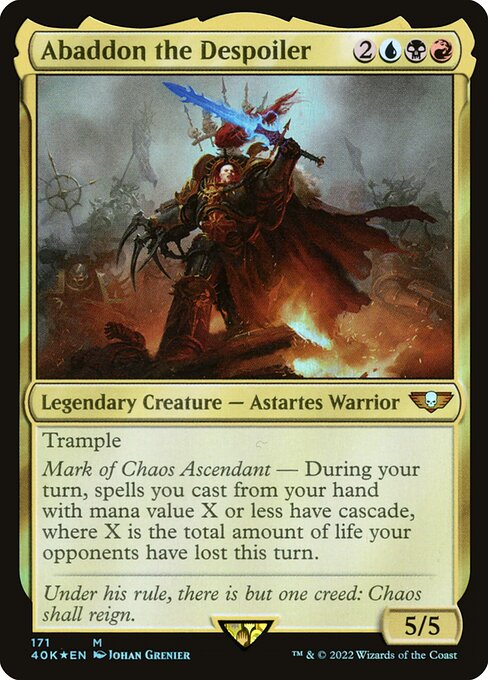
Abaddon the Despoiler is the most conditional commander Wizards has put in a precon. Mark of Chaos Ascendant reads: during your turn, spells you cast from your hand with mana value X or less have cascade, where X is the total amount of life your opponents have lost this turn. X starts every turn at zero. Every decision in this deck is really a question about how quickly you can raise it, and the box answers that question badly.
So this guide is mostly about one number. Fourteen swaps, about $48, and afterwards a single creature entering the battlefield can turn on ninety-eight percent of the list.
100 cards, 38 lands (24 basic), 30 creatures, average mana value 3.82. Mana sources: 22 blue, 25 black, 23 red.
No Game Changers and no mass land denial, so it sets no bracket floor. How brackets work →
What are the best Ruinous Powers upgrades?
Ranked by how much they move X, which is the only currency this deck spends:
- Purphoros, God of the Forge. Two damage to each opponent every time another creature enters. In a four-player game that is six life lost off one creature, and six is enough for sixty of the sixty-one nonland cards in the upgraded list.
- Impact Tremors. The same shape for a fraction of the money, at one damage per opponent instead of two.
- Lightning Greaves. Abaddon attacks the turn he lands. Nothing in the box does this for less than seven mana.
- Torbran, Thane of Red Fell. Every red source you control deals two more to opponents. Impact Tremors goes from three life lost to nine.
- Terminate and Bedevil. The box ships two unconditional kill spells and a lot of five-mana ways to almost kill something.
- Arcane Signet, Underground River and Sulfurous Springs: a three-colour commander on a mana base that was short in all three.
The fourteen cards going the other way are further down, with the reasoning for each.
X counts every opponent, added together
This is the part people get wrong at the table, and it is worth being exact about. Mark of Chaos Ascendant does not read “the most life an opponent has lost”. It reads the total. Three opponents each taking one damage is X = 3, not X = 1. Every card on this page that says “each opponent” is worth triple what it looks like in a four-player pod, and that multiplier is the whole reason the upgrade list looks the way it does.
Three more clauses matter. It only works during your turn, so an instant you hold up on somebody else’s turn is just an instant. It resets when the turn does. And it only grants cascade to spells cast from your hand, which means a cascaded spell never cascades again, because that one is cast from exile.
Here is what X buys you in the box as shipped, counted against the sixty-one nonland cards in the ninety-nine:
- X = 3: eighteen cards, thirty percent of the deck.
- X = 4: thirty-three cards, fifty-four percent.
- X = 5: forty-eight cards, seventy-nine percent.
- X = 6: fifty-seven cards, ninety-three percent.
The box’s average mana value is 4.31, so the typical card in it wants X at four or better before Abaddon does anything at all. That is a lot of life for a table to have lost by your second main phase.
Six cards mention haste, and only one can give it to Abaddon
Abaddon is a 5/5 with trample for five mana. Connecting with him is the most reliable X the box has: five life lost, which turns on seventy-nine percent of the list. The catch is that he arrives with summoning sickness, so the turn you spend five mana on your commander is a turn where X stays at zero.
Six cards in the box mention haste. Keeper of Secrets, Helbrute, Lucius the Eternal and Seeker of Slaanesh all have it themselves. Herald of Slaanesh grants it to other Demons, and Abaddon is an Astartes Warrior. That leaves Assault Suit, which genuinely works: four mana to cast, three more to equip.
The sequencing follows from the same fact. You attack first and cast second. Your postcombat main phase is where this deck happens, and tapping out before combat means casting everything at zero. It is the rare Commander deck where holding mana through your own combat step is correct almost every turn.
What the box offers instead of an attack is thin. Exalted Flamer of Tzeentch pings each opponent for one whenever you cast an instant or sorcery, and there are seventeen of those. Pink Horror deals two, but to a single target. The Ruinous Powers itself drains on your upkeep for whatever mana value it exiles, which is real but random. Great Unclean One takes six life off the table at your end step, after you have already cast your turn.
Three cards that raise X before combat, and what each is worth
All three numbers below assume a four-player game, because that is where the “each opponent” wording pays.
Impact Tremors costs two mana and takes three life off the table every time a creature enters under your control. There are twenty-nine other creatures in the ninety-nine, plus Spawn tokens, plus every creature a cascade puts into play. One trigger takes you to three, and thirty-nine percent of the upgraded list is live at three.
Purphoros, God of the Forge does the same thing for six. One creature entering is enough for every card in the upgraded deck except the seven-drop. It is indestructible, and because devotion to red will usually sit under five it spends most of the game as an enchantment that cannot be attacked or blocked out of the way.
Torbran, Thane of Red Fell multiplies the other two. Red sources you control deal two extra damage to opponents, so Impact Tremors becomes three per opponent and nine across the table, and Purphoros becomes four and twelve. Abaddon is himself a red permanent, so he connects for seven instead of five. The cost is {1}{R}{R}{R} on twenty-three red sources, and that is a genuine risk: two red pips by turn three already sits at sixty-seven percent, and three pips is worse. He is the add I would drop first if your pod is faster than mine.
Bastion of Remembrance works the other axis. Every creature you control that dies costs the table three life, which matters in a deck that attacks with 5/5s into open boards and still runs two sweepers. Its enter-the-battlefield token is itself a trigger for the two cards above.
Then the supporting cast. Lightning Greaves, Swiftfoot Boots and Rogue’s Passage are three slots spent on one job: making a single 5/5 land, survive and connect. That is a lot of redundancy for one creature and I think it is right here, because the commander is not a payoff in this deck. He is the rules text.
Terminate and Bedevil are the interaction the box skipped. Cut // Ribbons is both: four damage to a creature early, a scaling drain on every opponent late. One wrinkle worth knowing is that Ribbons is cast from your graveyard, so Abaddon never grants it cascade. Keeper of Secrets, The Lost and the Damned and Poxwalkers all pay you for casting a spell from somewhere other than your hand, though, and Ribbons triggers all three.
Painful Truths draws three for three mana in a four-player game. The three life it costs you is not really a downside in a deck running Mortarion, Daemon Primarch, who converts your own life loss into 2/2 tokens with menace at end of turn, and those tokens entering are more Impact Tremors triggers. Arcane Signet replaces Worn Powerstone: two mana instead of three, untapped instead of tapped, and it makes coloured mana in a deck whose commander asks for three different colours.
Thirteen of the fourteen adds have a market price on their default printing, and together they come to $48.08. Purphoros is $30.23 of that, so the other twelve cost $17.85 between them. Impact Tremors has no listed non-foil market price on its default printing, so it is not in that total.
Twenty-five black sources, and the card Abaddon most wants needs three of them
The best card in Magic for this commander is Bloodletter of Aclazotz, and it is not on my list. Its text is almost eerie: “If an opponent would lose life during your turn, they lose twice that much life instead.” Same clause, same window, and it doubles every single number on this page. One Impact Tremors trigger under it is six.
Two things kept it off. It costs $36.16, which is more than the other thirteen priced adds put together. And it wants {1}{B}{B}{B} in a three-colour deck with twenty-five black sources, where two black pips by turn three already sits at seventy-two percent. If you are building toward a blacker version of this deck, buy it first and add sources for it. If you are sleeving up the box and improving it from there, it is the wrong shape.
Triple pips are the real constraint on this deck, not money. The commander needs blue, black and red by turn five, and the box shipped six lands that always enter tapped plus a Temple of the False God that makes colourless mana and does nothing at all before your fifth land. That one leaves, along with Molten Slagheap and Dismal Backwater, for Underground River, Sulfurous Springs and Rogue’s Passage. Combined with Arcane Signet, sources go from 24/22/21 to 25/23/22 in black, red and blue, and always-tapped lands drop from six to five.
Path of Ancestry stays, but know what you own. Its scry triggers when the mana pays for a creature spell sharing a type with your commander, and Abaddon is an Astartes Warrior. Eight of the twenty-nine creatures in the ninety-nine qualify. Seventeen of them are Demons, and not one of those triggers it. It is a tapped tri-land worth running for the fixing alone, and the scry is close to blank text in this particular deck.
The three most expensive spells in the box come out first
The box has four cards costing more than six mana. Three of them are cuts.
Blood for the Blood God! costs eleven. It does deal eight to each opponent, which is twenty-four life and by some distance the largest X available here, but it is the last spell you cast, so the X it generates has nothing left to enable. Blasphemous Act gets cheap fast and then kills your own board, including the commander whose combat damage is your main engine. Decree of Pain is fine to cycle for {3}{B}{B} and unrealistic to cast for eight.
The rest of the spell cuts ask for a lot and hand back a little. Drach’Nyen is six mana and two more to equip, aimed at one creature in a deck with thirty. Assault Suit is the haste, at seven mana all in, when Lightning Greaves does the job for two. Khârn the Betrayer gives an opponent a creature the moment anything would damage him, which is backwards in a deck that needs opponents low. Lucius the Eternal is a five-mana body whose death trigger helps an opponent’s removal more than it helps your board. Chaos Mutation is symmetric and can hand somebody a better creature than the one you exiled. Nurgle’s Conscription wants five mana and a good creature in an opponent’s graveyard on the same turn. Nurgle’s Rot is a one-mana aura that does nothing until a creature you do not control dies. Worn Powerstone enters tapped and makes colourless.
Then Temple of the False God, Molten Slagheap and Dismal Backwater, for the reasons in the mana section above.
Why the five- and six-drops stay
I have just cut three expensive spells, so the obvious next move is to keep going and flatten the curve. That would be a mistake, and the reason is cascade itself. Cascade finds the first nonland card with a lower mana value, so a five-drop that cascades wants four-drops underneath it. Strip the deck down to twos and threes and every cascade you finally earn hits a Dark Ritual. Twelve five-drops and eight six-drops are not bloat here. They are the payload.
Four cards near the top of the curve pay for themselves:
Keeper of Secrets costs six and deals damage equal to a spell’s mana value to an opponent whenever you cast one from anywhere other than your hand. Every cascade hit is such a spell. A cascade off a five-drop is therefore up to four extra life off an opponent, which raises X, which grants more cascade. It also arrives with first strike and haste.
Chaos Terminator Lord hands another creature double strike every combat. Pointed at the commander that is ten combat damage instead of five, which is the difference between turning on seventy-nine percent of the deck and turning on all of it.
Warstorm Surge makes every creature that enters deal its power to any target. Alongside Impact Tremors and Purphoros that is three separate payoffs reading the same trigger, and this one scales with the 5/5s and 6/6s the deck is full of.
Great Unclean One takes two life from each opponent at your end step. That is six in your own end step, while you can still cast an instant from hand with cascade. It is the cheapest guaranteed six in the deck and it never asks you to attack anybody.
Sixty of sixty-one cards at X equals six
The same threshold count, run against the upgraded list:
- X = 3: twenty-four cards, up from eighteen.
- X = 4: forty cards, up from thirty-three.
- X = 5: fifty-two, up from forty-eight.
- X = 6: sixty of sixty-one.
Average mana value drops from 4.31 to 3.82 without the deck getting cheap, because the cuts came off the very top rather than out of the middle. Lands stay at thirty-eight with one fewer entering tapped, and the only card left above six mana is Lord of Change, which is worth hard-casting for three cards on a warded flier.
The bracket floor does not move. No Game Changers and no mass land denial before or after, so this stays a Bracket 1 list on paper that plays like a 2.
One weakness survives, and I would rather say so than pad the list. Unconditional removal goes from two to four, where five to ten is normal. Chaos Warp, Bile Blight, Bituminous Blast and the Cut half of Cut // Ribbons cover more ground than that number suggests, and Mandate of Abaddon and The Horus Heresy are the sweepers left standing. If you want a fifteenth swap, make it another two- or three-mana answer, and take it out of the five-drops rather than the lands.
The upgraded decklist
The full hundred, with the fourteen swaps already applied. Hover any card name to see the card.
“Load into the deck builder” opens this list in your account, pinned to the printings the box shipped, ready to edit or save. “Copy decklist” gives you plain text for Moxfield, Archidekt or Arena, with no account needed.
Commander 1
- Abaddon the Despoiler




Creatures 29
- Aspiring Champion
- Be'lakor, the Dark Master
- Bloodcrusher of Khorne
- Bloodthirster
- Chaos Defiler
- Chaos Terminator Lord
- Dark Apostle
- Exalted Flamer of Tzeentch
- Great Unclean One
- Helbrute
- Herald of Slaanesh
- Heralds of Tzeentch
- Keeper of Secrets
- Knight Rampager
- Lord of Change
- Magnus the Red
- Mortarion, Daemon Primarch
- Mutalith Vortex Beast
- Noise Marine
- Pink Horror
- Plague Drone
- Poxwalkers
- Purphoros, God of the Forge
- Seeker of Slaanesh
- Sloppity Bilepiper
- Tallyman of Nurgle
- Torbran, Thane of Red Fell
- Tzaangor Shaman
- Venomcrawler





Instants 9
- Bedevil
- Bile Blight
- Bituminous Blast
- Brainstorm
- Chaos Warp
- Dark Ritual
- Kill! Maim! Burn!
- Reverberate
- Terminate
Sorceries 7
- Blight Grenade
- Cut // Ribbons
- Deny Reality
- Let the Galaxy Burn
- Mandate of Abaddon
- Painful Truths
- Past in Flames

Artifacts 10
- Arcane Signet
- Chromatic Lantern
- Commander's Sphere
- Lightning Greaves
- Sol Ring
- Swiftfoot Boots
- Talisman of Creativity
- Talisman of Dominance
- Talisman of Indulgence
- Wayfarer's Bauble
Enchantments 6
- Bastion of Remembrance
- Impact Tremors
- The Horus Heresy
- The Lost and the Damned
- The Ruinous Powers
- Warstorm Surge
Lands 38
- Barren Moor
- Command Tower
- Crumbling Necropolis
- Evolving Wilds
- Exotic Orchard
- Foreboding Ruins
- Forgotten Cave
- 8× Island
- 8× Mountain
- Path of Ancestry
- Rogue's Passage
- Sulfurous Springs
- Sunken Hollow
- 8× Swamp
- Swiftwater Cliffs
- Terramorphic Expanse
- Underground River
FAQ
Does Abaddon’s cascade count each opponent separately?
No, and this is the single most important thing to get right with him. X is the total amount of life your opponents have lost this turn, added together across all of them. One Impact Tremors trigger in a four-player game sets X to three, not one.
What bracket does the upgraded deck sit in?
Bracket 1 on paper, both stock and upgraded. There are no Game Changers in the box and none in my add list, and nothing here denies anyone their lands. It plays around a Bracket 2 in practice, and the swaps raise its speed without touching the floor.
What do the fourteen upgrades to The Ruinous Powers cost?
$48.08 across the thirteen adds that have a market price on their default printing. Purphoros, God of the Forge is $30.23 of that on its own, so the other twelve come to $17.85 between them. Impact Tremors has no listed non-foil market price on its default printing, so it is not in the total.
Can Be’lakor lead this deck instead of Abaddon?
Yes, and it becomes a different deck. Be'lakor, the Dark Master shares the blue-black-red identity, draws a card for each Demon you control when it arrives, and pings a target whenever another Demon enters. With seventeen Demons in the ninety-nine that is a real payoff, and it stops caring about a cascade threshold entirely. Abaddon is the more interesting build and Be'lakor is the more forgiving one.
Do the spells you cascade into cascade again?
No. Abaddon only grants cascade to spells cast from your hand, and a spell you cascade into is cast from exile. The box builds on that limitation rather than fighting it: Keeper of Secrets, The Lost and the Damned and Poxwalkers each pay you for casting a spell from somewhere other than your hand.
Is The Ruinous Powers worth playing straight out of the box?
You can, and it plays slowly. Thirty percent of its nonland cards are live at X equals three, and the box has almost nothing that reaches three before combat, so early turns are spent casting spells at full price with the commander’s ability doing nothing. The upgrade that matters most here is not raw power, it is getting that ability switched on before turn seven.
Should I cut the five-drops to speed the deck up?
No, because cascade needs a top end. A cascade off a five-drop finds the first nonland card with a lower mana value, so a deck full of twos and threes cascades into a mana rock. Cut the eight-, nine- and eleven-mana spells that X realistically cannot reach and leave the fives and sixes where they are.