Stalwart Unity precon upgrade guide
Twenty of the hundred cards in this box hand something to an opponent. Two of them ever charge for it.
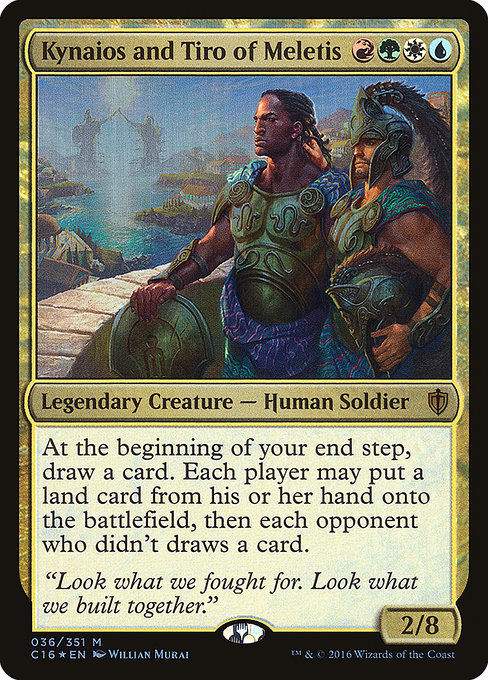
Kynaios and Tiro of Meletis is one of the better-built commanders Wizards has put in a precon. At the beginning of your end step you draw a card, and every player may put a land from their hand onto the battlefield. Each opponent who doesn’t draws instead. Nobody has a reason to refuse either half, which is the point: your commander is the one permanent on the battlefield that three other people are actively rooting for.
Commander 2016 then spent the rest of the box on the giving and almost nothing on the collecting. Twenty cards here put a card, a land, a creature, a counter or a whole permanent into an opponent’s possession. Two convert any of that into damage without asking you to attack. The deck isn’t badly built so much as unfinished, and finishing it costs about $111.
100 cards, 40 lands (20 basic), 21 creatures, average mana value 3.51. Mana sources: 21 white, 20 blue, 20 red, 22 green.
No Game Changers and no mass land denial, so it sets no bracket floor. How brackets work →
What are the best Stalwart Unity upgrades?
In the order I’d buy them. Prices are TCGplayer market for the default printing, September 2026.
- Trouble in Pairs ($27.15). Every opponent who draws a second card in a turn draws you one. This deck already forces that: with Howling Mine on the battlefield each opponent takes two in their own draw step, so one enchantment turns into three cards a turn cycle.
- Alhammarret's Archive ($10.64). It doubles every card you draw except the first one in your draw step, so every shared draw the deck hands out stops being shared.
- The Locust God ($7.52) and Approach of the Second Sun ($7.13). The board and the button. One turns each of those draws into a hasty flier. The other wins from behind a wall without ever attacking.
- Fevered Visions ($1.62). Two damage at each opponent’s end step whenever they’re holding four cards, which in this deck is nearly always. Six a turn cycle for a dollar sixty.
- Court of Grace ($2.99) and Palace Jailer ($0.23). Two crowns behind five pillowfort pieces. The monarch card most decks can’t hold onto is one this deck holds by default.
- Mystic Remora ($12.77) and Idyllic Tutor ($12.72). A first-turn tax on a table that hasn’t ramped yet, and a way to find whichever of the deck’s thirteen enchantments the board is asking for.
- Reflecting Pool ($14.87) and City of Brass ($12.11). The only two adds that have nothing to do with the theme. Four colours on twenty to twenty-two sources each needs untapped fixing more than it needs a thirteenth tapped land.
- Generous Gift ($0.71), Dictate of Kruphix ($0.33) and Kwain, Itinerant Meddler ($0.32). A dollar thirty-six for a second unconditional answer and two more shared draws, both of which are only worth having once the payoffs above are in the deck.
Fourteen cards come out to make room. That list is further down.
Twenty cards feed the table. Two collect.
Here is the giving half of the box, counted off the shipped list: Kynaios and Tiro of Meletis, Veteran Explorer, Humble Defector, Orzhov Advokist, Gwafa Hazid, Profiteer, Ludevic, Necro-Alchemist, Selvala, Explorer Returned, Edric, Spymaster of Trest, Akroan Horse, Zedruu the Greathearted, Minds Aglow, Collective Voyage, Tempt with Discovery, Howling Mine, Temple Bell, Rites of Flourishing, Assault Suit, Evolutionary Escalation, Forbidden Orchard and Oath of Druids.
Now the collecting half. Psychosis Crawler drains each opponent for one every time you draw a card. Treacherous Terrain deals each opponent damage equal to their own land count, which lands funny in a deck that helped them get there. That is the entire list. Chasm Skulker, Hoofprints of the Stag, Rubblehulk and Empyrial Plate all want combat damage, and the box is wearing six separate effects designed to stop combat from happening.
An input pipe twenty cards wide and an output pipe two cards wide is why group hug has a reputation for never closing. Every add on this page is either a second output pipe or a way to survive long enough to use one.
Making the giving one-sided
The trick is not to stop sharing. Sharing is what buys the table’s goodwill, and goodwill is this deck’s real protection for the first six turns. The trick is to get paid twice for the same generosity.
Alhammarret's Archive is the clearest version of that. It doubles every draw except your natural one, so Howling Mine gives an opponent one card and gives you two. Rites of Flourishing, Temple Bell, Dictate of Kruphix and the commander’s own end-step trigger all get the same treatment. Land the Archive with three shared-draw effects out and your draw step is seven cards: one natural, then three doubled.
That number is what makes the rest of the list work. Seven cards through Psychosis Crawler is seven life off every opponent in a single draw step. Seven cards through The Locust God is seven 1/1 fliers with haste. Trouble in Pairs needs no help at all: it triggers on each opponent’s second draw, their second spell, and any attack on you with two or more creatures, and this deck manufactures the first two on purpose.
Fevered Visions is the cheapest card on the list and close to the best. Two damage per opponent per turn cycle, conditional on them holding four cards, in a deck whose whole function is making people hold cards. Six a turn cycle, for $1.62, while the fort holds.
The two courts are the other half of the plan. Palace Jailer exiles a creature only until an opponent becomes the monarch, which is why most decks treat it as a rental. Here the crown sits behind Ghostly Prison, Propaganda, Sphere of Safety, Windborn Muse and Blazing Archon, so the rental quietly becomes ownership, and Court of Grace turns each of your upkeeps into a 4/4 Angel for as long as it lasts.
Approach of the Second Sun earns its own line, because a fort deck with no finisher is just a long game you eventually lose. Cast it once, gain seven, and it goes seventh from the top. This deck draws four to seven cards a turn cycle. You will see it again inside two turns, and the second cast does not care what anybody’s board looks like.
Two cards are missing from that list on price, and they are the two I would most like to be recommending. Smothering Tithe ($64.01) turns every opponent draw into a Treasure unless they pay, and few commanders in the format hand out more opponent draws than this one. Rhystic Study ($69.90) taxes the spells all those extra cards let them cast. Either would be my first purchase on a different budget. Together they cost more than everything else on this page combined, and they carry a bracket consequence I come back to at the end.
Fourteen cards that neither hold the fort nor end the game
After the swaps, every card in this deck should do one of three things: keep you alive, put resources into the table, or convert what the table has into a win. These fourteen do none of the three.
Five artifacts cost too much for what they give back. Keening Stone is six mana to mill one player at five mana a shot. Venser's Journal is five for a hand-size clause and some incidental life. Prismatic Geoscope is a five-mana rock that enters tapped, and it is the one genuinely painful cut here, because it takes a source of all four colours with it. Empyrial Plate and Assault Suit are equipment in a deck with maybe four creatures worth equipping and a stated policy of not attacking.
Four creatures go with them. Rubblehulk is a vanilla body whose bloodrush mode needs an attack. Realm Seekers is a six-mana land tutor. Progenitor Mimic is six mana to copy the best creature on a board that is mostly small utility bodies. Kazuul, Tyrant of the Cliffs asks for two red pips at five mana on twenty-one red sources, and cutting it removes the last double-red requirement from the deck entirely.
Akroan Horse is the cut people argue with, so: it gives one opponent a 0/4 and then gives all three of them a 1/1 on every single one of your upkeeps, in a deck with no way to profit from other people’s creatures and no goad. You are spending a card to build three armies.
Two sorceries leave from the top of the curve. Reverse the Sands is eight mana to rearrange life totals, which is a real effect and not one you can build around. Seeds of Renewal is undaunted, so it is a four-mana Regrowth-for-two in a four-player game, and nothing in this graveyard is worth that slot.
Last, two lands. Rupture Spire and Transguild Promenade both enter tapped and then demand another mana or sacrifice themselves. In a deck whose commander already hands you a free land drop every end step, a land that costs you a turn and a mana is strictly worse than the untapped rainbow land replacing it.
The curve that comes out the other side averages 3.51 mana value against the box’s 3.83, with cards costing six or more falling from ten to six.
Blazing Archon costs nine mana and is the last card I’d cut
Nine mana, three white pips, no effect on the board when it lands. Every number says cut it. Then read the text: creatures can’t attack you. Not taxed, not discouraged. Can’t. In a deck whose plan is buying time to draw cards nobody can punish you for drawing, that is not a bad nine-drop, it is the ceiling of the strategy, and forty lands plus seven ramp pieces will get you there.
Sphere of Safety keeps its slot for a related reason. Five mana for a tax effect reads lazy until you count the enchantments: eight in the stock deck, thirteen after the swaps, and the toll is one generic mana per enchantment per attacking creature. Nobody is attacking into that with a wide board, and a wide board is the only board that beats this deck.
Blasphemous Act reads as a nine-drop and effectively never is. It costs one less for each creature on the battlefield, and this deck spends the entire game putting creatures onto the battlefield for other people. In practice it is a one- or two-mana wipe that kills nothing of yours worth keeping.
Wave of Reckoning is the sharper one, and at about $17 it is one of the three most valuable cards in the box. Each creature deals damage to itself equal to its power, so Kwain, Selvala, Gwafa Hazid and every 1/1 Spirit you handed out all survive, while the 6/6 somebody built to kill you does not. This colour combination does not get a more one-sided sweeper.
Lurking Predators is the closest call I did not make. Six mana with two green pips on twenty-two sources is castable by turn six only 80.1% of the time, and twenty-one creatures in ninety-nine means it misses about four times in five. It stays because the one thing this deck guarantees is opponents casting spells, so a one-in-five hit rate still fires more than once a turn cycle, and because at $19.71 it is the most expensive card in the box, which is a reason to explain the decision rather than bury it.
Humble Defector stays too, specifically because Homeward Path is in the same ninety-nine. Tap it, draw two, hand it over, then tap Homeward Path whenever you like and take it back. The box shipped a repeatable draw-two engine across two cards and never mentioned it on the packaging.
Forty lands is right, and four of the tapped ones are fuel
Forty lands in a deck averaging 3.51 mana value sits three to five above the normal band, and it stays there. Kynaios and Tiro of Meletis converts a surplus land in hand into a free land drop at every one of your end steps, so the flood card that would be dead anywhere else is a mana advantage here. Rites of Flourishing adds a second extra drop. Ash Barrens, Migratory Route, Treacherous Terrain and Sylvan Reclamation all cycle away for a basic once you have enough.
The same trigger redeems what looks like the mana base’s worst feature. Azorius Chancery, Gruul Turf, Izzet Boilerworks and Selesnya Sanctuary enter tapped and bounce a land you already control, which is card-neutral and tempo-negative almost everywhere else. Here you play the karoo on your turn and the bounced land goes straight back down for free at your end step. Four of the box’s twelve always-tapped lands are secretly fine.
The other eight are not, and two of them leave. Trading Rupture Spire and Transguild Promenade for Reflecting Pool and City of Brass takes always-tapped lands from twelve down to ten and untapped sources from twenty-eight up to thirty, with the land count unchanged.
White is the colour to watch afterwards. Twenty-one sources gets a single white pip by turn two 86.3% of the time, which is ordinary for four colours, but four cards want double white by turn four: Blazing Archon, Court of Grace, Palace Jailer and Trouble in Pairs. That is a 67.3% proposition. So when Cultivate or Krosan Verge asks which basic you want, the answer is usually Plains. Blue has the same shape at a lower stake, with Dictate of Kruphix and Reins of Power both wanting double blue.
The one figure I am knowingly leaving under the usual band is ramp, at seven pieces against a normal eight to twelve. Forty lands, a commander that gives you a free land drop a turn and an enchantment that gives you a second one is ramp under another name.
The two best cards for this deck are the two that move its bracket
Everything on this page leaves Stalwart Unity where the box put it: a Bracket 1 floor before the swaps and a Bracket 1 floor after them. Nothing in the ninety-nine appears on the Game Changers list, the only tutor I am adding fetches an enchantment, and a deck that hands out free land drops was never going to start destroying them. For something this slow and this social, that is the honest answer.
Smothering Tithe and Rhystic Study are both on the Game Changers list. Adding either takes the floor to Bracket 3, because Bracket 2 permits none at all. That is a real decision rather than a technicality. A deck that hands three opponents free cards all game and takes a Treasure for each of them is a materially different experience for everyone else at the table, and it belongs in a conversation that happens before the game starts.
My read is that this deck is more fun at Bracket 2 than at Bracket 3, so the fourteen cards above are the fourteen I would buy. If you want the Bracket 3 version, buy the Tithe first, tell your pod, and run the finished list through the bracket checker rather than guessing at it.
The upgraded decklist
The list below is the ninety-nine after all fourteen swaps, grouped the way the deck builder groups it. Hover any card name to see the card.
“Load into the deck builder” opens this list in your account, pinned to the printings the box shipped, ready to edit or save. “Copy decklist” gives you plain text for Moxfield, Archidekt or Arena, with no account needed.
The two upgrade buttons open only the cards this guide adds, for when you already own the box. TCGplayer links are affiliate links, so we may earn a commission on purchases.
Commander 1
- Kynaios and Tiro of Meletis




Creatures 20
- Blazing Archon
- Chasm Skulker
- Edric, Spymaster of Trest
- Gwafa Hazid, Profiteer
- Horizon Chimera
- Humble Defector
- Hushwing Gryff
- Kraum, Ludevic's Opus
- Kwain, Itinerant Meddler
- Ludevic, Necro-Alchemist
- Orzhov Advokist
- Palace Jailer
- Psychosis Crawler
- Selfless Squire
- Selvala, Explorer Returned
- Sidar Kondo of Jamuraa
- The Locust God
- Veteran Explorer
- Windborn Muse
- Zedruu the Greathearted






Instants 10
- Arcane Denial
- Beast Within
- Benefactor's Draught
- Entrapment Maneuver
- Generous Gift
- Oblation
- Reins of Power
- Swan Song
- Swords to Plowshares
- Sylvan Reclamation
Sorceries 11
- Approach of the Second Sun
- Blasphemous Act
- Collective Voyage
- Cultivate
- Idyllic Tutor
- Kodama's Reach
- Migratory Route
- Minds Aglow
- Tempt with Discovery
- Treacherous Terrain
- Wave of Reckoning

Artifacts 5
- Alhammarret's Archive
- Commander's Sphere
- Howling Mine
- Sol Ring
- Temple Bell
Enchantments 13
- Court of Grace
- Dictate of Kruphix
- Evolutionary Escalation
- Fevered Visions
- Ghostly Prison
- Hoofprints of the Stag
- Lurking Predators
- Mystic Remora
- Oath of Druids
- Propaganda
- Rites of Flourishing
- Sphere of Safety
- Trouble in Pairs
Lands 40
- Ash Barrens
- Azorius Chancery
- City of Brass
- Command Tower
- Evolving Wilds
- Exotic Orchard
- Forbidden Orchard
- 5× Forest
- Frontier Bivouac
- Gruul Turf
- Homeward Path
- 5× Island
- Izzet Boilerworks
- Jungle Shrine
- Krosan Verge
- 5× Mountain
- Myriad Landscape
- Mystic Monastery
- Opal Palace
- 5× Plains
- Reflecting Pool
- Seaside Citadel
- Selesnya Sanctuary
- Terramorphic Expanse
FAQ
Which bracket does Stalwart Unity land in after these upgrades?
Bracket 1 on the floor, before and after. Nothing in the box is on the Game Changers list and nothing I recommend buying is either, and nothing here takes an extra turn or blows up a land. In practice it plays like a Bracket 2 deck: the swaps make it better at finishing, not faster at starting. The one thing that would move it is buying Smothering Tithe or Rhystic Study, either of which takes the floor straight to Bracket 3.
How does a group hug deck actually win a game?
Three ways here, and none of them involve attacking. Psychosis Crawler drains every opponent for each card you draw, which with Alhammarret's Archive and three shared-draw effects out is seven life a draw step. The Locust God turns those same draws into 1/1 fliers with haste. Approach of the Second Sun wins outright on its second cast, and a deck drawing four to seven cards a turn cycle finds it again quickly. Fevered Visions and Treacherous Terrain chip in on top.
Doesn’t giving opponents free cards just make them beat you faster?
It does when nothing collects, which is the stock deck’s actual flaw. Two things fix it. Ghostly Prison, Propaganda, Sphere of Safety, Windborn Muse and Blazing Archon tax or forbid attacks on you specifically, so the resources you handed out get spent on each other. And every card on the add list charges for a draw an opponent was taking anyway, which turns their card advantage into yours.
What do the fourteen upgrades cost?
$111.11 at TCGplayer market prices for default printings, September 2026. Reflecting Pool and City of Brass are $26.98 of that and are pure mana-base spend, so the theme half of the list is $84.13. Trouble in Pairs is another $27.15 on its own. The eleven cheapest adds together come to $56.98 and still change how the deck ends games.
Do I need Smothering Tithe or Rhystic Study for this to work?
No, and neither is on the list. They are the two strongest cards in the format for a deck built on opponents drawing cards, and at $64.01 and $69.90 they would each cost more than half of everything else recommended here. They also both carry the bracket consequence above. If you already own one, play it and tell your pod what you did.
Is the Stalwart Unity precon still worth buying?
It has been out of print since 2016, so the sealed price depends entirely on where you find one. The singles inside come to roughly $192 at market, and the concentration is unusually friendly: Lurking Predators, Homeward Path, Wave of Reckoning, Benefactor's Draught and Swan Song are about $80 of that total and all five stay in the deck after these swaps. The Stalwart Unity data page tracks the current number.
Can I run Kynaios and Tiro without the group hug plan?
People do, usually as a lands deck or a four-colour goodstuff pile. Be honest about what that costs, though: the commander’s text is symmetric whatever you build around it, so a deck that isn’t exploiting the symmetry is paying four colours for an end-step cantrip and a free land drop. Most of the twenty giving cards would leave, and this is not the guide for that build.