Dance of the Elements precon upgrade guide
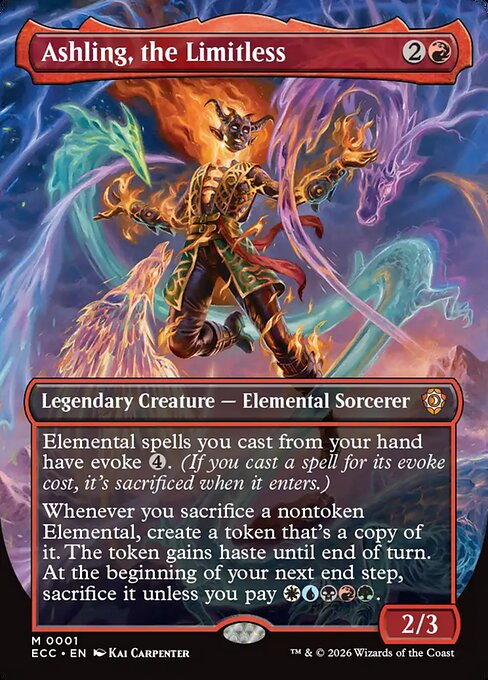
Ashling, the Limitless rewrites the price tag on most of this box — no Elemental you cast from hand ever has to cost more than four mana, and the best upgrades are the ones that make each four-mana loop pay twice.
Dance of the Elements is the five-colour deck of the Lorwyn Eclipsed Commander cycle, and on paper it reads slow: thirteen five-drops, sixteen cards at six mana or more, an average mana value of 4.27, and 14 of its 40 lands entering tapped. Resolve the decklist and the picture changes. 33 of the 36 creatures are Elementals, and Ashling, the Limitless gives every Elemental permanent spell you cast from your hand evoke {4}.
The loop is worth spelling out, because the whole upgrade job hangs on it. You cast an Elemental for four, it enters, its trigger happens, and evoke sacrifices it. That sacrifice is a nontoken Elemental dying, so Ashling hands you a token copy with haste — which enters, so its trigger happens again — and at your next end step you pay {W}{U}{B}{R}{G} to keep the copy or let it go having already attacked. Mulldrifter is the version the box teaches you with: evoke it for its own {2}{U} and it draws two, the copy draws two more, and three mana became four cards plus a 2/2 flier you can ransom.
That loop is also the honest test for every card here. Mana value stops mattering; what matters is whether a card's value arrives with it, because the body is getting sacrificed either way. The cuts below are the cards whose value needs them to stick around, and the adds make each arrival count twice.

Upgraded list: 100 cards, 37 lands (16 basic), 38 creatures, average mana value 3.98. Mana sources: 29 white, 31 blue, 28 black, 31 red, 41 green. No Game Changers and no mass land denial, so the deck sets no bracket floor. How brackets work →
What are the best Dance of the Elements upgrades?
Ranked by how much each one changes a game:
- Panharmonicon. The box already runs Yarok, the Desecrated; this is the colourless second copy. With either on the table, one evoke is four enter triggers — the cast and the copy, both doubled — and the Mulldrifter loop above draws eight.
- Elemental Bond. Card draw was the box's one below-range number: seven pieces where a hundred-card deck wants eight to twelve. Nearly everything here has power 3 or greater, token copies included, so this is a card per arrival.
- Grief. The box ships Fury and Endurance, two of the five Incarnations that evoke for free. Grief is the cheapest of the missing three at $3.43, and with Ashling out its free cast strips two cards from a hand instead of one.
- Flamekin Harbinger. One red mana puts whichever engine piece the hand is missing on top of the library, and the search is an enter trigger, so the doublers stack it. The only add over $10.
- Brighthearth Banneret. Cost reduction applies to evoke costs, so this turns Ashling's evoke {4} into {3} — and shaves every Elemental you cast at full price too.
- Omnath, Locus of Creation. A card on arrival, and with twelve ramp pieces the landfall text is live the turn it lands.
Eleven cards leave to make room. What comes out is a shorter list than a 4.27 curve usually earns, and the reason why is the next section.
No Elemental here has to cost more than four
The reflex with a top-heavy precon is to cut the six- and seven-drops. Ashling breaks the reflex, because the expensive Elementals are exactly the ones evoke {4} discounts hardest — provided their value walks in the door with them.
Lamentation evoked is “destroy target creature an opponent controls and gain 3 life” twice, for four mana. Titan of Industry chooses two of its four modes, twice. Shriekmaw and Ingot Chewer come with their own cheaper evoke costs — {1}{B} for two creature kills, a single red mana for two dead artifacts — and each sacrifice still hands you the hasty copy on top.
The strangest case is Maelstrom Wanderer. Cascade triggers when you cast the spell, not when you pay full price, and the spell's mana value stays eight however you pay — so evoking it for four cascades twice into nearly anything in the deck, and then the copy is a hasty 7/5 that gives your whole board haste until you decide whether to ransom it.
Incandescent Soulstoke is the box's other cheat, and it was doing this before the commander existed: {1}{R} and a tap puts an Elemental from your hand straight into play with haste, sacrificed at end of turn — at which point Ashling copies it, and the copy is the one you keep.
Two lines of fine print matter here. The grant only touches spells cast from your hand, so Muldrotha, the Gravetide recasting permanents out of the graveyard and Realmwalker casting Elementals off the top of the library both pay full price. Neither stops being worth it; they just do a different job.
Who actually pays {W}{U}{B}{R}{G}
Keeping a copy costs one mana of each colour at your end step, and there is a rules trap buried in that sentence. Paying a cost during the resolution of a triggered ability is not casting a spell and not activating an ability — so every restricted source in the deck is useless for it. Smokebraider, Flamebraider, Primal Beyond, Ancient Ziggurat, Unclaimed Territory and Secluded Courtyard all make mana that can only cast spells or activate abilities. That mana evokes Elementals all day; it never ransoms a single token.
The unrestricted producers are the ones that do the work, and the box quietly stocks good ones: Jegantha, the Wellspring taps for exactly {W}{U}{B}{R}{G} and refuses to pay generic costs, which reads like a drawback until you notice it is the ransom on a stick. Timeless Lotus is the same five pips from an artifact. Chromatic Lantern, Faeburrow Elder and Selvala, Heart of the Wilds cover it from three more directions, and Cascading Cataracts on the add list converts five of anything into it.
Springleaf Parade might be the quietest good card in the box: creature tokens you control tap for any colour, and Ashling's copies are creature tokens. Every copy you keep helps pay for the next one.
This is also why two cards that look like obvious cuts are staying. Fertile Ground and Abundant Growth look like the weakest ramp in the deck — single-land auras, one extra mana — but the mana is unrestricted and any colour, which is precisely the mana this deck runs out of. The better-looking replacements mostly make green.
What the swaps do to the numbers
Eleven out, eleven in, about $45. Lands go from 40 to 37, inside the typical 35–38 for this curve. Always-tapped lands drop from 14 to 9. Average mana value falls from 4.27 to 3.98, draw climbs from seven pieces to nine, ramp from eleven to twelve. The creature count actually rises, 36 to 38, and the Elemental share holds at 92%.
One number moves the wrong way, and I took the trade with open eyes. Red and blue each sit at 31 sources against the 36 that a reliable turn-three double pip wants, and white at 29 against 33 for turn four. But look at who is asking. The red and blue demand is Eclipsed Flamekin, whose two hybrid pips accept either colour, plus evoke cards — Fury casts itself for free off a red card in hand. Black's double pips are Grief, which is usually free, and two five-plus-mana sorceries. The one card genuinely exposed is Shatter the Sky, and a board wipe that occasionally arrives a turn late is a price I will pay for five fewer tapped lands.
What I'd cut
Two spells the commander never discounts
Evoke {4} touches Elemental permanents. Elemental Spectacle is a six-mana sorcery that pays you for already having colours and creatures on the table, and Kindred Summons is a seven-mana instant that puts Elementals from your library into play — a job the commander already sells for four, off cards you actually chose. Both cost full price forever, in the one deck where nothing else does.
The two weakest Incarnations
Impulsivity casts an instant or sorcery out of a graveyard for free when it enters, which sounds like the dream evoke until you play it: on turn four the graveyards are empty, and later they are a lottery. Subterfuge gives one creature flying and a draw trigger for a single combat — a targeted buff in a deck fielding 38 creatures. The other four Incarnations stay.
Two engines that never spin up
Vernal Sovereign makes its token on entering or attacking, so evoked it is two tokens and done, and kept it is a five-drop producing one token a turn. Hoofprints of the Stag needs four draw triggers and three mana per 4/4 — in the deck whose draw count was its one below-range stat. And here is the neat proof of the whole method: Hoofprints is an Elemental enchantment, so it genuinely does gain evoke {4} — which is worthless, because it has no enter trigger. Value that arrives with the card is the audition, and it fails.
The five Thriving lands
Thriving Grove, Thriving Heath, Thriving Isle, Thriving Bluff and Thriving Moor all enter tapped and each fixes exactly two colours, one of them locked at printing. Fourteen tapped lands was the box's worst number, and these five buy the least fixing per turn lost — the three-colour shard lands at least fix more. The replacements enter untapped or put extra lands into play.
The cards that look like cuts and aren't
Blasphemous Act says nine mana in the corner, and at a four-player table with 38 creatures in this deck alone it rarely costs more than one or two.
Omnath, Locus of Rage is seven real mana and clunky — and its death trigger turns the deck's engine into a weapon. Every evoke is an Elemental dying, which is three damage, and an evoked Omnath left unransomed deals six on its own: once when the original is sacrificed, once when the copy goes.
Muldrotha, the Gravetide is a six-drop that wants to stick around, the exact profile I have been cutting — but everything evoke sacrifices is a permanent in your graveyard, and casting permanents out of the graveyard is Muldrotha's entire text. The engine stocks her shelves.
Selvala, Faeburrow Elder and Realmwalker are the deck's three off-type creatures on paper. Realmwalker is a changeling, so it is an Elemental everywhere that matters. The other two make unrestricted coloured mana — see above for why that outranks a creature type here.
Timeless Lotus and Jegantha, the Wellspring both read as five-mana do-nothings to a curve check. Five exact pips on a stick is not nothing in this deck; it is the win condition's rent.
What I'd add
The engine
Panharmonicon and Flamekin Harbinger are argued in the ranked list; the detail worth adding is that they compound — a doubled Harbinger trigger finds two pieces, and one of them can be the next Harbinger. Brighthearth Banneret is the third piece: evoke {4} becomes {3}, real casts get cheaper, and at {1}{R} it comes down before Ashling does.
Draw
Elemental Bond is the headline. Cloudkin Seer is the modest one — a 2/2 flier that replaces itself, a cheap Mulldrifter impression with a doubler out — and it exists to move the draw count from seven to nine, which it does. Omnath, Locus of Creation draws on arrival and threatens considerably more if anyone lets it sit.
The missing Incarnation
Grief runs $3.43 as I write this, and there is no cheaper way to interact on turn one in these colours: exile a black card, take their best spell — and with Ashling out, take their two best. If the budget stretches, Subtlety runs about $11 and Solitude about $34, and both slot straight into the same loop.
The graveyard is a second hand
After three or four evoke cycles your graveyard is the best board in the game, and Living Death trades the ransomed tokens for all of it at once. Haunting Voyage, already in the box, is the same play foretold — name Elemental and take everything back.
Mana
Nature's Lore fetches any Forest untapped, and in this deck that includes Sodden Verdure, a Forest Island. Cascading Cataracts is indestructible and turns five of anything into exactly the ransom. Gemstone Mine gives three untapped any-colour activations, which is about how many times a game will ask.
Name Elemental every time
Five cards make you choose a creature type — Realmwalker, Haunting Voyage, Distant Melody, Unclaimed Territory and Secluded Courtyard — and after the swaps 35 of 38 printed creatures are Elementals, 36 counting Realmwalker's changeling. There is no second-best answer to weigh.
The count is better than it looks for Distant Melody, which counts permanents of the chosen type: Springleaf Parade's changeling tokens, Belonging's changeling tokens and every Ashling copy on the table all pay out alongside the printed Elementals.
The upgraded decklist
The full hundred with all eleven swaps applied — hover any card name to see it.
“Load into the deck builder” opens this list in your account, pinned to the printings the box shipped, ready to edit or save. “Copy decklist” gives you plain text for Moxfield, Archidekt or Arena — no account needed.
Commander 1
- Ashling, the Limitless

Creatures 37
- Avenger of Zendikar
- Bane of Progress
- Belonging
- Brighthearth Banneret
- Cavalier of Thorns
- Cloudkin Seer
- Eclipsed Flamekin
- Endurance
- Faeburrow Elder
- Flamebraider
- Flamekin Harbinger
- Foundation Breaker
- Fury
- Greenwarden of Murasa
- Grief
- Horde of Notions
- Incandescent Soulstoke
- Ingot Chewer
- Jegantha, the Wellspring
- Jubilation
- Lamentation
- Maelstrom Wanderer
- Mass of Mysteries
- Muldrotha, the Gravetide
- Mulldrifter
- Omnath, Locus of Creation
- Omnath, Locus of Rage
- Omnath, Locus of the Roil
- Realmwalker
- Risen Reef
- Selvala, Heart of the Wilds
- Shimmercreep
- Shriekmaw
- Slithermuse
- Smokebraider
- Titan of Industry
- Yarok, the Desecrated
Instants 4
- Crib Swap
- Path to Exile
- Reality Shift
- Return of the Wildspeaker
Sorceries 8
- Blasphemous Act
- Cultivate
- Distant Melody
- Haunting Voyage
- Kodama's Reach
- Living Death
- Nature's Lore
- Shatter the Sky
Artifacts 6
- Arcane Signet
- Chromatic Lantern
- Fellwar Stone
- Panharmonicon
- Sol Ring
- Timeless Lotus
Enchantments 7
- Abundant Growth
- Cream of the Crop
- Descendants' Fury
- Elemental Bond
- Fertile Ground
- Garruk's Uprising
- Springleaf Parade
Lands 37
- Abundant Countryside
- Ancient Ziggurat
- Cascading Cataracts
- Command Tower
- Exotic Orchard
- Flamekin Village
- 8× Forest
- Frontier Bivouac
- Gemstone Mine
- 2× Island
- Jungle Shrine
- 2× Mountain
- Opal Palace
- Opulent Palace
- Path of Ancestry
- 2× Plains
- Primal Beyond
- Raging Ravine
- Rain-Slicked Copse
- Sandsteppe Citadel
- Savage Lands
- Seaside Citadel
- Secluded Courtyard
- Sodden Verdure
- 2× Swamp
- Unclaimed Territory
FAQ
How does Ashling, the Limitless change what the cards in this deck cost?
Every Elemental permanent spell you cast from your hand gains evoke {4}, meaning you can pay four generic mana instead of its printed cost — the creature enters, its trigger happens, and it is sacrificed. That sacrifice then triggers Ashling's second ability: you get a hasty token copy, and its enter trigger happens again. You keep the token past your end step by paying {W}{U}{B}{R}{G}. In practice no Elemental in the deck ever has to cost more than four mana.
Can Smokebraider's mana pay the {W}{U}{B}{R}{G} to keep a token copy?
No. Smokebraider, Flamebraider, Primal Beyond, Ancient Ziggurat, Unclaimed Territory and Secluded Courtyard all restrict their mana to casting spells or activating abilities, and paying a cost during the resolution of a triggered ability is neither. That mana pays evoke costs, because evoking is casting an Elemental spell. To keep the tokens you need unrestricted sources — Jegantha, the Wellspring, Timeless Lotus, Chromatic Lantern, Faeburrow Elder, Selvala, or plain lands.
What type do Realmwalker, Haunting Voyage and Distant Melody name in this deck?
Elemental, every time, and the same goes for the lands Unclaimed Territory and Secluded Courtyard. After the swaps 35 of the deck's 38 printed creatures are Elementals, and Realmwalker itself is a changeling, so the real count is 36. Naming anything else abandons the deck.
What do the Dance of the Elements upgrades cost?
About $45 at market prices as I write this, across eleven cards. Flamekin Harbinger is the priciest at around $12; six of the eleven are under $3.50. Skipping the Harbinger brings the package to roughly $33.
Does upgrading this precon push it out of low-bracket pods?
No. The stock deck has no Game Changers and neither does any card on the add list, so the upgraded deck's bracket floor is unchanged. It plays faster — the average mana value drops from 4.27 to 3.98 and five tapped lands leave — but nothing on the list moves it up a bracket on its own.
Why keep Fertile Ground and Abundant Growth over stronger ramp?
Because they make unrestricted mana of any colour, and the deck's real colour demand is paying {W}{U}{B}{R}{G} at your end step to keep Ashling's token copies. Most of the deck's fixing — six different cards — is restricted to casting Elemental or creature spells and cannot pay that cost. The two auras can.