Desert Bloom precon upgrade guide
Fifteen of this deck's forty lands are Deserts, and that fraction decides how often the commander's headline ability does anything at all. Thirteen swaps at $52.80 leave the count almost exactly where it was, deliberately.
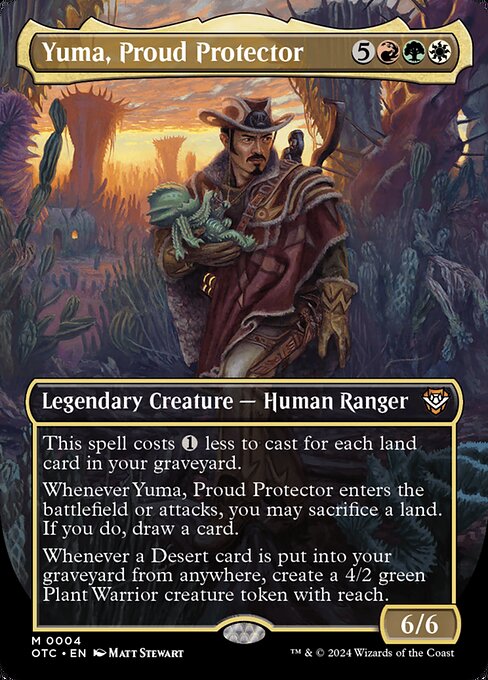
Outlaws of Thunder Junction sold this deck on one promise: put a Desert in your graveyard, get a 4/2 with reach. Yuma, Proud Protector reads like a commander that turns your mana base into an army, and the 99 around it are built to sacrifice, mill and recur lands all game.
Then you count the Deserts. There are fifteen. The deck plays forty lands, so the other twenty-five are ordinary, and when one of those reaches your graveyard the third line of the commander does nothing.
I don't think that makes it a bad deck. It makes the upgrade an actual decision instead of a shopping list, because there are two honest answers and they pull in opposite directions: raise the Desert count, or stop needing it to be high.
100 cards, 40 lands (17 basic), 24 creatures, average mana value 3.2. Mana sources: 22 white, 20 red, 24 green.
No Game Changers and no mass land denial, so it sets no bracket floor. How brackets work →
What are the best Desert Bloom upgrades?
In buying order, with market prices for the default printings. The whole list is $52.80, four of the thirteen cards cost under a dollar, and the first three entries here come to $12.23 between them.
- Nature's Lore ($2.12) and Three Visits ($4.63). Both put a Forest onto the battlefield untapped, and two of this deck's tapped lands, Sheltered Thicket and Scattered Groves, are Forests. They turn the box's own slow lands into fast ones.
- Splendid Reclamation ($0.35). Returns every land card in your graveyard to the battlefield at once. In a deck that sacrifices and mills lands on purpose, this is the payoff the box forgot.
- Life from the Loam ($5.13). Dredge three puts lands in your graveyard every turn, which is the resource four separate cards here are waiting on.
- Zuran Orb ($3.28). Free, repeatable, unlimited land sacrifice. It converts your board into triggers at instant speed for no mana.
- Skyshroud Claim ($1.08). Two Forests, untapped, which can be both cycling duals in one card.
- Chord of Calling ($7.58). The tutor that finds Dune Chanter, convoked out with tokens the deck is already making.
- Tireless Provisioner ($3.76) and Tireless Tracker ($0.30). Landfall that pays in Treasures and Clues. The Provisioner also counts as a source of all three colours.
- Wayward Swordtooth ($4.43) and Cultivate ($0.39). More land drops, and a land in hand to make them with.
- Constant Mists ($19.37). Repeatable land sacrifice stapled to a fog. The most expensive card here by a distance, and the one to buy last.
- Survivors' Encampment ($0.38). The only Desert I added, and the reason for that restraint is the next section.
What leaves is further down.
Fifteen Deserts, forty lands
Yuma has three abilities and they don't all want the same deck. It costs {1} less for each land card in your graveyard. It sacrifices a land on entry and on attack to draw a card. And it makes a 4/2 green Plant Warrior with reach whenever a Desert card is put into your graveyard from anywhere.
The first two work with any land. The third works with fifteen of them.
So the deck's most natural sequence, attacking with Yuma and sacrificing a land to draw, produces a Plant Warrior a little over a third of the time. The rest of the time you drew a card and that was all.
Here is the part that surprised me: the box already hedges against this. Four cards trigger on any land card reaching the graveyard rather than on a Desert. Turntimber Sower makes a 0/1 Plant, Sand Scout makes a 1/1 Sand Warrior once each turn, Crawling Sensation makes a 1/1 Insect once each turn, and Titania, Protector of Argoth makes a 5/3 Elemental when a land you control dies. All four fire on all forty lands.
Which means the Desert count gates the commander and nothing else. The rest of the sacrifice package is already type-agnostic, and that is what decided the shape of this upgrade.
The three-drop the whole deck bends around
Dune Chanter costs {2}{G} and reads, in part: lands you control and land cards you own that aren't on the battlefield are Deserts in addition to their other types.
Read that again with the deck in mind. It applies to your hand, your graveyard and your battlefield at once, so every one of your forty lands becomes a Desert. Yuma's trigger goes from fifteen live lands to forty. Hazezon, Shaper of Sand, which makes two 1/1 Sand Warriors whenever a Desert you control enters, stops being conditional and fires on every land drop you make.
Dune Chanter's second line then grants all your lands "{T}: Add one mana of any color", which quietly repairs the colour problem in the same slot.
One card, three of this deck's problems. The box runs a single copy and gives you no way to look for it, which is the strongest argument on this page for adding a tutor. Chord of Calling at $7.58 finds it at instant speed, and this deck is usually holding tokens to convoke with.
I looked hard at Green Sun's Zenith for the same job. It is the cleaner card and it costs $34.51, roughly two thirds of this entire upgrade on its own. Chord does about ninety per cent of the work because the deck goes wide anyway, so the Zenith is where I would spend next if the deck earns it.
What I bought, and why most of it is green
Once you stop chasing the Desert count, the deck's real weaknesses are easier to see. It runs three mana rocks, and they are Sol Ring, Arcane Signet and Chromatic Lantern. Its average mana value is 3.58. It wants double green, double red and double white at different points and reliably has none of them.
So nine of the thirteen adds are green ramp and land recursion.
The best interaction I found is small and specific. Sheltered Thicket is a Mountain Forest and Scattered Groves is a Forest Plains. Both enter tapped, and both are exactly the kind of land an upgrade guide normally tells you to cut. But they carry the Forest type, so Nature's Lore and Three Visits put them onto the battlefield untapped, and Skyshroud Claim fetches both at once. The box shipped its own fix and no way to use it.
Splendid Reclamation and Life from the Loam are the payoff half of the plan. This deck mills itself with Perpetual Timepiece, Satyr Wayfinder, Eccentric Farmer, Winding Way and Crawling Sensation, and until now the only ways to cash that in were The Mending of Dominaria and World Shaper. Zuran Orb and Constant Mists are the input half: both sacrifice lands repeatedly for almost nothing, which turns those four type-agnostic payoffs into an engine instead of an occasional bonus.
I skipped Crucible of Worlds at $35.34. The deck already plays lands from the graveyard three ways, through Ramunap Excavator, Ancient Greenwarden and Hazezon for Deserts, so a fourth copy of that effect is the least useful expensive card on the table. Azusa, Lost but Seeking at $12.55 lost its slot to Wayward Swordtooth at $4.43 on the same logic: extra land drops matter, but not at three times the price.
What leaves, and the twelve lands that stay
Start with what doesn't leave, because it is where most advice about this deck goes wrong.
Twelve of the forty lands enter tapped, and the reflex is to cut them for speed. Eight of those twelve are Deserts: Cactus Preserve, Desert of the True, Desert of the Indomitable, Desert of the Fervent, Mirage Mesa, Bristling Backwoods, Creosote Heath and Abraded Bluffs. Cutting a Desert so it can enter untapped one turn sooner means cutting the card that makes the 4/2. The three cycling Deserts are better still, because cycling one puts a Desert card into your graveyard straight from your hand and triggers Yuma without you ever drawing the land.
Of the remaining four, Sheltered Thicket and Scattered Groves also cycle and are now fetchable untapped. Krosan Verge finds two lands and buries itself doing it, which this deck reads as a bonus. Jungle Shrine is a plain tapped tri-land, and in a deck this short on coloured sources I will take the fixing.
So all twelve stay. The only land I cut is Sunscorched Divide, which isn't a Desert and charges you {1} every time you tap it for mana.
The rest of the cuts fall into three groups.
Too expensive for what they do. Rumbleweed costs {10}{G} and its own discount rarely closes that gap in time. Angel of Indemnity is a six-mana reanimation spell in a deck that recurs lands rather than creatures. Perennial Behemoth is the fourth card here that lets you play lands from your graveyard.
Fighting the deck's own plan. Escape to the Wilds exiles the top five cards of your library, and this is a deck that wants those cards in the graveyard. Genesis Hydra digs for a nonland permanent when the engine is lands. Skullwinder hands an opponent a card back every time you cast it.
Costing colours the deck can't pay. Omnath, Locus of Rage and Nesting Dragon both want double red, and Marshal's Anthem wants double white. Dropping those three is most of the reason the mana improves below. Swiftfoot Boots protects one creature in a deck that wins with a crowd, Requisition Raid is narrow, and Bitter Reunion is the weakest of the five spells that already turn a card in your hand into a card in your graveyard, alongside Thrilling Discovery, Electric Revelation, Magmatic Insight and Embrace the Unknown.
Where the mana ended up
Every number here describes the upgraded list, not the box.
Green sources go from 22 to 24, which puts a single green pip by turn 2 at 90.1%, exactly the target. Red goes from 19 to 20 and double red by turn 3 improves from 54.8% to 58%. That is still the weakest line in the deck, but it is now demanded by only two cards, Cataclysmic Prospecting and Heaven // Earth, and both are content to be cast late. White goes from 21 to 22, and with Marshal's Anthem gone the earliest card wanting double white is a six-drop, so that check moves out to turn 6 and reads 80.1%.
Two adds do a lot of that work: Survivors' Encampment and Tireless Provisioner each count as a source of all three colours.
Average mana value drops from 3.58 to 3.20 and the curve's centre of gravity settles on three, where there are now 21 cards. Land count stays at 40 and the tapped count stays at 12, both deliberately.
The bracket floor doesn't move. It was Bracket 1 in the box and it is Bracket 1 after the swaps, because nothing I added is a Game Changer. You will still play this at a Bracket 2 table, and the swaps make it a better deck there without making it a different one.
The upgraded decklist
The full 100 after the swaps. Hover any card name to see the card.
“Load into the deck builder” opens this list in your account, pinned to the printings the box shipped, ready to edit or save. “Copy decklist” gives you plain text for Moxfield, Archidekt or Arena — no account needed.
Commander 1
- Yuma, Proud Protector




Creatures 23
- Ancient Greenwarden
- Angel of the Ruins
- Avenger of Zendikar
- Dune Chanter
- Eccentric Farmer
- Elvish Rejuvenator
- Hazezon, Shaper of Sand
- Kirri, Talented Sprout
- Nantuko Cultivator
- Oracle of Mul Daya
- Ramunap Excavator
- Sand Scout
- Satyr Wayfinder
- Scaretiller
- Scute Swarm
- Springbloom Druid
- Sun Titan
- Tireless Provisioner
- Tireless Tracker
- Titania, Protector of Argoth
- Turntimber Sower
- Wayward Swordtooth
- World Shaper




Instants 10
- Bovine Intervention
- Chord of Calling
- Constant Mists
- Electric Revelation
- Harrow
- Heaven // Earth
- Path to Exile
- Return of the Wildspeaker
- Unholy Heat
- Valorous Stance

Sorceries 19
- Cataclysmic Prospecting
- Cultivate
- Decimate
- Descend upon the Sinful
- Embrace the Unknown
- Explore
- Hour of Promise
- Life from the Loam
- Magmatic Insight
- Map the Frontier
- Nature's Lore
- Sevinne's Reclamation
- Skyshroud Claim
- Splendid Reclamation
- Three Visits
- Thrilling Discovery
- Vengeful Regrowth
- Winding Way
- Wreck and Rebuild
Artifacts 5
- Arcane Signet
- Chromatic Lantern
- Perpetual Timepiece
- Sol Ring
- Zuran Orb

Enchantments 2
- Crawling Sensation
- The Mending of Dominaria
Lands 40
- Abraded Bluffs
- Bristling Backwoods
- Cactus Preserve
- Command Tower
- Conduit Pylons
- Creosote Heath
- Desert of the Fervent
- Desert of the Indomitable
- Desert of the True
- Dunes of the Dead
- Evolving Wilds
- 7× Forest
- Hashep Oasis
- Jungle Shrine
- Krosan Verge
- Mirage Mesa
- 4× Mountain
- Painted Bluffs
- 6× Plains
- Ramunap Ruins
- Scattered Groves
- Scavenger Grounds
- Shefet Dunes
- Sheltered Thicket
- Survivors' Encampment
- Terramorphic Expanse
FAQ
Should I just add more Deserts to Desert Bloom?
Mostly no. The good Deserts left in Yuma's colours produce colourless mana, and this deck is already 4 sources short of the double red it wants on turn 3. I added exactly one, Survivors' Encampment, because it taps for any colour instead of costing you one. The better answer is to lean on the four payoffs that trigger on any land card reaching the graveyard rather than on a Desert specifically.
Can Kirri, Talented Sprout lead this deck instead of Yuma?
Kirri is the alternate commander in the box and returns a Plant, Treefolk or land card from your graveyard every postcombat main phase, which is a fine value engine. But Kirri is mono-green. Leading with Kirri throws away the red and white halves of the deck, including Cataclysmic Prospecting, Descend upon the Sinful and Angel of the Ruins. Keep Kirri in the 99, where the box already put it.
What happens if I never draw Dune Chanter?
The deck still works, it just stops being a Desert deck. Yuma keeps sacrificing lands to draw, Turntimber Sower, Sand Scout and Crawling Sensation still make tokens off any land hitting the graveyard, and Titania still makes a 5/3. What you lose is the 4/2 Plant Warrior on 25 of your 40 lands. That gap is why I added Chord of Calling, which finds Dune Chanter at instant speed off tokens you already control.
How much do these Desert Bloom upgrades cost?
The 13 adds total $52.80 at market prices for the default printings. Four of them are under a dollar. The most expensive single card is Constant Mists at $19.37, and it is the one I would buy last if you are splitting the order across paychecks.
Is Desert Bloom worth playing straight out of the box?
Yes, against other precons. It has a real engine, 6 pieces of spot removal and a genuine top end. What it lacks is speed: average mana value is 3.58 and 12 of its 40 lands enter tapped, so it spends the first four turns setting up and falls behind decks that do not.
Is 40 lands too many after the swaps?
It reads high against the usual 35 to 38, and I kept all 40 anyway. This is the rare deck where a land in the graveyard is a resource rather than a dead draw: it discounts Yuma, feeds Splendid Reclamation and Life from the Loam, and turns into a body off three different permanents. Cutting lands here cuts the engine.