20 Ways to Win Secret Lair Commander deck guide
Sixteen cards in this hundred literally read you win the game. Sorting them by how much of the deck is actually helping is the whole review.
100 cards, 37 lands (2 basic), 26 creatures, average mana value 3.34. Mana sources: 34 white, 27 blue, 27 black, 27 red, 34 green.
Bracket floor 3 (Upgraded). How brackets work →
The sixteen, sorted by how much of the deck is helping
The box name counts routes, not cards. Sixteen of the hundred state a win outright. The rest of the twenty are the ones every deck has anyway, plus Drown in Dreams, which can mill somebody out if you have the mana spare. That is the honest frame, and it isn't the interesting part.
The interesting part is how uneven the sixteen are. Some have a dozen cards feeding them. Some need one specific other permanent in play or they do nothing at all. Here are all sixteen, in three groups.
Five the deck genuinely builds toward
Maze's End is the best-supported win in the box, and it isn't close. It wants ten Gates with different names. The deck runs nineteen Gates, every one of them uniquely named. Circuitous Route fetches two more, Maze's End tutors another every time you bounce it, and Heap Gate, Gond Gate and Baldur's Gate each reward the count on their own.
Felidar Sovereign and Test of Endurance ask for 40 and 50 life, and they share one engine. Soul's Attendant and Auriok Champion turn every creature that enters into a life point. Mangara, the Diplomat and Alseid of Life's Bounty carry lifelink, as does Felidar Sovereign itself. Sphinx's Revelation, Happily Ever After, Plaza of Harmony, Mayael's Aria and Approach of the Second Sun all gain in lumps. Two win conditions off one package is good value for eleven slots.
Simic Ascendancy wants twenty growth counters, and eleven cards in the deck put +1/+1 counters on your creatures. The one that matters is Heliod, Sun-Crowned: every life-gain trigger becomes a counter, and every counter on a creature becomes a growth counter. Stack that on the lifegain package above and those two win conditions are really one.
Happily Ever After reads like the hardest card here and is close to the easiest. Five colours among your permanents is free in a five-colour deck. A life total at or above your starting one is the package you're already running. Six card types is the clause people misread: it counts your graveyard as well as the battlefield, and Crib Swap is a Kindred Instant while Lignify is a Kindred Enchantment. Kindred gets you to six without the deck's single planeswalker ever resolving.
Four that need one specific partner
Liliana's Contract wants four Demons with different names. Count the Demons in this deck: there are none. Taurean Mauler is a changeling, so it counts as one. The other three exist only while Maskwood Nexus is on the battlefield making your creatures every type. Without the Nexus, this is a four-mana draw-four that costs you four life, and it's the clearest case of the box shipping a win condition it didn't build for.
Biovisionary needs four creatures carrying its own name. The deck has one. Rite of Replication with kicker makes five copies, which is exactly the line and also ten mana on top of the three you already spent.
Mechanized Production wants eight artifacts sharing a name, and the deck's nine artifacts all have different ones. It has to build on tokens: Treasures from Revel in Riches or Monologue Tax, Clues from Tireless Tracker. It does copy the enchanted artifact every upkeep, so left alone for seven turns it gets there by itself.
Hellkite Tyrant asks for twenty artifacts. Nine are in the deck and three of those are lands. The other eleven have to come off your opponents, which is what the Tyrant's combat trigger is for, and that's a lot of connecting for a six-drop with no haste.
Seven riding on the counters, the Treasures, or nothing much
Mayael's Aria and Twenty-Toed Toad both cash in the counter package. The Aria wants a creature with power 20, and Forgotten Ancient can move its whole accumulated pile onto one body in a single upkeep. The Toad wins on twenty counters or twenty cards in hand, and it raises your own maximum hand size to twenty.
Helix Pinnacle is the sleeper of the group. A hundred tower counters sounds absurd until you notice that Sanctum Weaver taps for one green mana per enchantment you control, in a deck with twenty-three enchantments, and Baldur's Gate taps for one per other Gate, in a deck with nineteen. On a developed board those two cover most of a hundred between them.
Revel in Riches wants ten Treasures and only makes them when an opponent's creature dies. The deck kills opponents' creatures with Austere Command, Supreme Verdict, Tragic Arrogance and Crib Swap. Four cards, three of which are also clearing your own board.
The last three are closer to decoration. Halo Fountain asks you to untap fifteen tapped creatures and pay five white mana, in a deck whose only repeatable token production is one Shrine per commander cast plus the Fountain's own Citizens at one a turn. Approach of the Second Sun is fourteen mana across two casts with nothing in the list to find the second copy. Triskaidekaphile wants exactly thirteen cards in hand, and nothing here lets you land on a number precisely.
Go-Shintai is a Shrine commander with no Shrines to lead
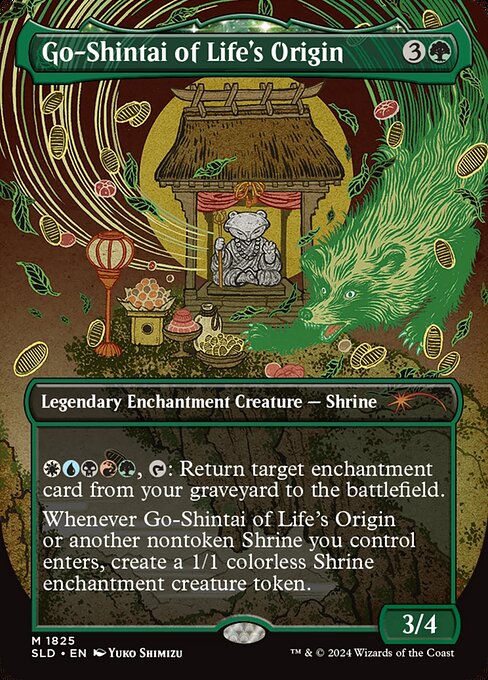
Go-Shintai of Life's Origin makes a 1/1 Shrine token whenever it or another nontoken Shrine you control enters. Count the Shrines in this deck: one, and it's Go-Shintai. Tokens don't trigger it either, so that ability makes exactly one body per cast and then stops.
The other ability is the reason it leads the deck. Five mana, one of each colour, tap: return an enchantment from your graveyard to the battlefield. Eight of the sixteen win conditions are enchantments, out of twenty-three enchantments in the list.
That's the deck's real safety net. Half the ways to win are cards a board wipe would otherwise take away for good, and the commander buys them back one per turn. The bill is five specific pips, which the mana can just about cover: 34 white and 34 green sources, 27 each of blue, black and red.
Nineteen Gates, and the tempo they cost
Maze's End is the most reliable win in the box because this is a Gates deck first. The mana base is where you pay for that.
Thirty-seven lands, two of them basic. Twenty enter tapped no matter what you do: sixteen Gates, plus Path of Ancestry, The World Tree, Thornglint Bridge and Maze's End itself. Three more are conditional, and Bountiful Promenade, Overgrown Farmland and Razorverge Thicket are all usually fine in practice. That leaves fourteen lands entering untapped without an asterisk.
Two lands in five cost you a turn on arrival, in a deck with an average mana value of 3.34 and four ramp spells: Sol Ring, Arcane Signet, Chromatic Lantern and Circuitous Route. Sanctum Weaver, Faeburrow Elder, Fertile Ground and Trace of Abundance add more, but only once creatures and enchantments are already down, which is later than you would like.
The pip maths is comfortable in four colours and has one hole. Blue is nine sources short of what it wants for double blue on turn three, at 76.4% to have both by then, and the cards asking are Mechanized Production, Rite of Replication and Sphinx's Revelation. None of those is a card you need on curve, so it stays a slow deck's kind of problem rather than a real one.
The plan is to not die, and the removal count shows it
One card in this deck unconditionally removes a creature. It's Crib Swap, and that is the entirety of the spot removal. There are two wipes in Austere Command and Supreme Verdict, Tragic Arrogance alongside them, and a handful of auras that neutralise rather than kill: Darksteel Mutation, Lignify, Pariah.
What stands in for removal is tax and protection. Ghostly Prison makes attacking you expensive. Monologue Tax and Mangara, the Diplomat both charge opponents for their second spell each turn, one in Treasures and one in cards. Shalai, Voice of Plenty hands you and your other creatures hexproof. Auriok Champion is simply invisible to two of the five colours. Clever Concealment phases your board out through somebody else's wipe, often for nothing thanks to convoke.
Card draw is the deck's quietly strong suit at ten pieces, headed by Mystic Remora and Sphinx's Revelation.
What you get is a deck that sits behind a tax wall, accumulates, and eventually presents a win the table has to answer at instant speed or lose to. Sixteen finishers, and the speed a durdle deck implies. The bracket floor is 3, on a single Game Changer: Seedborn Muse.
Keep a hand that produces more than one colour and lands a cheap lifegain creature early. The trap hand this deck deals more often than any other is five Guildgates and a seven-drop.
What the hundred cards are worth
Every market figure below is from September 2026. The Secret Lair Commander deck values page tracks them nightly if you're reading this later.
The deck sold for $149.99 in December 2024. The exact printings the box shipped are worth $456.77 at TCGplayer market and $555.54 at Card Kingdom, so a shade over three times the sale price.
The more useful number is where that money sits. The most expensive card in the box is the foil Revel in Riches at $38.27, which is 8.4% of the total. The top ten cards together come to 45.6%. Both figures are the lowest of the seven Secret Lair Commander decks: every other deck in the run has its top ten at 53% or more, and the Angels deck reaches 71.6%.
Sixteen cards here are worth $10 or more, twenty-eight are worth $5 or more, and forty-eight of the hundred are under a dollar. No chase card is carrying this deck. It's a long list of moderately expensive ones.
The split between drop-exclusive and ordinary printings is close to even, which I did not expect. The 26 printings you can only get in this box are worth $231.17, about 2.5 times what those same cards cost elsewhere. The 74 stamped reprints are worth $225.60, at 1.26 times. So a little over half the deck's value sits in cards carrying no drop premium at all, among them Heliod, Sun-Crowned at $21.38, Bountiful Promenade at $20.81 and Seedborn Muse at $18.53.
Rebuilding it saves less than you would hope
Swap every card for its cheapest legal printing and the hundred comes to $270.39. That's 59% of the exact-printing figure, a worse saving than four of the other six Secret Lair Commander decks manage. Goblin Storm rebuilds for 39% of its box value. This one won't go much below three-fifths.
That follows directly from the concentration numbers. When a deck's value is three chase foils, buying cheap printings of everything else strips most of the cost out. When it's spread across sixteen ten-dollar cards and twenty-eight five-dollar ones, the cheap printings of those cards are still ten-dollar and five-dollar cards.
It makes the sealed-versus-singles call unusually clean. Sealed is a better proposition here than on most of these decks, for a reason specific to this list: you aren't paying a large premium for one chase card you would happily have skipped. What sealed copies actually change hands for now is a moving target this page doesn't track. If you only want the deck's idea rather than its printings, the Copy decklist button below hands you the list to price up yourself, and the honest expectation is nearer $270 than the $150 the box cost.
The decklist
All hundred cards as the box shipped them. Hover any name to see the card and its current prices.
“Load into the deck builder” opens this list in your account, pinned to the printings the box shipped, ready to edit or save. “Copy decklist” gives you plain text for Moxfield, Archidekt or Arena, with no account needed.
Commander 1
- Go-Shintai of Life's Origin


Creatures 25
- Alseid of Life's Bounty
- Augur of Autumn
- Auriok Champion
- Biovisionary
- Dryad of the Ilysian Grove
- Faeburrow Elder
- Felidar Sovereign
- Forgotten Ancient
- Hangarback Walker
- Heliod, Sun-Crowned
- Hellkite Tyrant
- Kynaios and Tiro of Meletis
- Mangara, the Diplomat
- Morbid Opportunist
- Sanctum Weaver
- Seedborn Muse
- Shalai, Voice of Plenty
- Soul's Attendant
- Sun Titan
- Sunscorch Regent
- Taurean Mauler
- Tireless Tracker
- Triskaidekaphile
- Twenty-Toed Toad
- Yahenni, Undying Partisan








Planeswalkers 1
- The Eternal Wanderer
Instants 5
- Clever Concealment
- Crib Swap
- Drown in Dreams
- Heliod's Intervention
- Sphinx's Revelation
Sorceries 7
- Approach of the Second Sun
- Austere Command
- Circuitous Route
- Eerie Ultimatum
- Rite of Replication
- Supreme Verdict
- Tragic Arrogance

Artifacts 6
- Arcane Signet
- Chromatic Lantern
- Halo Fountain
- Lightning Greaves
- Maskwood Nexus
- Sol Ring
Enchantments 18
- Darksteel Mutation
- Fertile Ground
- Ghostly Prison
- Ghoulish Impetus
- Happily Ever After
- Helix Pinnacle
- Lignify
- Liliana's Contract
- Mayael's Aria
- Mechanized Production
- Monologue Tax
- Mystic Remora
- Pariah
- Revel in Riches
- Shiny Impetus
- Simic Ascendancy
- Test of Endurance
- Trace of Abundance

Lands 37
- Azorius Guildgate
- Baldur's Gate
- Black Dragon Gate
- Boros Guildgate
- Bountiful Promenade
- Brushland
- Citadel Gate
- Cliffgate
- Command Tower
- Darksteel Citadel
- Dimir Guildgate
- Exotic Orchard
- Forbidden Orchard
- Forest
- Gateway Plaza
- Golgari Guildgate
- Gond Gate
- Gruul Guildgate
- Heap Gate
- Homeward Path
- Izzet Guildgate
- Manor Gate
- Maze's End
- Orzhov Guildgate
- Overgrown Farmland
- Path of Ancestry
- Plains
- Plaza of Harmony
- Rakdos Guildgate
- Razorverge Thicket
- Reflecting Pool
- Sea Gate
- Selesnya Guildgate
- Simic Guildgate
- The World Tree
- Thornglint Bridge
- Wooded Bastion
FAQ
How many cards in 20 Ways to Win actually say “you win the game”?
Sixteen, out of the hundred. Eight of those are enchantments, five are creatures, and the others are a land, an artifact and a sorcery. The remaining routes the product name counts are the ordinary ones: combat damage, commander damage, and milling an opponent out with Drown in Dreams.
Which win condition is this deck most likely to pull off?
Maze's End. It needs ten Gates with different names and the deck runs nineteen, all uniquely named, plus Circuitous Route to fetch two more and Maze's End itself to tutor another every time you bounce it. Nothing else in the box has that much support behind it.
Is Liliana's Contract a dead card in this list?
Almost. It wants four Demons with different names, and no card in the deck has Demon printed on it. Taurean Mauler counts because it's a changeling. The other three need Maskwood Nexus on the battlefield. Draw the Contract without the Nexus and it's a four-mana draw-four that costs you four life.
Is 20 Ways to Win a Bracket 3 deck?
Yes, and only just. The floor is Bracket 3 on a single Game Changer, Seedborn Muse, and everything else in the list would sit comfortably in Bracket 2. Nothing here is a fast combo, and with one piece of spot removal in the whole deck it plays well below its bracket.
Where does the value in this box actually sit?
Spread out, more than in any other Secret Lair Commander deck. The most expensive card is 8.4% of the total and the top ten come to 45.6%, both the lowest of the seven decks in the run. Sixteen cards are worth $10 or more and twenty-eight are worth $5 or more, as of September 2026.
Is it cheaper to buy the singles than the sealed deck?
Less so than usual here. Rebuilding the hundred from the cheapest legal printings still costs $270.39, or 59% of what the box printings are worth, because there's no chase card to skip. Four of the other six Secret Lair Commander decks rebuild for a bigger discount than that.