Nature of the Beast precon upgrade guide
Forty-two lands, seventeen of which make or fetch red, and a sorcery in the same box that destroys twenty-five of them. Commander 2013’s Naya deck has a mana problem that costs about ten dollars to fix.
Marath is the oldest commander with a guide on this site, and the deck around him is the oldest precon full stop, from November 2013, back when a Commander deck shipped with forty-two lands and nobody thought that was strange. Twelve years later it is the cheapest deck here to improve and the one that improves most.
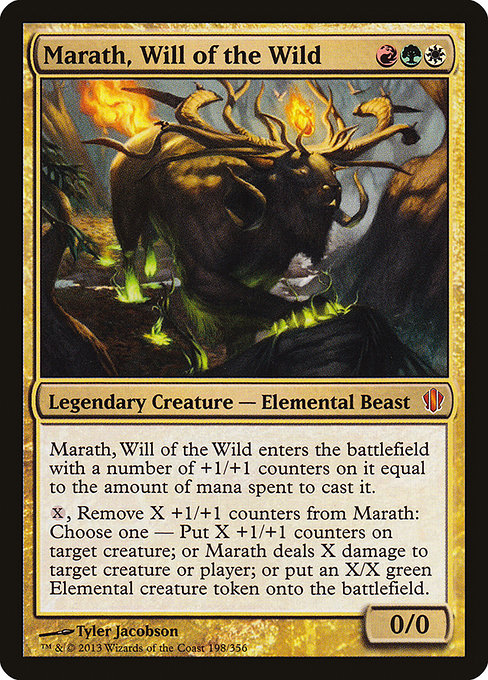
His text is a machine for spending mana. He arrives carrying a +1/+1 counter for every mana you paid, and then converts those counters back into damage, tokens or counters on something else, one generic mana at a time. Every line of him wants a big mana base underneath.
What he got was forty-two lands, five ramp spells, and one card that blows the whole thing up.
100 cards, 38 lands (17 basic), 20 creatures, average mana value 3.59. Mana sources: 18 white, 19 red, 24 green.
No Game Changers and no mass land denial, so it sets no bracket floor. How brackets work →
The stock Nature of the Beast decklist, and what it is worth →
What are the best Nature of the Beast upgrades?
The order I’d buy them, and none of them is expensive:
- Cutting From the Ashes: free, and the single biggest improvement on this list. It is in the box, it destroys twenty-five of your own lands, and it costs you nothing to leave in the binder.
- Kodama's Reach, Rampant Growth, Farseek, Explosive Vegetation: four ramp spells that fetch basics. They fix the acceleration and the colour shortage with the same cards, which is the whole trick to repairing a three-colour deck cheaply.
- Chromatic Lantern. Every land you control taps for any colour. In a deck where six lands make no coloured mana at all, this is the most direct answer available.
- Rootbound Crag, Sunpetal Grove, Clifftop Retreat, Battlefield Forge: four duals for $1.09 together, replacing four lands that entered tapped for nothing.
- Swords to Plowshares, Beast Within, Generous Gift, Chaos Warp. The box ships four pieces of spot removal across a hundred cards.
- Garruk's Uprising and Return of the Wildspeaker: two green cards that turn a board of oversized Beasts into cards in hand.
- Sakura-Tribe Elder, Arcane Signet, Solemn Simulacrum: the cheap, dull, correct additions every 2013 precon wants.
Eighteen cards leave to make room, and the list starts with the obvious one.
The box contains a spell that destroys twenty-five of its own lands
From the Ashes is a four-mana sorcery that destroys all nonbasic lands, then lets each player replace what they lost by searching out basics.
Twenty-five of this deck’s forty-two lands are nonbasic. That includes Command Tower, Jungle Shrine, every Guildgate, both Karoo bounce lands and Vivid Crag, which is to say every land in the deck that produces more than one colour. The seventeen survivors are eight Forests, five Mountains and four Plains.
Then look at the replacement clause, which is the part that decides it. You may search for basics, and the box contains seventeen. Some of them are already on the battlefield being destroyed. Meanwhile a two-colour opponent refills from a library with twenty of them.
It is, at roughly $3.67, one of the two most valuable cards in the box. It is also the first card I’d take out of it.
Forty-two lands and seventeen red sources
Marath costs one red, one green and one white. Here is what the box gives him to work with:
- Green has 22 sources, and a single green pip by turn two lands about 88% of the time.
- Red has 17. That’s 79.2%.
- White has 18, at 81%.
Those are single pips. Marath wants all three at once, on turn three, and the odds of that are worse than any of the numbers above.
Forty-two lands and this still happens because of what the lands are. Seventeen enter tapped. Six of them (Contested Cliffs, Homeward Path, Naya Panorama, Temple of the False God, Vitu-Ghazi and Evolving Wilds) produce no coloured mana when they tap. Naya Panorama and Evolving Wilds can at least fetch a basic, which is why they count toward all three colours above, but that basic arrives tapped. Nine more are mono-coloured cycling lands and Karoos that give you one colour a turn late.
Land count was never the issue. Forty-two lands is not the same thing as mana.
Marath is a mana sink with five ramp spells behind him
Count the acceleration in the stock list and you get five: Sol Ring, Cultivate, Sprouting Vines, Tempt with Discovery and Druidic Satchel. A Commander deck at this average mana value wants eight to twelve.
That gap matters more here than it would elsewhere, because Marath doesn’t just want to be cast. He wants mana left over afterwards. Every activation is {X} plus counters, and the counters came from the mana you spent casting him. A turn where you tap out for Marath and pass is a turn where he does nothing at all.
So the fix isn’t more lands. It’s ramp that goes and gets lands, which is the same card doing both jobs, and in green, that card is also the cheapest thing on the shelf.
What leaves, starting with the self-destruct button
From the Ashes first, for the reason above. Then three more cards that work against you:
- Witch Hunt. It deals four damage to you every upkeep, stops all life gain, and at end of turn hands itself to a random opponent. You pay five mana to start a clock on yourself.
- Mystic Barrier: five mana to change who can attack whom. It doesn’t affect the board and it makes you the player everyone negotiates with.
- Tower of Fortunes: eight mana per activation to draw four. In a deck that couldn’t reliably reach six.
Then the top of the curve, where seventeen cards cost six or more:
- Spawning Grounds (eight mana) and Naya Soulbeast (eight): the two most expensive cards in a deck already too slow.
- Archangel and Eternal Dragon: seven mana each, both double white, in a deck with eighteen white sources.
- Krosan Tusker: a seven-mana 6/5 nobody casts. Cycling it for three to draw a card and fetch a basic is the real mode, and the ramp coming in does that job at two.
- Magus of the Arena: six mana and double red for an ability that needs a whole extra turn.
And eight lands. Temple of the False God, Naya Panorama, Rupture Spire and Homeward Path make no coloured mana or tax you to fix that. New Benalia, Drifting Meadow, Secluded Steppe and Smoldering Crater each enter tapped for a single colour. Forty-two becomes thirty-eight, and the ones that enter tapped fall from seventeen to twelve.
Sixty percent Beasts, and six cards that notice
Fourteen of the twenty-three creatures are Beasts, which is enough for the type counter to call this a Beast deck. It’s worth knowing how little that means before you go buying more of them.
Six cards in the box mention the word. Krosan Warchief makes Beast spells cost one less and regenerates one. Ravenous Baloth sacrifices one for four life. Contested Cliffs fights with one. Rampaging Baloths, One Dozen Eyes and Spawning Grounds make them. That’s the entire payoff, and nothing in the deck names a creature type the way a real typal build does.
The swaps leave the ratio almost exactly where it was, at 60%. That’s not an accident of the list. It’s that the Beasts were never the problem. Getting to cast them was.
Ten dollars, and a dollar of it is the mana base
Eight of the eighteen adds are ramp or fixing, and that’s deliberate:
- Farseek ($0.49) is the one to understand. It searches for a Plains, Island, Swamp or Mountain, which here means a basic Plains or a basic Mountain, the exact two colours running short. Nature's Lore and Three Visits are better cards in a vacuum and worse ones here, because they fetch a Forest and green is the colour this deck already has.
- Kodama's Reach ($1.58), Rampant Growth ($0.29) and Explosive Vegetation ($0.28). Three more that turn a spell into land drops you missed.
- Chromatic Lantern ($1.00). The cleanest fix on the list. Every land taps for every colour, including the six that currently tap for none.
- Sakura-Tribe Elder ($0.30), Arcane Signet ($0.41) and Solemn Simulacrum ($0.27).
- Four duals: Rootbound Crag ($0.31), Sunpetal Grove ($0.32), Clifftop Retreat ($0.25), Battlefield Forge ($0.21). The first three come in untapped whenever you already have a matching basic, and with seventeen basics that’s most of the time.
The removal is four cards and $2.99 the lot: Swords to Plowshares ($1.16), Beast Within ($0.57), Generous Gift ($0.94) and Chaos Warp ($0.32). Beast Within earns a small extra smile in this deck, since the 3/3 it leaves behind is a Beast.
Two cards convert the board into cards: Garruk's Uprising ($0.45) draws whenever a creature with power four or greater arrives, which describes most of the deck, and gives everything trample, and Return of the Wildspeaker ($1.40) draws cards equal to the biggest non-Human power you control. Marath is an Elemental Beast, and so is nearly everything he makes.
Eighteen cards, $10.55 on 6 September 2026, counting each card at the cheapest paper printing it has. Four of them are lands and those four cost $1.09 together.
Three cards the cut list is wrong about
Contested Cliffs is a land that taps for colourless, which is exactly what I spent a section cutting lands for. It stays, because for two mana it makes one of your Beasts fight something an opponent controls, over and over. In a deck whose removal I’ve just called thin, that’s a repeatable answer sitting in the mana base, and the Beast requirement is met by fourteen creatures.
Mayael the Anima is the closest call on this page, and I’ll show my working rather than just keeping her. Activating costs six mana including all three colours, and the upgraded list holds seven creatures with power five or greater, so looking at the top five cards finds one roughly a third of the time. That is a real card when it hits and a wasted turn when it doesn’t. She stays because the hits are six- and seven-drops the deck otherwise struggles to cast, but if you add more fatties she gets better, and if you cut them she should go too.
Krosan Warchief is a 2/2 for three that most cut lists would flag as a small creature in a big deck. Its first line takes a mana off every Beast spell, which is twelve cards after the swaps, and its second regenerates one for two mana, a real answer to the Wrath of God this deck still runs.
After the swaps
The mana is the headline. Lands drop from forty-two to thirty-eight and the ones entering tapped from seventeen to twelve, while green sources go 22 to 24, red 17 to 19 and white holds at 18. Red’s single-pip odds by turn two move from 79.2% to 83.1%, green’s from about 88% to 90%.
Ramp goes from five to nine and spot removal from four to seven, which takes both from short to normal. Average mana value falls from 4.21 to 3.59, and the pile costing six or more from seventeen cards to eleven.
The sweepers all stay: Wrath of God, Savage Twister, Slice and Dice and Crater Hellion are in both lists.
Bracket floor is 1 before and after. There are no Game Changers in this box and none of these adds is one.
What the swaps don’t fix is double pips. Casting two red on turn four still sits at about 61%, and the honest answer is that four cards in the deck ask for it and none of them is worth rebuilding a mana base around. If one of them keeps stranding in your hand, it’s the card to cut, not the lands.
Check the mana on your own version
These figures come from resolving the shipped decklist card by card. If yours has changed, the Deck Mana Audit reports the same source counts and pip odds for whatever you paste in, and how many lands should I run? covers why forty-two was too many.
The upgraded decklist
The full hundred after the swaps. Hover any name to see the card.
“Load into the deck builder” opens this list in your account, pinned to the printings the box shipped, ready to edit or save. “Copy decklist” gives you plain text for Moxfield, Archidekt or Arena, with no account needed.
Commander 1
- Marath, Will of the Wild



Creatures 19
- Avenger of Zendikar
- Baloth Woodcrasher
- Crater Hellion
- Deadwood Treefolk
- Drumhunter
- Gahiji, Honored One
- Grazing Gladehart
- Krosan Warchief
- Mayael the Anima
- Mold Shambler
- Rakeclaw Gargantuan
- Rampaging Baloths
- Ravenous Baloth
- Sakura-Tribe Elder
- Solemn Simulacrum
- Spellbreaker Behemoth
- Spitebellows
- Terra Ravager
- Valley Rannet





Instants 10
- Beast Within
- Boros Charm
- Chaos Warp
- Generous Gift
- Naya Charm
- Return of the Wildspeaker
- Slice in Twain
- Sprouting Vines
- Street Spasm
- Swords to Plowshares

Sorceries 16
- Cultivate
- Explosive Vegetation
- Farseek
- Fiery Justice
- Fireball
- Harmonize
- Hull Breach
- Kodama's Reach
- One Dozen Eyes
- Rain of Thorns
- Rampant Growth
- Restore
- Savage Twister
- Slice and Dice
- Tempt with Discovery
- Wrath of God
Artifacts 7
- Arcane Signet
- Behemoth Sledge
- Chromatic Lantern
- Druidic Satchel
- Seer's Sundial
- Sol Ring
- Swiftfoot Boots
Enchantments 9
- Curse of Chaos
- Curse of Predation
- Curse of the Forsaken
- Darksteel Mutation
- Fires of Yavimaya
- Garruk's Uprising
- War Cadence
- Warstorm Surge
- Where Ancients Tread
Lands 38
- Battlefield Forge
- Boros Garrison
- Boros Guildgate
- Clifftop Retreat
- Command Tower
- Contested Cliffs
- Evolving Wilds
- 8× Forest
- Forgotten Cave
- Gruul Guildgate
- Jungle Shrine
- Khalni Garden
- Mosswort Bridge
- 5× Mountain
- Opal Palace
- 4× Plains
- Rootbound Crag
- Selesnya Guildgate
- Selesnya Sanctuary
- Slippery Karst
- Sunpetal Grove
- Tranquil Thicket
- Vitu-Ghazi, the City-Tree
- Vivid Crag
FAQ
Is 42 lands too many for this deck?
Yes, and the count is the smaller half of the problem. Seventeen of the 42 enter tapped and six make no coloured mana at all, so a deck needing red, green and white on turn three has 42 lands and only 17 red sources. This guide trims the count to 38 and spends the freed slots on ramp that searches out basics, which fixes the acceleration and the colours with the same cards.
How many +1/+1 counters does Marath enter with?
Exactly as many as the mana you spent casting him, so a first cast for three gives three counters. The useful consequence is that commander tax works in your favour here: the second cast costs five and hands you five counters, the third costs seven and gives seven. Marath is one of the few commanders who gets bigger every time an opponent kills him, which is worth remembering before you spend a counter you didn’t need to.
What do the eighteen adds cost?
About $10.55 on 6 September 2026, counting each card at the cheapest paper printing it has, which makes this the cheapest precon on the site to fix. Four of those cards are lands and they come to $1.09 between them. Nothing here is a money card, because the deck’s problems are that it does the wrong things rather than that it’s missing expensive ones.
Do the swaps change the bracket?
No. Nature of the Beast contains no Game Changers and this list adds none, so it floors at Bracket 1 before and after. What changes is consistency: the deck casts its commander on curve more often, has ramp behind him, and answers a threat when it needs to. That’s the kind of upgrade that keeps a precon playable at the table it was bought for.
Should I really cut From the Ashes?
Yes, and it’s the first card out. From the Ashes destroys every nonbasic land on the battlefield, and 25 of this deck’s 42 lands are nonbasic, including every dual, every tri-land and Command Tower. Each player then replaces what they lost with basics from their library, which is a trade you lose badly: the box holds only 17 basics, and your opponents’ mono-coloured decks refill fine. It’s also, at about $3.67, one of the two most valuable cards in the box.
Why add Farseek rather than another Forest-fetching spell?
Because of which colours it can find. Farseek searches for a Plains, Island, Swamp or Mountain, and in this deck that means a basic Plains or a basic Mountain, precisely the two colours running short at 18 and 17 sources. Nature's Lore and Three Visits are stronger cards in the abstract and worse ones here, because they fetch a Forest and green is the colour this box already produces reliably. Fixing a mana base means asking what a spell can actually find in the list you’re playing.
Does the Beast theme actually do anything?
Barely, and it’s worth knowing before you go buying more Beasts. Fourteen of the 23 creatures are Beasts, but only six cards in the whole box mention the word: Krosan Warchief makes Beast spells cost one less, Ravenous Baloth sacrifices one for four life, Contested Cliffs fights with one, and Rampaging Baloths, One Dozen Eyes and Spawning Grounds make them. Nothing names a creature type the way a typal deck normally does, so the type is closer to flavour than to a plan.