Vampiric Bloodlust precon upgrade guide
Eighteen of the box’s 37 lands enter tapped, and Edgar Markov starts paying out on turn one without ever leaving the command zone. Most of this upgrade is a mana base, and all of it costs $64.91.
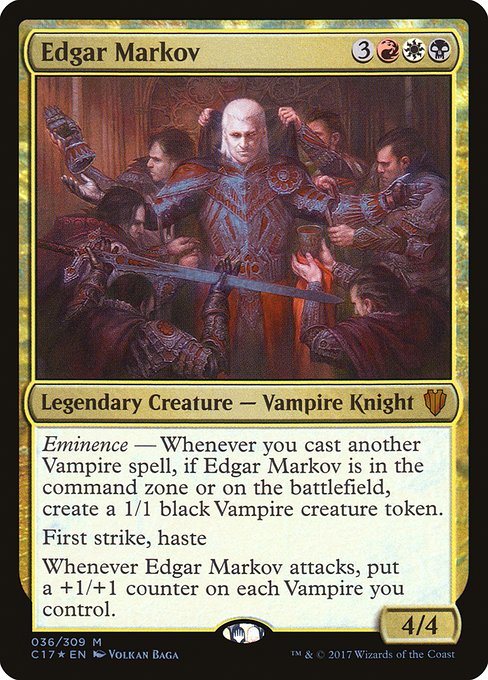
Eminence is easy to misread. Edgar Markov's first line works from the command zone: cast a Vampire, get a 1/1 black Vampire token, from the first turn of the game, with no six-mana commander sitting on the battlefield waiting to be answered. The engine runs long before its commander does, and what throttles it is mana. A turn you spend casting a two-mana Vampire is a token. A turn you spend playing a Guildgate is not, and the box ships three Guildgates, three bouncelands and twelve more lands that enter tapped.
100 cards, 37 lands (15 basic), 27 creatures, average mana value 3.37. Mana sources: 21 white, 31 black, 22 red.
Bracket floor 3 (Upgraded). How brackets work →
The stock Vampiric Bloodlust decklist, and what it is worth →
What are the best Vampiric Bloodlust upgrades?
Ordered by what each does for this list rather than by price. The seventeen cards they replace are argued in the cut list.
- Bloodline Keeper ($8.17). Taps for a 2/2 flying Vampire every turn, and once you control five Vampires it transforms into a lord that gives the rest of them +2/+2. Nothing in the box makes a Vampire without casting one first.
- Sorin, Imperious Bloodlord ($6.00). Three mana, and his −3 puts a Vampire creature card from your hand straight onto the battlefield. That skips the cast, so it skips the eminence trigger too. Take the free Butcher of Malakir anyway.
- Shared Animosity ($3.08). Every attacking creature gets +1/+0 for each other attacker sharing a type with it. Attack with five Vampires and each one is +4/+0, which is what a board of 1/1 tokens has been missing.
- City of Brass ($12.11). Any colour, untapped, every turn, for one damage a tap. The most expensive card here and the one that fixes the most.
- Legion Lieutenant ($0.34). A Vampire lord for two mana, so it is also a turn-two eminence trigger, which this deck is short of.
- Vault of Champions ($17.00). A plain untapped white-black dual at any table of three or more players, which is where this deck lives. It went in for white specifically.
- Champion of Dusk ($0.25). Draw a card for each Vampire you control, lose that much life. Cast it on an ordinary board and it is three or four cards for five mana.
- Phyrexian Arena ($4.50). A card a turn for three mana, in a deck the box shipped with seven draw effects against a normal eight to twelve.
- Luxury Suite ($9.16). The black-red half of the same multiplayer cycle, and black is where the demand is.
- Vampiric Rites ($0.11). The deck's only sacrifice outlet. With Blood Artist or Falkenrath Noble out, a board wipe stops being a disaster.
Arcane Signet ($0.60), Caves of Koilos ($0.73), Battlefield Forge ($0.46), Sulfurous Springs ($1.18), Dragonskull Summit ($0.46), Isolated Chapel ($0.37) and Tainted Field ($0.39) are the other seven. All seven are mana.
Seventeen of the 37 lands tap for mana the turn you play them
The box has 18 lands that always enter tapped and none that enter tapped conditionally. It is a binary mana base: either the land works this turn or it does not. Of the 19 that do enter untapped, two are Evolving Wilds and Terramorphic Expanse, which fetch a basic land tapped. So the real count of lands producing mana on the turn they arrive is 17: the fifteen basics, Command Tower and Opal Palace.
In a deck that wants to reach seven mana and cast one big thing, 20 slow lands out of 37 is a nuisance. Here it is the whole problem. Every Vampire you cast is a token, so a turn spent installing a tapped land is not a turn you developed more slowly. It is a token that never existed, on a board where Shared Animosity and Captivating Vampire later multiply the count.
The three bouncelands are the worst of them. Boros Garrison enters tapped and returns a land you control to your hand, so playing it on turn three leaves you with two lands, one of them tapped. Orzhov Basilica and Rakdos Carnarium do the same. The three Guildgates are at least honest about doing nothing except entering tapped, and Forsaken Sanctuary, Stone Quarry and Cinder Barrens are that same card with different art. Those nine leave.
What replaces them: three painlands that tap for either colour at the cost of one damage, four lands that read “enters tapped unless”, Tainted Field, which always enters untapped and taps for white or black so long as one of the eight Swamps is out, and City of Brass. After the swaps, nine lands always enter tapped instead of 18, four enter tapped only under a condition, and the conditions are ones this deck meets. Luxury Suite and Vault of Champions ask only that the table is bigger than two players. Dragonskull Summit wants a Swamp or a Mountain, and twelve of the fifteen basics are one of those. Isolated Chapel wants a Plains or a Swamp, which is eleven of them. Lands producing mana on arrival: 22, or 26 counting the conditional four honestly.
Eighteen cards want double black and two want double white
The box spreads its colour sources almost evenly: 28 black, 22 red, 20 white. Its demands are not even at all. Eighteen cards want two black pips by turn three, and 28 sources get you there 78.5% of the time against the 90% a deck should want. Four cards want two red by turn four. Two cards want two white by turn four.
That asymmetry is worth being precise about, because the red and white numbers look alarming on their own and mostly are not. The two cards asking for double white are Kindred Boon and Return to Dust. The four asking for double red are Bloodsworn Steward, Crimson Honor Guard, Disrupt Decorum and Kindred Charge, two of which are cuts. Double black is a different kind of list: Anowon, the Ruin Sage, Captivating Vampire, Malakir Bloodwitch, Vampire Nighthawk, Butcher of Malakir, Patron of the Vein and twelve more. It is the deck.
So the new lands lean black without abandoning the other two. Black goes from 28 sources to 31, and the double-black check from 78.5% to 83.9%. White moves 20 to 21, red stays at 22, and with Kindred Charge and Crimson Honor Guard gone, only two cards in the deck still want double red.
White at 21 sources is the number I am least happy with. Fourteen spells want a white pip, and 21 sources produce one by turn two 86.3% of the time. I left it there deliberately: the cheapest white card in the deck is Swords to Plowshares, an instant you are holding rather than casting on turn two, and the rest of the white sits at four and five mana. The card that would help it most is Marsh Flats at $31.35, which fetches a Plains or a Swamp and costs half again what this whole list costs. If white keeps letting you down, that is the next purchase. It is also the only card on this page I passed over for its price rather than for what it does.
Nine lands, the top of the curve, and one card that punishes eminence
The nine lands are the ones above: Boros Garrison, Orzhov Basilica, Rakdos Carnarium, Boros Guildgate, Orzhov Guildgate, Rakdos Guildgate, Forsaken Sanctuary, Stone Quarry and Cinder Barrens. Every one enters tapped and hands back nothing for the turn.
Four of the eight spells come off the top of the curve. The box runs six cards at six mana and one at eight, which is a lot for a deck whose plan starts on turn one. Licia, Sanguine Tribune costs eight before her life-gain discount and is the only eight-drop in the box. Blood Tribute halves one opponent's life for six mana and leaves the other two alone. Vein Drinker is a six-mana 4/4 that has to survive a turn before it fights anything. Kindred Charge is the one that hurts to lose, because copying a wide Vampire board for six mana does end games. It is also the card you cast when you are already winning, and Shared Animosity costs three and does that job from a worse position.
Crimson Honor Guard is the strangest thing in the box. At the beginning of each player's end step it deals 4 damage to that player unless they control a commander, and it means every player: your end step counts too. Edgar Markov's design encourages you to leave him in the command zone, casting Vampires and collecting tokens, because eminence does not care where he is and a full table does not need to see a six-mana 4/4 on turn six. Play that way with Crimson Honor Guard on the battlefield and you take 4 a turn from your own creature. The box put a card in this deck that charges rent on its own commander's best line.
Then three enchantments that need a second card to matter. Sanguine Bond costs five and does nothing until you gain life. Curse of Vitality and Curse of Disturbance are worse than doing nothing: both read "each opponent attacking that player does the same", so the 2 life and the 2/2 Zombies go to everyone who attacks the cursed player, not only to you. The Zombies are also Zombies, and not one card in this deck cares about those.
Two lords in 99 cards
Twenty-six creatures in the ninety-nine, plus Edgar Markov himself, and every one of them is a Vampire. Every anthem in the deck is therefore live on every creature it could be pointed at. The box shipped two: Captivating Vampire and Stromkirk Captain. Door of Destinies and Kindred Boon make three and four if you count the permanents that name a type on the way in, and after that the cupboard is bare.
That is what most of the spell budget buys. Legion Lieutenant is a lord for two mana. Bloodline Keeper is a lord on the back of a token maker, and it is the only card in the upgraded list that produces a Vampire without a cast, which matters when your hand is empty and Edgar is still in the zone. Sorin, Imperious Bloodlord is a three-mana planeswalker whose +1 hands a Vampire deathtouch, lifelink and a counter, and whose −3 cheats one out of your hand.
Shared Animosity pays off the tokens rather than the lords, and the difference is the point: a lord adds one power per Vampire, while Shared Animosity adds one power per Vampire per attacker. Six attackers is +5/+0 on each of the six.
The rest fills gaps the box left open. Draw was seven cards, below the eight to twelve a Commander deck normally wants. Phyrexian Arena, Champion of Dusk and Vampiric Rites take it to ten. Ramp was seven and Arcane Signet takes it to eight. Vampiric Rites does double duty: it is the deck's first repeatable sacrifice outlet, so a Merciless Eviction pointed at your board becomes a pile of cards, and every 1/1 token becomes a card once the attack is off.
Across all 17 swaps the average mana value drops from 3.68 to 3.37, the six-drops go from six cards to three, and the eight-drop is gone.
Two taplands stay, and so does the one-mana Equipment
Path of Ancestry enters tapped, which is what the last three sections have been complaining about, and it stays. It taps for any colour in the identity, and spending that mana on a Vampire scries 1. Edgar Markov is a Vampire Knight and every creature in the deck is a Vampire, so there is no practical sense in which that scry is conditional. Bojuka Bog stays for a related reason: a tapped land that exiles a graveyard on arrival is a removal spell attached to a land drop you were making anyway.
Skullclamp looks like a one-creature Equipment in a deck built to go wide, and it is the second-best card in the box after Sol Ring. Eminence makes 1/1s. Skullclamp gives +1/-1. One mana, equip, the token dies, draw two, and again next turn. Blade of the Bloodchief answers the same objection differently: it counts every creature that dies anywhere at the table, and it adds two counters rather than one whenever the equipped creature is a Vampire, which here is always.
Anowon, the Ruin Sage is a five-mana 4/3 with no evasion, which is the profile of a card that gets cut. Read it again: at the beginning of your upkeep, each player sacrifices a non-Vampire creature. Every creature you control is a Vampire, so you sacrifice nothing and everyone else does. It is a repeating one-sided edict, and it is the best reason to hold the deck's Vampire rate at 100% instead of adding the strongest three-mana creature in Mardu regardless of its type.
The upgraded decklist
Ninety-nine cards and Edgar Markov, with all 17 swaps applied. Hover any card name to see the card.
“Load into the deck builder” opens this list in your account, pinned to the printings the box shipped, ready to edit or save. “Copy decklist” gives you plain text for Moxfield, Archidekt or Arena, with no account needed.
Commander 1
- Edgar Markov




Creatures 26
- Anowon, the Ruin Sage
- Blood Artist
- Blood Baron of Vizkopa
- Bloodhusk Ritualist
- Bloodline Keeper // Lord of Lineage
- Bloodline Necromancer
- Bloodlord of Vaasgoth
- Bloodsworn Steward
- Butcher of Malakir
- Captivating Vampire
- Champion of Dusk
- Dark Impostor
- Drana, Kalastria Bloodchief
- Falkenrath Noble
- Kheru Mind-Eater
- Legion Lieutenant
- Malakir Bloodwitch
- Mathas, Fiend Seeker
- Patron of the Vein
- Pawn of Ulamog
- Rakish Heir
- Sangromancer
- Skeletal Vampire
- Stromkirk Captain
- Tithe Drinker
- Vampire Nighthawk




Planeswalkers 1
- Sorin, Imperious Bloodlord
Instants 7
- Crackling Doom
- Go for the Throat
- Mortify
- Return to Dust
- Skeletal Scrying
- Swords to Plowshares
- Teferi's Protection

Sorceries 9
- Ambition's Cost
- Consuming Vapors
- Damnable Pact
- Disrupt Decorum
- Fell the Mighty
- Merciless Eviction
- New Blood
- Read the Bones
- Syphon Mind
Artifacts 11
- Arcane Signet
- Blade of the Bloodchief
- Boros Signet
- Door of Destinies
- Heirloom Blade
- Orzhov Signet
- Rakdos Signet
- Skullclamp
- Sol Ring
- Well of Lost Dreams
- Worn Powerstone
Enchantments 8
- Black Market
- Blind Obedience
- Kindred Boon
- Outpost Siege
- Phyrexian Arena
- Shared Animosity
- Underworld Connections
- Vampiric Rites
Lands 37
- Akoum Refuge
- Battlefield Forge
- Bloodfell Caves
- Bojuka Bog
- Caves of Koilos
- City of Brass
- Command Tower
- Dragonskull Summit
- Evolving Wilds
- Isolated Chapel
- Kabira Crossroads
- Luxury Suite
- 4× Mountain
- Nomad Outpost
- Opal Palace
- Path of Ancestry
- 3× Plains
- Scoured Barrens
- Sulfurous Springs
- 8× Swamp
- Tainted Field
- Terramorphic Expanse
- Urborg Volcano
- Vault of Champions
- Wind-Scarred Crag
FAQ
Do the Vampire tokens still appear if Edgar Markov never leaves the command zone?
Yes. Eminence checks whether Edgar Markov is in the command zone or on the battlefield, so casting any other Vampire spell creates a 1/1 black Vampire token either way. You never have to pay his six mana to run the engine. Casting him adds first strike, haste, and the attack trigger that puts a +1/+1 counter on each Vampire you control.
What bracket does the upgraded Vampiric Bloodlust list sit in?
Bracket 3, the same floor as the box, and for the same single reason: Teferi's Protection is on the Game Changers list and Bracket 2 allows none of them. None of the 17 adds is a Game Changer, so cutting Teferi's Protection is the only change that would move this list to Bracket 2. The bracket checker will say the same thing about your own version of it.
Which creature type should Door of Destinies and Kindred Boon name?
Vampire, and in this deck the choice costs nothing at all: every creature in the deck is a Vampire, the commander is a Vampire Knight, and the eminence tokens are Vampires too. One rules note on Door of Destinies. It gains a charge counter only when you cast a spell of the named type, so the tokens take the bonus without ever adding to it.
Is Edgar Markov too strong for a table of unmodified precons?
Probably, and the bracket number is not what tells you. The upgraded list starts producing Vampire tokens on turn two whether or not the commander is ever cast, which is a clock most out-of-the-box decks are not built to race. If that is the table you play at, leave Shared Animosity and Bloodline Keeper out. They are the two adds that turn a wide board into a lethal one.
What does this upgrade cost, and what is the cheapest useful slice of it?
All 17 adds come to $64.91 at market for default printings, priced in September 2026. Nine lands account for $41.86 of that and the eight spells for $23.05. The cheapest useful slice is $4.89: Legion Lieutenant, Champion of Dusk, Arcane Signet and Vampiric Rites cost $1.30 between them, and the six budget lands cost $3.59. That is ten of the seventeen cards for under five dollars.
Why cut Kindred Charge from a deck built to go this wide?
Because it costs six mana and only works once you already have the board it doubles. Shared Animosity costs three, stays on the battlefield, and pumps every attack rather than one. Kindred Charge is also one of the two remaining cards demanding double red on turn four, a requirement this mana base struggles with, so cutting it fixes two problems with one slot.