Wade into Battle precon upgrade guide
Fourteen of this box’s thirty-one creatures are Giants, six are Angels, and every card that reduces a cost or grants a bonus names the Giants. Fifteen swaps pick the side the box was already leaning on.
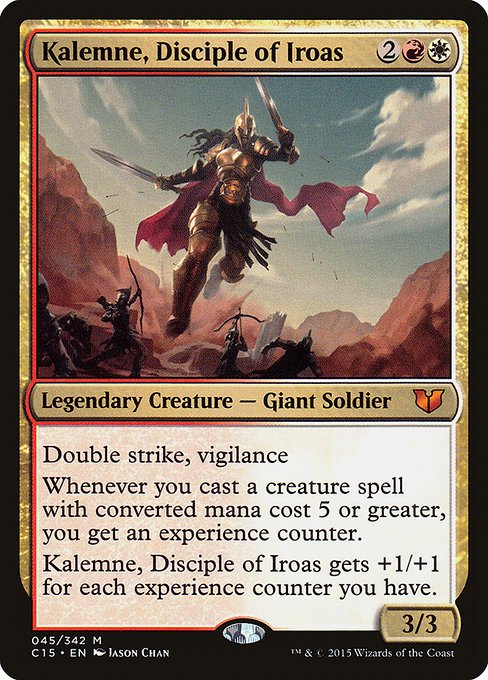
Commander 2015 is the experience-counter set, and Kalemne is its combat one: cast a creature costing five or more, get a counter, and she grows permanently. The box takes that instruction seriously. Twenty-three of its thirty-one creature spells cost five or more, which is more commitment than most precons manage to a commander’s actual text.
The trouble is what that commitment costs. Twenty cards in the stock list cost six or more mana, the average mana value is 4.27, and the deck draws five extra cards across the whole ninety-nine. It plays like a hand of expensive spells you cannot cast and cannot replace.
Everything below is about closing that gap, and almost all of it is free.
100 cards, 39 lands (25 basic), 24 creatures, average mana value 3.82. Mana sources: 27 white, 30 red.
No Game Changers and no mass land denial, so it sets no bracket floor. How brackets work →
What are the best Wade into Battle upgrades?
Ranked by how much they change the games you actually play:
- Herald's Horn, Vanquisher's Banner, Icon of Ancestry: three artifacts that each name a creature type. They answer the deck’s two shortages at the same time: the Giants get cheaper and you draw off casting them.
- Sacred Foundry and Battlefield Forge: two untapped duals for a deck that wants double red on turn three. They’re also $10 of the $24, which is most of this list’s cost.
- Endless Atlas: fourteen Mountains and eleven Plains means its condition is met from about turn three onwards, forever.
- Realm-Cloaked Giant: a seven-mana Giant whose adventure half destroys every non-Giant creature on the board. It only reads as one-sided once you’ve committed to the type, which is what the rest of this list is doing.
- Swords to Plowshares, Generous Gift, Chaos Warp: the box ships four pieces of spot removal and two of those only answer artifacts and enchantments.
- Mind's Eye, Hedron Archive, Outpost Siege: three more ways to turn mana into cards in a deck that runs out of them.
- Arcane Signet and Solemn Simulacrum: straight replacements for the two worst mana rocks in the box.
Fifteen cards leave. The list is below.
Fourteen Giants, six Angels, and every payoff names the Giants
Sort the stock creatures by type and the box splits in half. Fourteen Giants, six Angels, and eleven other things. The type counter puts Giants at 48% of the creature base, which is one card short of the line where a deck stops being a pile of good creatures and starts being a typal deck.
Now look at what the box does with that. Urza's Incubator, at $23.42 the most valuable card in the deck, takes two mana off creature spells of a type you name. Stinkdrinker Daredevil takes two off Giant spells specifically. Sunrise Sovereign gives other Giants +2/+2 and trample. And Ancient Amphitheater, a land, enters untapped only if you reveal a Giant from your hand.
Four cards, all pointed at one type. The six Angels get nothing from any of them, and two of them are among the hardest cards in the deck to cast.
So the swaps pick the side the box was already leaning on. Giants go from 48% of the creature base to 58%, which crosses the threshold and makes the type the deck’s actual plan rather than its largest coincidence.
Kalemne counts to five, and twenty-three creatures oblige
Her trigger is narrow and specific: a creature spell with mana value five or greater, cast, gets you an experience counter. Not a creature entering, not a token, not something reanimated.
Twenty-three of the box’s thirty-one creatures clear that bar. Only seven don’t. Oreskos Explorer, Magus of the Wheel, Stinkdrinker Daredevil, Taurean Mauler, Dawnglare Invoker, Desolation Giant and Fumiko the Lowblood, and most of those are doing a support job rather than trying to be a threat.
That is a deck built correctly around its commander, and it is also why it stalls. Eleven cards cost six, nine cost seven, and there are five ways in the entire deck to draw an extra card. The curve is the plan, so the fix can’t be to flatten it. It has to be to pay for it.
Five of the eight double-white cards are Angels
Twenty-seven white sources want a double-white cast by turn five, and eight spells in the box ask for one. That lands at about 86%, which is under where you want it and not obviously fixable: the deck is already thirty-nine lands and twenty-five of them are basics.
But read the eight names. Angel of Serenity, Dawnbreak Reclaimer, Gisela, Herald of the Host and Victory's Herald are Angels. Jareth, Kalemne's Captain and Sun Titan are the rest.
Cutting four of those Angels drops the double-white demand from eight spells to five without touching the mana base at all. Two new duals come in for two tapped ones, so the source count holds at 27 and the demand side is doing all of the work here. It’s the side people forget they can change.
The fifteen that come out
Four Angels first, for the reason above:
- Angel of Serenity: seven mana, three of them white. The best card in the box and the wrong one for this deck.
- Victory's Herald: six mana, also triple white.
- Dawnbreak Reclaimer: it returns a creature from an opponent’s graveyard as well as yours, every turn. You are not looking for a fair trade at six mana.
- Herald of the Host: a 4/4 flier with myriad for five, and double white on top. The deck already has Blade of Selves for the myriad plan, on a body that chooses its target.
Then the non-Giant top end, where the deck is thickest:
- Sandstone Oracle: seven mana to catch up to one chosen opponent’s hand size, which pays nothing when the player you pick has also been casting their spells.
- Dream Pillager: seven mana, and it needs to connect before it does anything.
- Hostility: a 6/6 haste for three generic and three red, in a deck that’s already six sources short of casting its double-red cards on time.
Two of the cuts are Giants, which is awkward given everything above, and they earn it:
- Arbiter of Knollridge: it sets every life total to the highest. You spend seven mana handing life to whichever opponent is closest to dying.
- Magma Giant: two damage to each creature and each player, you included, on a body that cost seven.
And four pieces of support that were never quite doing a job:
- Curse of the Nightly Hunt: three mana to make one opponent’s creature attack someone.
- Orim's Thunder: it only ever answers an artifact or an enchantment.
- Boros Cluestone: three mana for one, when Arcane Signet does it for two.
- Dreamstone Hedron: six mana to start ramping is a turn you don’t have.
Plus Boros Guildgate and Wind-Scarred Crag, two lands that enter tapped and give you nothing for it.
Three artifacts that fix the cost and the draw at once
The interesting part of this list is that its best cards aren’t the most powerful ones. They’re the ones doing two jobs.
- Herald's Horn ($2.27): Giant spells cost one less, and each upkeep you look at the top card and take it free if it’s a Giant. Cheaper Giants and more Giants, on one three-mana artifact.
- Vanquisher's Banner ($5.20): every Giant you cast draws a card. In a deck where casting one big creature a turn is the game plan, this turns the plan into card advantage.
- Icon of Ancestry ($0.37): an anthem, and a mana sink that digs three deep for a Giant on the turns you have nothing to cast.
Then the plain card draw, because three typal artifacts don’t make a deck:
- Endless Atlas ($1.99): needs three lands sharing a name. The box runs fourteen Mountains and eleven Plains, so it’s live from about turn three and never stops.
- Mind's Eye ($0.43) and Hedron Archive ($0.27): one draws off everyone else’s turns, the other ramps you to your seven-drops and then cashes itself in for two cards.
- Outpost Siege ($0.25): name Khans and take a card off the top every upkeep.
The removal is unglamorous and overdue: Swords to Plowshares ($1.16), Generous Gift ($0.94) and Chaos Warp ($0.32). Four pieces of spot removal in a hundred cards is thin anywhere, and two of the box’s four only answer artifacts and enchantments.
Realm-Cloaked Giant ($0.27) is the one I’d point at. Seven mana for a 7/7 Giant, and its adventure half, Cast Off, destroys every non-Giant creature on the battlefield for five. In the stock list that would kill fifteen of your own creatures. After these swaps it kills nine, and one of those nine is Taurean Mauler, which is a changeling and therefore a Giant, so it survives too.
The rest is housekeeping: Arcane Signet ($0.41), Solemn Simulacrum ($0.27), Sacred Foundry ($9.76) and Battlefield Forge ($0.21).
Fifteen cards, $24.12 taking the cheapest paper printing of every card, priced on 6 September 2026, and $9.76 of that is the Sacred Foundry. Eight of the fifteen cost under a dollar.
Name Giant, and know what you’re leaving out
After the swaps, four cards make you choose a creature type: Urza's Incubator, Herald's Horn, Vanquisher's Banner and Icon of Ancestry. Name Giant on all four. Nothing else is close. The runner-up is Warrior at five.
What that leaves out, precisely: Gisela and Anya are Angels, Solemn Simulacrum is a Golem, Oreskos Explorer is a Cat, Magus of the Wheel and Dawnglare Invoker are Wizards, Fumiko is a Samurai, Hunted Dragon is a Dragon, and Stinkdrinker Daredevil is a Goblin whose entire text is about making Giants cheaper. Nine cards, none of which you were casting for a discount anyway.
Taurean Mauler is the exception worth knowing. It’s a Shapeshifter with changeling, so it’s every creature type at once, and the type counter files it under Shapeshifter, but all four artifacts see a Giant.
Why Gisela and the two-drops stay
Gisela, Blade of Goldnight is an Angel costing seven with two white pips, which is everything I just spent a section cutting. She stays because of what she does with the commander: Kalemne has double strike, Gisela doubles the damage your creatures deal, and those two multiply rather than add. Kalemne is a 3/3, so four experience counters make her a 7/7 hitting for 14 across two strikes, and 28 with Gisela out.
Taurean Mauler costs three and never triggers Kalemne. It also grows every time an opponent casts anything, which in a four-player game is the cheapest large creature in the deck, and it counts as a Giant for all four type-naming artifacts.
Stinkdrinker Daredevil and Oreskos Explorer are two- and three-drops in a deck whose average is nearly four. Both are doing work the expensive cards can’t: one makes every Giant cost two less, the other fetches Plains in a deck where white is the tighter colour.
Blade of Selves looks like a single-creature attachment in a deck full of creatures, which is fair as a general rule and wrong here. Equipping myriad onto a Kalemne with four counters attacks each opponent with a token copy, and every copy is a 7/7 with double strike.
Where the deck ends up
Giants go from 48% of the creature base to 58%, which is the difference between a deck with Giants in it and a Giant deck. Creature count drops from 31 to 24 and average mana value from 4.27 to 3.82. The pile of cards costing six or more falls from twenty to twelve.
Card draw goes from five to eight and spot removal from four to five, which moves both off the “low” end of where a Commander deck should sit. Ramp was already fine at eleven and is now twelve.
Lands stay at thirty-nine, with the ones entering tapped down from nine to seven.
The colour maths improves for both colours without a real mana investment, and all of it comes from demand. The source counts hold, so double red by turn three stays at 82.2% while the spells demanding it drop from sixteen to thirteen, and double white by turn five stays at 86.1% with the demand down from eight spells to five.
Bracket floor is 1 before and after. There are no Game Changers in this box and none of these adds is one.
One number the swaps don’t rescue: at eight, card draw is at the bottom of the normal band rather than comfortably inside it. Three of the adds (Herald's Horn, Icon of Ancestry and Outpost Siege) put cards in your hand in ways a role counter doesn’t recognise, so the real figure is better than eight. If you want it higher on paper, Tome of Legends is another 28 cents.
Run these numbers on your own list
Changed the deck already? The Deck Mana Audit reports the same double-pip figures for whatever you paste in, and the bracket checker tells you which bracket your version can honestly claim.
The upgraded decklist
All hundred cards after the swaps. Hover a name to see the card.
“Load into the deck builder” opens this list in your account, pinned to the printings the box shipped, ready to edit or save. “Copy decklist” gives you plain text for Moxfield, Archidekt or Arena, with no account needed.
Commander 1
- Kalemne, Disciple of Iroas



Creatures 23
- Anya, Merciless Angel
- Borderland Behemoth
- Dawnglare Invoker
- Desolation Giant
- Fumiko the Lowblood
- Gisela, Blade of Goldnight
- Hamletback Goliath
- Hammerfist Giant
- Hunted Dragon
- Inferno Titan
- Jareth, Leonine Titan
- Kalemne's Captain
- Magus of the Wheel
- Oreskos Explorer
- Realm-Cloaked Giant // Cast Off
- Solemn Simulacrum
- Stinkdrinker Daredevil
- Stoneshock Giant
- Sun Titan
- Sunrise Sovereign
- Taurean Mauler
- Thundercloud Shaman
- Warchief Giant





Instants 5
- Chaos Warp
- Crib Swap
- Fall of the Hammer
- Generous Gift
- Swords to Plowshares
Sorceries 5
- Breath of Darigaaz
- Disaster Radius
- Earthquake
- Fiery Confluence
- Meteor Blast

Artifacts 22
- Arcane Signet
- Basalt Monolith
- Blade of Selves
- Boros Signet
- Coldsteel Heart
- Darksteel Ingot
- Endless Atlas
- Fellwar Stone
- Hedron Archive
- Herald's Horn
- Icon of Ancestry
- Lightning Greaves
- Loxodon Warhammer
- Mind Stone
- Mind's Eye
- Seer's Sundial
- Sol Ring
- Staff of Nin
- Thought Vessel
- Urza's Incubator
- Vanquisher's Banner
- Worn Powerstone
Enchantments 5
- Banishing Light
- Faith's Fetters
- Outpost Siege
- Rite of the Raging Storm
- Warstorm Surge
Lands 39
- Ancient Amphitheater
- Battlefield Forge
- Blasted Landscape
- Boros Garrison
- Command Tower
- Drifting Meadow
- Evolving Wilds
- Forgotten Cave
- 14× Mountain
- 11× Plains
- Sacred Foundry
- Secluded Steppe
- Smoldering Crater
- Terramorphic Expanse
- Vivid Crag
- Vivid Meadow
FAQ
Should I buy the Commander Anthology II version instead?
It’s the same ninety-nine cards. Commander Anthology Volume II reprinted Wade into Battle whole in 2018, and comparing the two decklists card for card and quantity for quantity turns up no difference at all, only different printings, different art treatments and a different price. Buy whichever sealed copy is cheaper on the day. The swaps on this page apply identically to both.
Do Kalemne’s experience counters disappear when she dies?
No. Experience counters sit on you, the player, not on the creature. Kalemne can be killed, exiled or tucked and every counter you’ve earned stays. Recast her and she comes back exactly as big as she was, plus whatever you’ve gained since. That’s what makes her worth committing to in a deck this slow. The commander tax is the only thing punishing you for replaying her.
Why cut Angel of Serenity when it’s the strongest card in the box?
Because of what it costs to cast rather than what it does. Four generic and three white, in a deck holding twenty-seven white sources, is a card you hold in hand. It’s also the clearest example of the split this guide is trying to close: an Angel in a deck whose cost reducers, whose lord and whose land all say Giant. In a deck built around Angels it would be the last card cut.
What do the fifteen adds cost altogether?
About $24.12 taking the cheapest paper printing of every card, priced on 6 September 2026, and $9.76 of that is a single Sacred Foundry. The other fourteen come to $14.36 between them, eight of them under a dollar. This is a cheap deck to improve because its problems are structural rather than expensive: it needs cards that draw and cards that cost less, not a better rare.
Do these swaps push the deck out of Bracket 1?
No. The stock deck runs no Game Changers and neither does the upgraded one, so the floor stays at Bracket 1 in both directions. Nothing added here is a tutor chain, a fast mana rock or a two-card combo. The list gets more consistent at what it already did rather than faster, which is the point of upgrading a precon you intend to keep playing at the same table.
Is Urza's Incubator worth keeping at twenty-three dollars?
Yes, and it’s the single most valuable card in the box at $23.42. It takes two generic mana off every Giant spell you cast, which in a deck whose Giants average well over five mana is close to a free ramp spell every turn. If you’re building this from singles rather than from the sealed deck, though, it’s the one card where Herald's Horn at about $2.27 does most of the same job for a tenth of the money.
Which creature type should I name on Urza's Incubator?
Giant, and after these swaps you’re naming it four times. Urza's Incubator, Herald's Horn, Vanquisher's Banner and Icon of Ancestry all ask. Naming Giant leaves out nine creatures in the upgraded list: two Angels, Solemn Simulacrum, Oreskos Explorer, Magus of the Wheel, Dawnglare Invoker, Fumiko the Lowblood, Hunted Dragon and, with some irony, Stinkdrinker Daredevil, a Goblin whose only job is making Giants cheaper. Taurean Mauler is a changeling, so it counts as a Giant for all four.