Deadly Disguise precon upgrade guide
The average morph in this box costs 4.29 mana to turn face up. Kaust does it for nothing, once per combat, and only to a creature that is already attacking.
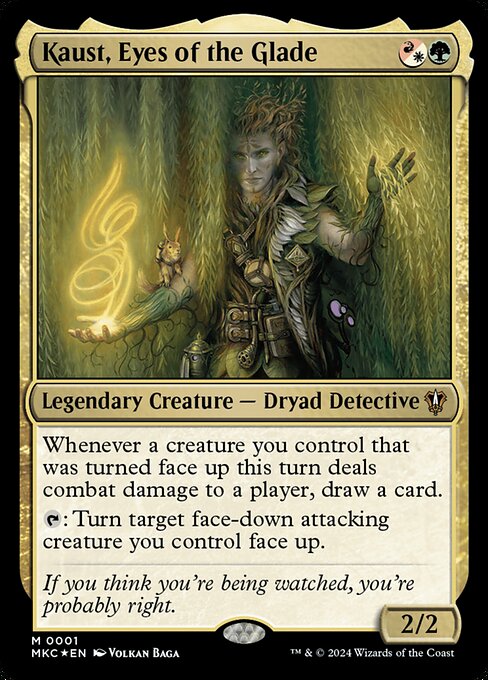
Murders at Karlov Manor's Naya deck runs on one of the oldest tricks in the game. You pay  , put a creature onto the battlefield face down as a 2/2, and pay a second cost later to reveal what it really is. Kaust, Eyes of the Glade sits on top of that as a two-mana engine. Tap her to flip an attacking creature for nothing, and anything you flipped that turn draws you a card when it connects with a player.
The engine is real. What the box is short of is throughput. Kaust taps once a turn, so she pays for one flip a turn, and every other card in the deck gets turned over at full price.
100 cards, 37 lands (11 basic), 35 creatures, average mana value 3.48. Mana sources: 23 white, 24 red, 24 green.
Bracket floor 3 (Upgraded). How brackets work →
What are the best Deadly Disguise upgrades?
In the order I would buy them. Prices are TCGplayer market for the default printing, read in September 2026.
- Hauntwoods Shrieker, $1.16.

 , repeatable, turns any face-down creature you control face up regardless of what its printed flip cost says. It is the single card that fixes this deck.
 - Yarus, Roar of the Old Gods, $0.25. Draws on the combats where you do not flip, gives Kaust haste so she can tap the turn she lands, and turns a face-down creature over for free when it dies.
- Iroas, God of Victory, $12.05. Kaust's draw needs combat damage to a player. Menace across the board and no damage to your attackers is how a pile of 2/2s gets there.
- Expose the Culprit, $0.19. A second free flip, at instant speed, for two mana.
- Overgrown Zealot, $0.27. Taps for two mana of one colour if that mana is turning something face up.
- Four untapped lands, $3.33 for the set. Rugged Prairie, Battlefield Forge, Karplusan Forest and Brushland. The deck asks for mana on the turn after it deploys, which is the worst possible schedule for a tapland.
The full swap list is further down, and the finished decklist is at the bottom of the page.
Every creature in this deck gets bought twice
Twenty-four of the ninety-nine can be played face down for . Most are morph, megamorph or disguise creatures, but the count also includes an enchantment (True Identity) and two lands (Zoetic Cavern and Branch of Vitu-Ghazi). Eight more cards put a card onto the battlefield face down rather than being cast that way, through cloak or manifest: Unexplained Absence, Veiled Ascension, Ransom Note, Ugin's Mastery, Mastery of the Unseen, Temur War Shaman, Whisperwood Elemental and Scroll of Fate.
Twenty-two cards in the box, Kaust included, do something when a permanent is turned face up. That is a lot of payoff, and it is why the deck feels like it ought to be a machine.
Here is the bill. Those twenty-four flip costs add up to 103 mana, an average of 4.29 each. Twelve of them cost five or more. Only seven cost two or less.
So the honest price of a morph is on the turn you deploy it and 4.29 more, on average, on some later turn. Call it seven mana for one creature, split across two turns, in a deck whose average mana value is already 3.84.
Kaust makes one of those payments disappear each combat. She is not the only card in Naya that can do it, but the list is short. Across the whole green, red and white colour identity there are exactly seven cards that turn a face-down creature you control face up without charging you its flip cost:
- Kaust, Eyes of the Glade (in the box, in the command zone)
- Ugin's Mastery (in the box, and only when you attack with six or more total power)
- Showstopping Surprise (in the box, at five mana)
- Hauntwoods Shrieker
- Expose the Culprit
- Skirk Alarmist
- Yarus, Roar of the Old Gods
The box ships three of the seven and leaves four on the table. Three of those four cost under fifty cents. That is the whole thesis of this upgrade. The deck does not need more things to hide, it needs more ways to turn them over.
One timing note, because it is the deck's best line and it is easy to miss. Kaust's ability targets an attacking creature, so you can use it after blockers are declared. Attack with a face-down 2/2, let an opponent block it as a 2/2 or wave it through, and only then decide what it becomes. Sidar Kondo of Jamuraa, already in the box, means ground creatures cannot block a face-down creature at all, because its power is 2.
The thirteen cards I would buy
Five of these are flips, two are about getting damage through to a player, four are lands, and two are extra bodies. The whole list is $23.86.
Flips
Hauntwoods Shrieker ($1.16) is the card that retroactively fixes the top of the curve. to reveal a face-down permanent and turn it face up, as often as you can pay, and the printed morph cost never enters into it. Krosan Colossus goes from a nine-mana card that also costs eight to flip, to a 9/9 you deployed for and switched on for . The Shrieker also manifests dread every time it attacks, which is another body and another Kaust target.
Yarus, Roar of the Old Gods ($0.25) covers the combats Kaust cannot. Kaust draws when a creature you turned face up this turn connects. Yarus draws when a creature that is still face down connects. Between them every attacking 2/2 is drawing you a card whichever way you play it. He also hands out haste, which matters more than it looks, because Kaust has a tap ability and without haste she does nothing the turn she arrives.
Expose the Culprit ($0.19) is two mana at instant speed for a free flip, and the second mode re-cloaks your face-up disguise creatures so you can charge their flip triggers again.
Overgrown Zealot ($0.27) taps for one mana of any colour, or two of a single colour if that mana is being spent turning permanents face up. In a deck with eight remaining flip costs of five or more, the restricted mode is the one you want most nights.
Lightning Greaves ($4.71) is here for one creature. Kaust is a two-drop the whole plan runs through, she has to tap to do her job, and she has to survive a rotation to do it twice. Haste and shroud for  , with an equip cost of
  , answers both halves.
Getting there
Iroas, God of Victory ($12.05) is the most expensive card on this list and I think it earns it. Kaust's draw trigger does not fire on a blocked creature, it fires on combat damage to a player. Iroas gives everything you control menace and prevents all damage dealt to your attackers, so a board of face-down 2/2s can attack into anything and either get through or come home. It is also indestructible and usually not a creature, which means the three wipes this deck already runs leave it alone.
Swords to Plowshares ($1.31) is one mana to answer the thing that beats you.
Bodies
Hide in Plain Sight ($0.28) looks at five cards and puts two of them onto the battlefield face down with ward . Two Kaust targets and a look at your top five, for four mana.
Valgavoth's Onslaught ($0.31) scales. At X=3 it is seven mana for three 5/5s, and every one of them is a face-down creature.
Lands
Rugged Prairie ($0.62), Battlefield Forge ($0.46), Karplusan Forest ($0.50) and Brushland ($1.75). Four lands that make coloured mana the turn they arrive, for $3.33 all in.
Where the thirteen slots come from
Six of the box's twenty-four face-down cards have no ability at all when they turn over. They are just a body arriving late: Exalted Angel, Akroma, Angel of Fury, Krosan Cloudscraper, Krosan Colossus, Broodhatch Nantuko and Zoetic Cavern. That on its own is not a cut. Exalted Angel flips into a 4/5 flying lifelinker for four, which is fine, and I am keeping Krosan Colossus for a reason I will come to.
It becomes a cut when the flip is also expensive, because then Kaust's one free flip a turn is being spent on nothing.
Krosan Cloudscraper is the worst card in the box. Ten mana to cast, nine to flip, no ability when it turns over, and it sacrifices itself every upkeep unless you pay .
Akroma, Angel of Fury costs six to flip and does nothing when it happens.
Imperial Hellkite costs eight to flip, and what you get is a search for a Dragon card. The deck contains exactly one other Dragon, Scourge of the Throne, and that one costs six.
Root Elemental is seven to flip. Its trigger puts a creature from your hand onto the battlefield, which is real value, but it puts it there face up, in the deck that wants creatures face down.
Broodhatch Nantuko makes Insect tokens when it is dealt damage, which asks to be blocked, in a deck that is trying to connect.
Neheb, the Eternal is a good card with nothing to do with anything else in the box.
Yedora, Grave Gardener returns your dead creatures face down as Forests. They are lands, not creatures, so Kaust cannot target them and they never attack.
Wild Growth and Ransom Note are both fine cards that are slower than the lands and the two-mana flip outlets taking their slots.
Four lands go too. Temple of the False God makes no mana until you have five lands and never makes a colour. Shrine of the Forsaken Gods wants six. Mosswort Bridge and Krosan Verge both always enter tapped, and Krosan Verge's reward for the lost turn is two more tapped lands.
The five-mana instant that stays
Showstopping Surprise looks like an easy cut. It is a five-mana instant in a deck already leaning heavy, it draws no cards and it protects nothing. It is also one of the seven cards in Naya that turns a morph face up for free, and it is the only one that can end a game on the spot. Flip Krosan Colossus with it and the 9/9 deals nine damage to every other creature on the board.
Which is why Krosan Colossus stays as well. On its own it is an eight-mana flip with no trigger, and the argument against it holds right up until Hauntwoods Shrieker joins the deck. After that it is to deploy and to turn into a 9/9, and it is the biggest number Showstopping Surprise can point at.
Seedborn Muse stays for a reason specific to this deck rather than general goodness. Morph and disguise creatures can be turned face up any time you have priority, including on somebody else's turn, so untapping your lands every turn means you can hold up Hidden Dragonslayer or Ainok Survivalist as an instant-speed answer and flip it when it matters.
Nantuko Vigilante, Hidden Dragonslayer and Ainok Survivalist all read as conditional removal, and they are. They are also flips that cost ,  and , which puts all three in the cheapest quarter of the deck's flip costs. Cheap flips with a trigger attached are the thing this deck has least of.
Ten tapped lands is still more than I want
The box ships 37 lands, of which 12 always enter tapped and five more enter tapped unless a condition is met. Swapping four of the worst offenders for four painlands moves that to 22 untapped and 10 always tapped.
The colour numbers move further than the land count suggests. On the play, at the 90% threshold this site's calculator uses, the box finds one white source by turn two 83.1% of the time off 19 sources. After the swaps that is 23 sources and 89%. Red goes from 21 sources and 86.3% to 24 and 90.1%. Green goes from 23 to 24, which is the first time it actually clears the bar.
Average mana value drops from 3.84 to 3.48 over the same thirteen swaps, so the deck is asking for less and getting it sooner.
Ten tapped lands is still too many for a deck that has to pay a second time on a later turn. The reason I stopped at four is price. Wooded Bastion is $16.29 and Fire-Lit Thicket is $8.39, and both are genuinely better than the painlands I picked, because a filter land turns one hybrid source into two coloured pips. If you already own them, play them. Buying them roughly doubles the cost of this upgrade in exchange for two land slots, and I would rather that money went into Iroas.
The upgraded decklist
The stock deck with the thirteen swaps applied. Hover any card name on this page to see the card.
“Load into the deck builder” opens this list in your account, pinned to the printings the box shipped, ready to edit or save. “Copy decklist” gives you plain text for Moxfield, Archidekt or Arena — no account needed.
Commander 1
- Kaust, Eyes of the Glade

Creatures 34
- Ainok Survivalist
- Ashcloud Phoenix
- Beast Whisperer
- Boltbender
- Deathmist Raptor
- Den Protector
- Duskana, the Rage Mother
- Exalted Angel
- Experiment Twelve
- Hauntwoods Shrieker
- Hidden Dragonslayer
- Hooded Hydra
- Iroas, God of Victory
- Krosan Colossus
- Master of Pearls
- Mirror Entity
- Nantuko Vigilante
- Nervous Gardener
- Ohran Frostfang
- Overgrown Zealot
- Printlifter Ooze
- Sakura-Tribe Elder
- Salt Road Ambushers
- Saryth, the Viper's Fang
- Scourge of the Throne
- Seedborn Muse
- Sidar Kondo of Jamuraa
- Temur War Shaman
- Tesak, Judith's Hellhound
- Thelonite Hermit
- Toski, Bearer of Secrets
- Welcoming Vampire
- Whisperwood Elemental
- Yarus, Roar of the Old Gods




Instants 7
- Chaos Warp
- Expose the Culprit
- Path to Exile
- Return of the Wildspeaker
- Showstopping Surprise
- Swords to Plowshares
- Unexplained Absence
Sorceries 9
- Austere Command
- Decimate
- Dusk // Dawn
- Fell the Mighty
- Hide in Plain Sight
- Jeska's Will
- Nature's Lore
- Three Visits
- Valgavoth's Onslaught
Artifacts 6
- Arcane Signet
- Lifecrafter's Bestiary
- Lightning Greaves
- Panoptic Projektor
- Scroll of Fate
- Sol Ring
Enchantments 6
- Mastery of the Unseen
- Obscuring Aether
- Trail of Mystery
- True Identity
- Ugin's Mastery
- Veiled Ascension
Lands 37
- Battlefield Forge
- Boros Garrison
- Branch of Vitu-Ghazi
- Brushland
- Canopy Vista
- Cinder Glade
- Command Tower
- Exotic Orchard
- 4× Forest
- Fortified Village
- Furycalm Snarl
- Game Trail
- Gruul Turf
- Jungle Shrine
- Karplusan Forest
- Kessig Wolf Run
- Mossfire Valley
- 3× Mountain
- 4× Plains
- Rugged Prairie
- Sacred Peaks
- Scattered Groves
- Selesnya Sanctuary
- Sheltered Thicket
- Sungrass Prairie
- Temple of Abandon
- Temple of Plenty
- Temple of Triumph
- Zoetic Cavern
FAQ
Should Duskana, the Rage Mother be my commander instead of Kaust?
Duskana is in the ninety-nine and she is excellent there, but I would leave Kaust in the command zone. A face-down creature has base power and toughness 2/2, so Duskana draws a card for each one when she enters and pumps every one of them to 5/5 when it attacks. That is a bigger single turn than Kaust ever has. What Duskana does not do is turn anything face up, and flips are the resource this deck runs out of. Kaust costs two, comes back for two more, and is the only repeatable free flip the box ships. Move Duskana to the command zone if you want the beatdown version and you are happy paying five mana every time she dies.
How much mana does it really take to turn a face-down creature face up?
The twenty-four cards in this box that can be played face down cost 103 mana to turn over between them, an average of 4.29 each, on top of the you already paid to put them down. Twelve of the twenty-four cost five or more. That is why my add list is mostly cards that flip things for free or at a discount rather than more things to hide.
What bracket is the Deadly Disguise precon?
The box floor is Bracket 3, and it is still Bracket 3 after my thirteen swaps. Two cards put it there. Jeska's Will and Seedborn Muse are both on the Game Changer list and Bracket 2 allows none at all. Nothing else in the box and nothing on my add list pushes it higher, so if you want a deck that can honestly claim Bracket 2 for a casual table, those two cards are the whole conversation.
What do the thirteen upgrades cost?
$23.86 at TCGplayer market prices for the default printings, read in September 2026. Iroas, God of Victory is half of that at $12.05 and Lightning Greaves is $4.71. The other eleven cards come to $7.10 between them, of which the four lands are $3.33.
Do face-down creatures count for cards that look for 2/2s?
Yes. A face-down permanent is a 2/2 creature with no name, no mana cost, no subtypes and no abilities, and its base power and toughness really are 2/2. Duskana, the Rage Mother sees every one of them, Welcoming Vampire sees them enter with power 2 or less, and Sidar Kondo of Jamuraa stops ground creatures blocking them. The part that catches people out is mana value. You cast a morph for , but on the battlefield its mana value is 0.
How does Deadly Disguise play before you change anything?
Slowly, but it holds its own against other precons. It has one of the better commanders in the Murders at Karlov Manor cycle and twenty-two cards that pay you for turning a permanent face up, so the deck does do the thing on the packaging. What it does not do is do it often. Out of the box you get one free flip a turn from Kaust and everything else at list price, so games settle into casting a 2/2 and waiting for the mana to reveal it.
Why keep Krosan Colossus if it costs eight mana to turn face up?
Because Hauntwoods Shrieker changes the question. On its own Krosan Colossus is a nine-mana 9/9 that also asks for eight more to reveal, and that is a bad card. Once the deck has a repeatable flip outlet it becomes a 9/9 you deployed for and switched on for two mana. It is also the best target in the deck for Showstopping Surprise, which turns it face up for nothing and then deals nine damage to every other creature on the board.