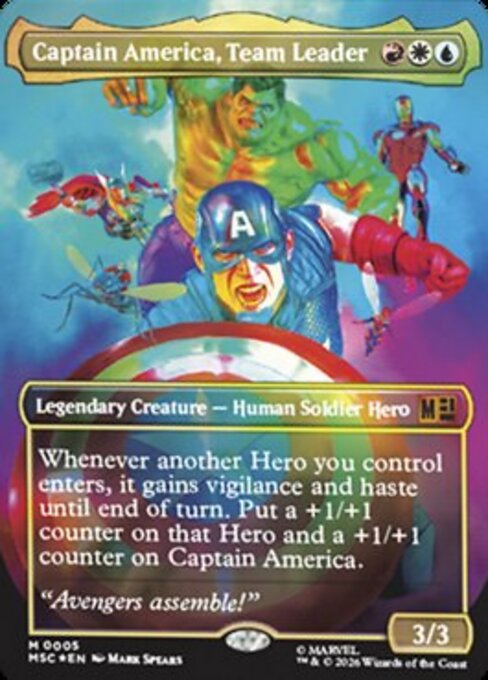
Avengers Assemble precon upgrade guide

Twelve cuts and twelve adds for Captain America, Team Leader — worked out from the real decklist rather than from what a Hero deck ought to want.

I ran the stock Avengers Assemble list through this site's own engines before writing a word of this, and two of the things I expected to say turned out to be wrong. The mana base is in better shape than precon mana usually is. And the deck isn't really a typal deck at all — it's a +1/+1 counters deck wearing a Hero costume, which changes what's worth adding.

Want these numbers for your own build? The Deck Mana Audit grades every colored cost in a decklist, and the bracket checker tells you the floor your version can honestly claim. No account, nothing stored.

What the stock deck actually looks like

Every number below comes from the shipped decklist, resolved card by card:

That last one is worth sitting with. Plenty of precons sneak into Bracket 2 or 3 on a single card. This one has nothing pushing it up, which is exactly why it's a satisfying deck to work on — there's headroom before you'd need to warn anybody.

The thing nobody tells you: it's a counters deck

Look at what Captain America, Team Leader does. Every other Hero that enters gets vigilance, haste, and a +1/+1 counter, and Captain America gets a counter as well. That's the commander's whole text, and it's a counters ability.

Then count how much of the deck is doing the same thing. Metallic Mimic gives every Hero an extra counter on the way in. Hercules, Olympian Hero grows when he attacks and again when he's damaged. Falcon and Redwing, She-Hulk, Wallbreaker, Jocasta, Automaton Avenger and Vision, Synthezoid Avenger all add counters off their own triggers.

Two cards then close the loop. Iron Man, Armored Avenger puts a +1/+1 counter on a creature every time you draw a card, and Shang-Chi and the Ten Rings does the same to itself and draws you five when it hits ten. So those 14 draw pieces aren't just card advantage — in this deck, drawing cards is the counters engine.

And Captain Marvel, Apex Avenger copies it all: any counters you put on another creature, she may take the same number herself.

Two more cards care about the results. War Machine, Avenging Arsenal gives modified attackers double strike, and Iron Man gives modified attackers flying. Counters are modifications. A board that's been growing for three turns is a board where every creature is modified.

Once you see that, the shopping list writes itself. The best additions aren't generic Hero payoffs. They're cards that multiply triggers, turn the wide board lethal, or keep it alive.

Which creature type do you name?

Seven cards in the stock deck make you choose a creature type: Kindred Discovery, Door of Destinies, Metallic Mimic, Raise the Palisade, Secluded Courtyard, Unclaimed Territory and Herald's Horn. That's seven decisions riding on one word, and the box doesn't tell you which.

Name Hero. It covers 27 of the 30 creatures. Naming Human covers 19.

The only creatures Hero misses are Jarvis, Earth's Mightiest Butler, Bastion Protector and Metallic Mimic itself — and Mimic exempts itself, because naming Hero makes it a Hero. So the real cost of naming Hero is two cards.

This is also the reason I'm cautious about the popular off-type upgrades. Adeline and Professional Face-Breaker are both fine Magic cards, but they're Humans, not Heroes, and each one you add is a card that eight different effects in the finished deck no longer see. That's a steeper price here than in most decks.

The mana base is better than it looks

Most upgrade guides open by cutting taplands. I'd mostly leave them alone, and the reason is that "enters tapped" and "enters tapped unless" are different cards.

Radiant Summit, Scorched Geyser and Prairie Stream all enter untapped if you control two or more basic lands. The deck runs 16 basics. They're untapped essentially always. Port Town, Frostboil Snarl and Furycalm Snarl just want you to reveal a land from hand. Spectator Seating is untapped whenever you have two or more opponents, which in Commander is most of the time.

Only five lands enter tapped no matter what: Coastal Peak, Glittering Massif, Irrigated Farmland, Mystic Monastery and Path of Ancestry. Three of those are worth cutting. The other two aren't, and I'll come back to that.

The real problem is a different one, and you'd never find it by eyeballing the list. Run the hypergeometrics and single blue is fine — 26 sources gets you one blue by turn two about 92% of the time. Double blue is where it breaks. Four cards want UU: Kindred Discovery, Professor Hulk, Reconnaissance Mission and West Coast Expansion. To cast those on curve at 90% you'd want around 36 blue sources. The deck runs 26, which puts you at roughly 74%.

Red has the same shape but it doesn't matter: only Thor, Asgard's Avenger asks for RR, so being six sources short costs you one card being occasionally late. White is comfortable at 28 sources.

So the mana fix isn't a rebuild. It's two better blue lands and an acceptance that Kindred Discovery is sometimes a turn late.

What I'd cut

Twelve cards. Nine spells and three lands.

Cards that only help one creature

Hero's Blade, Hulkbuster Armor and Gift of Immortality all pick one creature and improve it. In a deck with 30 creatures and a commander who rewards a crowd, that's the wrong shape. Hulkbuster Armor is the clearest case — four mana to cast, three more to equip a Hero, and the result is one very large creature in a deck that wins by having eight medium ones.

Patriot, Shield Wielder is the same problem on a body: two mana and a tap for +2/+0 and hexproof on one creature.

Cards that are too slow for what they do

Door of Destinies is the one people are most reluctant to cut, and I understand why — it's a Hero payoff and it can get enormous. But it enters with zero counters and only grows when you cast a Hero spell afterwards. You need two or three more Heroes after it lands before it changes a combat, and by then you'd rather have drawn almost anything else.

Heroic Return costs six (four if you're being attacked) to reanimate one creature. Speed, Young Avenger asks you to pay an extra mana on your noncreature spells to make one creature harder to block.

Removal that's too narrow

Make Your Move hits artifacts, enchantments, or creatures with power 4 or greater. Destroy Evil hits enchantments or creatures with toughness 4 or greater. Both miss the small utility creatures that actually stop this deck — and in a format full of them, "or greater" clauses are where removal goes to disappoint you.

Three lands

Coastal Peak, Glittering Massif and Mystic Monastery enter tapped unconditionally. The first two do cycle for two, which is a real consolation, but a deck with a 3.36 average mana value wants its lands online.

What I'd add

Twelve cards, in the order I'd buy them.

Make the wide board lethal

Shared Animosity is the single biggest change. It gives each attacker +1/+0 for every other attacker sharing a creature type — and with 27 Heroes and 19 Humans, nearly every attacker shares a type with nearly every other one. Attack with five Heroes and each of them is +4/+0. Note it counts each creature once, not once per shared type, so a Human Hero doesn't get counted twice.

Flowering of the White Tree is the upgrade that 93% legendary density unlocks. It gives legendary creatures +2/+1 and ward 1, and everything else +1/+1. In this deck that's +2/+1 and ward 1 on 28 of your 30 creatures, for two mana. Ward 1 doesn't sound like much until you notice how much removal it taxes.

Cathars' Crusade is the counters thesis made literal: every creature you play puts a +1/+1 counter on your whole board. With Captain Marvel copying counters and War Machine handing double strike to modified creatures, this ends games.

Multiply the triggers

Roaming Throne naming Hero is the best card in this list and the one people underrate. It doubles the triggered abilities of your Heroes — and Captain America is himself a Hero, so his own trigger doubles. Every Hero that enters now puts two counters on itself and two on Captain America. It also enters as a Hero, so it triggers him on the way down.

Patchwork Banner is the quiet one: +1/+1 to the type you name, and it taps for any color, which helps the double-blue problem.

Protect the board

Boros Charm gives your permanents indestructible for two mana at instant speed, and the other two modes are live often enough to matter.

Clever Concealment phases out any number of your nonland permanents, and convoke means a wide board casts it for close to free. Phasing dodges things indestructible doesn't — exile, sacrifice, −X/−X.

Reconnaissance is one of the strangest good cards in Commander. For zero mana it pulls an attacking creature out of combat and untaps it, after attack triggers have already happened. You attack with everything, see the blocks, and then decide what actually stays in.

Removal that answers things

Path to Exile and Generous Gift replace the two narrow removal spells. Path is one mana and exiles anything with a body; Generous Gift kills any permanent at all. Both hand something small to the opponent, and both are worth it.

Two lands

Sea of Clouds and Training Center both enter untapped whenever you have two or more opponents, and both make blue. They're the direct answer to the 74% double-blue number.

Three of these twelve carry most of the cost — Roaming Throne and the two lands. Hover any card name for its current price; the rest of the list is inexpensive, and if you only ever buy Shared Animosity, Flowering of the White Tree and Patchwork Banner you'll have captured a lot of the gain.

Three cards I'd leave alone

These all look cuttable and aren't.

Raise the Palisade reads like a clunky five-mana sorcery. It's a one-sided board wipe. "Choose a creature type; return all creatures that aren't of the chosen type to their owners' hands" — name Hero and 27 of your creatures stay while most tables lose everything. You bounce your own Jarvis and Bastion Protector, which is a real cost and a small one.

Metallic Mimic gets flagged as off-type by anything counting Heroes, because it's a Shapeshifter. That's backwards: it names a type and becomes it, so it's a Hero the moment it lands, and it makes every subsequent Hero enter bigger.

Path of Ancestry is an unconditional tapland, and I'm keeping it anyway. It taps for any color in your identity and scries every time you cast a creature of the chosen type — with 27 Heroes, that's a scry most turns.

The upgraded decklist

100 cards. Hover any name for the card and its current price.

Commander 1

Creatures 28

Instants 8

Sorceries 6

Enchantments 8

Artifacts 12

Lands 37

How the upgraded deck plays

Lead with mana and cheap Heroes. The deck has 19 two-drops and a commander who wants bodies on the board before he lands, so a hand of three lands and two early Heroes is a much better keep than a hand with a five-drop you're excited about.

From turn four or five, attack more than feels comfortable. Captain America gives every entering Hero vigilance and haste, so attacking often costs you nothing defensively — and with Reconnaissance out, you can attack with the whole board and retreat whatever the blocks punish.

Hold protection when you can. The deck's failure mode isn't running out of cards, it's losing eight creatures' worth of counters to one wrath. Boros Charm and Clever Concealment both cost little enough to leave up on a turn you're also developing.

FAQ

Is the Avengers Assemble precon good?

It's unusually focused. 27 of its 30 creatures are Heroes and 28 are legendary, so nearly every card pulls the same direction — that's rare in a precon and it's why the deck responds so well to a small number of changes. It's also genuinely low-powered: zero Game Changers and a Bracket 1 floor.

What should I cut from Avengers Assemble first?

The three cards that improve a single creature in a deck built to go wide: Hero's Blade, Hulkbuster Armor and Gift of Immortality. Door of Destinies is fourth, because it needs several more Hero spells after it lands before it changes a single combat.

What creature type should I name?

Hero, and it isn't close. Seven stock cards make you choose, and Hero covers 27 of the 30 creatures against Human's 19. The only creatures it misses are Jarvis, Earth's Mightiest Butler and Bastion ProtectorMetallic Mimic becomes whatever you name.

Does the mana base need fixing?

Less than you'd think. 23 of the 38 lands enter untapped unconditionally and only five always enter tapped. The genuine weakness is double blue: four cards want UU and 26 blue sources gets you there about 74% of the time by turn three, against the 90% you'd want. Two better blue lands fixes most of it.

What bracket is this deck?

Bracket 1 on the mechanical floor — no Game Changers, no mass land denial, no extra turns, no tutors. The twelve upgrades here keep it there, since none of them are on the Game Changers list. You can check your own version with the bracket checker.

Is Captain America, Team Leader a good commander?

He's a counters engine more than a combat trick. Every other Hero that enters gets vigilance, haste and a +1/+1 counter, and he takes one too — so a deck with 27 Heroes grows him for free. Strong at casual tables, and deliberately not pushed past them.