The Fantastic Four precon upgrade guide

Five cards in this box cost one mana of every colour, and on the turn you actually win you pay that bill twice.

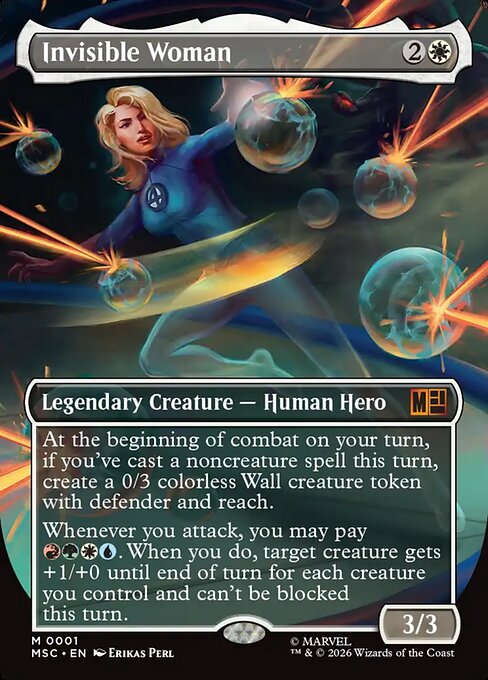
Invisible Woman is a 3/3 for three that looks like a support card, and her second ability is the whole deck: whenever you attack, pay {R}{G}{W}{U} and one creature gets +1/+0 for each creature you control and can't be blocked. Human Torch and The Thing have attack triggers with the identical price tag. Mister Fantastic's tap ability charges it again. Power Pack just costs it. The box shipped with 18 red sources. Almost everything below follows from that gap.

Invisible Woman
Invisible Woman
Bracket
No floorno Game Changers or land denial
0Game Changers
0Mass land denial
0Extra turns
0Nonland tutors
Mana curve
Mana sources
W24
U24
R22
G25

Upgraded list: 100 cards, 37 lands (17 basic), 22 creatures, average mana value 3.15. Mana sources: 24 white, 24 blue, 22 red, 25 green. No Game Changers and no mass land denial, so the deck sets no bracket floor. How brackets work →

What are the best upgrades for The Fantastic Four?

Five cards, in the order I'd buy them. Each one is argued further down.

  1. Prismatic Omen — two mana, and every land you control becomes every basic land type, so all 37 tap for all four colours and six of the deck's conditional lands stop having a condition.
  2. Faeburrow Elder — vigilance, so it attacks without tapping, then taps for one mana of every colour among your permanents. That's the whole attack bill off one creature.
  3. Third Path Iconoclast — a 1/1 for every noncreature spell you cast, which is the exact clause nine other cards in this deck are already watching for.
  4. Coalition Relic — any colour on demand, or a charge counter that cashes out at your next first main phase.
  5. Flame Jab — one red mana, and retrace means you can cast it from the graveyard every turn for the rest of the game.

The full eleven, and what comes out for them, is further down the page. None of it is on the Game Changers list, so the deck keeps its Bracket 1 floor.

Twenty creatures, and every one of them legendary

Every figure here comes from the shipped decklist, resolved card by card:

Eighteen cards are waiting on one noncreature spell

Invisible Woman's first ability looks like filler. At the beginning of combat, if you've cast a noncreature spell this turn, make a 0/3 Wall with defender and reach — a creature that can't attack, in a deck that wants to attack.

Then you count how many other cards in the box open with that same clause.

Nine cards, the commander included, have a beginning-of-combat trigger gated on "if you've cast a noncreature spell this turn." Mister Fantastic draws. Human Torch gains flying, double strike and haste. The Thing takes four +1/+1 counters. Council of Reeds copies itself. Lockjaw makes two creatures unblockable. Alicia Masters makes a Treasure. Franklin Richards discovers 6. H.E.R.B.I.E. surveils.

Worth flagging now, because the decklist reads like a typo otherwise: the box ships two different Reed Richards cards. Mister Fantastic is the {2}{U} one just mentioned, with the combat draw and the {R}{G}{W}{U} copy ability. Mister Fantastic, Reed Richards costs {3}{U} and draws whenever one or more tokens enter. Both are in the 99, and they do different jobs.

Nine more trigger on the cast itself with no combat clause: Black Bolt, Crystal, Inhuman Princess, The Fantasticar, Whirlwind of Thought, Valeria Richards, Cosmic Crucible, Medusa and Namor — plus Third Path Iconoclast once you've added it.

One cheap spell before combat turns on all eighteen. The upgraded deck runs 41 noncreature spells and 16 of them cost two or less, which is plenty — but the box also ships a quieter way of paying that clause for nothing.

Seven cards have rebound. Rebound exiles the spell as it resolves and lets you cast it again from exile at the beginning of your next upkeep, and your upkeep comes before your combat step. Cast Fantastic Elasticity on turn five and turn six's nine triggers are already live before you've drawn for the turn, at no mana. Four more cards come back out of the graveyard: Deep Analysis, Seize the Day and Galvanic Iteration have flashback, and Flame Jab, once you add it, has retrace and never runs out.

The bill is {R}{G}{W}{U}, and the kill turn pays it twice

Here's the turn this deck is built to have.

You cast something cheap before combat, so Human Torch picks up flying, double strike and haste off his own trigger. You attack with him. Invisible Woman's trigger asks for {R}{G}{W}{U}; pay it and he gets +1/+0 for each creature you control and can't be blocked. His own attack trigger asks for {R}{G}{W}{U} again; pay that and every point of combat damage he deals to an opponent gets dealt to each other opponent too.

With eight creatures out — the commander, a couple of real bodies, two Walls, a few tokens — a 3/2 Human Torch swings as an 11/2 with double strike that nobody can block. That's 22 to the player he's attacking and 22 to everyone else at the table.

It costs eight coloured mana in four specific colours, on top of whatever you spent before combat.

Four things in the stock deck can produce more than one colour, and they're worth knowing one at a time:

One piece of timing runs in your favour. Alicia Masters makes her Treasure at the beginning of combat step, before attackers are declared, so it's there for the trigger it's about to help pay.

The mana base doesn't need new lands

Thirty-seven lands at an average mana value of 3.69 is where it should be, and I'm not cutting or adding one. The count was never the problem.

Feed the stock list to the same hypergeometrics that drive this site's calculators and every colour comes up short for a single pip by turn two: green 21 sources against the 24 it wants, blue and white 20 apiece, red 18 for 81.2%. Four colours, all slightly thin, in a deck that needs all four in the same step.

The double-pip picture is where the cuts do their work. Four cards in the box ask for two of a colour that isn't white. Genesis Ultimatum costs {G}{G}{U}{U}{U}{R}{R} and is the only double-green card in the deck. Mind's Dilation and Recurring Insight both want {U}{U}. Nova Flame wants {R}{R}.

All four are cuts for reasons that have nothing to do with pips, and what falls out is that the upgraded deck's only remaining double-pip requirement is whiteCleansing Nova, Clever Concealment, Collective Effort and Tragic Arrogance. White is the commander's own colour. Green, blue and red never ask for two of anything again, which means every source of those three only has to turn up once, and a land that makes several colours starts being worth several lands.

Which is what Prismatic Omen does for two mana. Every land you control becomes every basic land type, so all 37 tap for all four colours, and the six check lands — Clifftop Retreat, Glacial Fortress, Hinterland Harbor, Rootbound Crag, Sulfur Falls and Sunpetal Grove — find their condition met by any other land on the battlefield.

It doesn't rescue all thirteen conditional lands, and the reason is worth being exact about. Canopy Vista, Cinder Glade, Prairie Stream, Radiant Summit, Scorched Geyser and Sodden Verdure want two or more basic lands, and Prismatic Omen grants basic land types, not the Basic supertype. Those six keep their condition. The deck's 17 basics answer them well enough on their own.

After the swaps, and without a single land changing: green 25 sources, blue 24, white 24, red 22. Red is the one still under target and it reads worse than it plays — the check measures red by turn two because Flame Jab is a one-mana red card, and Flame Jab is perfectly happy to wait until turn six.

Want these numbers for your own build? The Deck Mana Audit grades every coloured cost in a decklist — it's what found the four-way single-pip shortfall above — and the bracket checker tells you the floor your version can honestly claim. No account, nothing stored.

Annie Joins Up doubles 17 of the deck's 18 legendary creatures

Annie Joins Up reads: if a triggered ability of a legendary creature you control triggers, that ability triggers an additional time. In most decks that's a fine card. Here every creature the box shipped is legendary, and after my swaps 18 of the 22 still are — 17 of which have a triggered ability for her to double. Dragon Man is the only exception, and his ability is static.

So Annie means two Walls a turn instead of one, eight +1/+1 counters on The Thing instead of four, two discover 6s off Franklin Richards, two Merfolk per spell off Namor and +4/+4 on Black Bolt every time you cast a noncreature spell.

What she does to Council of Reeds is easier to miss. Council of Reeds switches off the legend rule for your creatures and then, every combat, makes a token copy of itself — and each copy carries the same trigger. One becomes two, two become four, four become eight, and every body in that pile is another +1/+0 the next time Invisible Woman's attack trigger resolves. With Annie out, each Council triggers twice, so the doubling becomes tripling.

Now the part that costs you mana if you don't know it. Doubling a trigger that asks you to pay {R}{G}{W}{U} asks you to pay it twice. Annie doesn't discount Invisible Woman's attack trigger, or Human Torch's, or The Thing's — she hands you a second copy that wants its own four coloured mana. Where she's free is the triggers that ask for nothing: the Wall, the counters, the discover, the token copy.

Mister Fantastic's tap ability has the same shape. "Copy target triggered ability you control twice" is enormous on The Thing's four counters or Franklin Richards' discover, and a mana trap on any of the {R}{G}{W}{U} triggers, because each copy will ask again.

What I'd cut

Eleven cards, and not one of them a land.

The ten-drop, and the card whose job is to find it

Galactus costs ten in a deck that ramps six times. He's a 12/12 with flying, trample and indestructible and I still can't get there in a game that ends around turn ten. His Insatiable Hunger clause also forces him to attack whichever opponent has the most life, which is frequently not the one you need dead.

Silver Surfer follows him out, and this is the cut I expect argument about, because it's the flavour pairing the box is built around. Read what he does once Galactus is gone: five mana, a 4/5 flier, and an enters trigger that searches your library for a card that isn't in it. If you want to keep the pair, the honest price is four or five more ramp pieces, and that's a different deck from the one the other ninety-eight cards are describing.

Four cards that were the only ones asking for a pip

Genesis Ultimatum is seven mana and seven pips across three colours, the hardest cast in the box by a distance. Mind's Dilation is seven mana for a trigger that fires on one opponent's first spell each turn and gives you whatever happens to be on top of their library. Recurring Insight draws equal to a single opponent's hand size, which in a pod that's been casting spells is often two or three cards for six mana.

Nova Flame earns its own paragraph. It puts X counters on your creature and then deals that creature's power to each other creature — your 0/3 Walls, your Merfolk, your Soldier tokens and every Council of Reeds copy included. In a deck whose commander multiplies by creature count, it's a sweeper pointed the wrong way.

Two of the four board wipes

The box ships four cards that make everybody lose creatures, in a deck whose payoff is a count of yours.

Promise of Loyalty leaves each player one creature, and each player picks their own, so you trade a board for their best card. Ultimate Nullification exiles every creature and every graveyard, costs five, and charges you a legendary creature as an additional cost on the way in.

Cleansing Nova stays, because it's modal and can take artifacts and enchantments instead. Tragic Arrogance stays because you choose every survivor on every side of the table.

Two artifacts and a five-mana sorcery

Lightning Greaves is the one I'd flag even if you change nothing else about the deck. It grants haste and shroud, and shroud stops every spell and ability targeting that creature, yours included. Invisible Woman's attack trigger targets. Lockjaw's unblockable clause targets. So do Quantum Misalignment, Flame On!, It's Clobberin' Time!, Invisible Force Field, Clever Concealment, and the equip ability of the deck's other Equipment. Strap the Greaves to your best creature and you've switched the deck off.

Negative Zone Portal costs two, then {2} an activation to exile one card from an opponent's graveyard, and once it's holding four cards it starts flipping coins to sacrifice itself. Every {2} it wants is {2} the attack trigger wanted first.

Taunt from the Rampart goads every creature your opponents control and stops them blocking until your next turn. That's a genuine finisher at five mana — competing for the exact turn, and the exact mana, that the {R}{G}{W}{U} triggers need, in a deck whose commander already makes the one creature that matters unblockable.

What I'd add

Eleven cards, and six of them are about mana.

Six ways to pay a four-colour bill

Prismatic Omen goes first because it's two mana and it upgrades all 37 lands at once, covered above.

Faeburrow Elder is the one I'd most want in an opening hand. It's a 0/0 that gets +1/+1 for each colour among permanents you control, so a four-colour board makes it a 4/4, and it taps for one mana of every one of those colours — the entire attack bill off a single creature. The vigilance is the part that matters: it attacks without tapping, so you swing with it and then tap it to pay for the trigger it just caused. A 4/4 also clears toughness four, which is what Baxter Building wants before it'll draw you anything.

Bloom Tender is the same ability a mana earlier on a 1/1. It's the one card on this list that costs real money, and the first I'd skip if you're buying selectively — it's redundancy on the effect that matters most, not a requirement.

Coalition Relic taps for any colour, or banks a charge counter that pays out at your next first main phase, which is how one rock produces two colours across a turn cycle. Fellwar Stone is the cheapest real fixing in the format. Nature's Lore searches out a Forest card and puts it onto the battlefield untapped, and three of the deck's duals — Canopy Vista, Cinder Glade and Sodden Verdure — are Forests, so it skips the tapland clause on the way past.

Those six take ramp from 6 to 8 and lift every colour by four.

Two bodies that count

Third Path Iconoclast makes a 1/1 Soldier every time you cast a noncreature spell, on a two-mana 2/1. Every Soldier is another +1/+0 on the commander's pump, and it's a Human, so Path of Ancestry scries when its mana casts it.

Murmuring Mystic makes a 1/1 flier for each of the 26 instants and sorceries left in the list, off a 1/5 body that survives most of what a table aims at a blocker. Mister Fantastic, Reed Richards draws a card whenever one or more tokens enter, so both of these turn into card advantage without spending a slot on it.

Three cheap spells

Flame Jab is a one-mana sorcery that deals 1 damage, which is not why it's here. Retrace lets you cast it from your graveyard by discarding a land, so from the moment it first hits the yard you have a one-mana noncreature spell available every turn for the rest of the game. Nine beginning-of-combat triggers, switched on for {R} and a land you weren't going to play.

Swords to Plowshares answers anything for one white mana, and here it does a second job. It's the cheapest way to satisfy "you've cast a noncreature spell this turn," and it's an instant, so you can do it in your upkeep and leave the main phase alone.

Swiftfoot Boots replaces the Greaves. Hexproof stops your opponents targeting the creature and leaves you free to point the commander's trigger at it, which is the entire reason the Greaves came out.

Hover any name for its current price. Bloom Tender is the only card here that costs meaningful money, and the five ranked at the top of this page carry the whole argument without it.

What my own cut list flags that I'm keeping

The analysis script shortlists fifteen cards in the upgraded deck. It's wrong about most of them, and three of the cards it flags are ones I just added.

H.E.R.B.I.E., Dragon Man, Faeburrow Elder, Bloom Tender and Namor all get flagged as "off-type: not Hero or Human." That flag is empty in this deck, and the script says why in the same breath: zero cards here make you choose a creature type. Thirteen Heroes and twelve Humans, no lord, no banner, nothing to name. Namor is one of the deck's better cards regardless — a Merfolk token for every noncreature spell you cast is exactly what the commander wants to count.

Lockjaw gets flagged for buffing a single creature. He's what lets the deck attack with two unblockable creatures instead of one, for two mana, every combat.

Cosmic Crucible gets flagged as a six-drop, and six is a lot. It also copies a noncreature spell once a turn and hands you four rainbow mana at the top of every main phase, which in this deck buys the precombat spell and leaves the lands up. The timing trap above is real; the card is still one of the strongest things in the box.

Path of Ancestry is the deck's only unconditional tapland and it stays. In a four-colour deck an any-colour land buys back the untap step it costs you, and its scry fires whenever that mana casts a creature sharing a type with Invisible Woman — a Human Hero, which covers 17 of the 22 creature spells.

Unstable Molecule Suit and Swiftfoot Boots both draw the single-creature-Equipment flag. The commander's whole design is to pick one creature and make it lethal, so Equipment that protects that creature is aimed at the plan rather than across it. The Suit's equip-commander cost of {2} is why it survived the box's own list.

Quantum Misalignment, Into the Time Vortex and Flame On! are flagged as five-drops. All three have rebound, so each is two noncreature spells across two turns and the second one is free and arrives in your upkeep. Into the Time Vortex cascades on both casts.

Two numbers this list makes worse

Both come off the same script that produced everything above, so they belong on the record.

Draw drops from 8 to 7, under the 8–12 band, because Recurring Insight is a cut. I'm leaving it, because the count measures the wrong thing here. Whirlwind of Thought draws on every noncreature spell. Valeria Richards draws on the first one each turn. Mister Fantastic draws every combat. Mister Fantastic, Reed Richards draws whenever a batch of tokens enters, which Murmuring Mystic and Third Path Iconoclast now do constantly. Willie Lumpkin draws whenever he connects, and he can't be blocked. Seven cards, five of them per-turn engines rather than one-shot spells.

Wipes drop from 2 to 1, and that one is on purpose. Every symmetrical wipe in this deck deletes the creature count Invisible Woman multiplies by, so it wants fewer of them than a typical list rather than more. Cleansing Nova stays as the modal one, Tragic Arrogance stays because you choose the survivors, and Clever Concealment answers somebody else's wipe by phasing out any number of your nonland permanents — with convoke, so the 0/3 Walls that can never attack can at least pay the generic half of its cost.

Two cards I nearly ran

Both turn up on other Fantastic Four lists, and the arithmetic sent me the other way on each.

Roaming Throne names a creature type and doubles the triggered abilities of creatures of that type and of your commander, which is the effect this deck wants more than any other. It's also the smaller version of something already in the box. Naming Hero covers 13 of the upgraded deck's 22 creatures; Annie Joins Up covers all 18 legendary ones, which is every card in the deck with a trigger worth doubling. The two do stack, and four triggers instead of one is a real turn — but as a purchase it's a lot of money for the lesser half of an effect you own already.

Bear Umbra is the cleanest answer I found to paying the bill twice. It gives the enchanted creature "whenever this creature attacks, untap all lands you control," and every attack trigger goes on the stack together, so you can order the untap to resolve first and pay for both {R}{G}{W}{U} triggers behind it with the same lands. It costs {2}{G}{G}. I spent four cuts specifically deleting the last non-white double pip from this deck, and handing one straight back for a four-mana Aura that dies to any removal aimed at the creature isn't a trade I want. If your build runs greener than mine, it's the first thing I'd try.

The upgraded decklist

The full 100 with the eleven swaps applied. Hover any name for the card and what it currently costs.

“Load into the deck builder” opens this list in your account, pinned to the printings the box shipped, ready to edit or save. “Copy decklist” gives you plain text for Moxfield, Archidekt or Arena — no account needed.

Commander 1

  • Invisible Woman

Creatures 21

  • Alicia Masters, Skilled Sculptor
  • Black Bolt, Inhuman King
  • Bloom Tender
  • Council of Reeds
  • Crystal, Inhuman Princess
  • Dragon Man, Reformed Robot
  • Faeburrow Elder
  • Franklin Richards, Ascendant
  • H.E.R.B.I.E., Lovable Robot
  • Human Torch
  • Lockjaw, Slobbering Teleporter
  • Medusa, Inhuman Queen
  • Mister Fantastic
  • Mister Fantastic, Reed Richards
  • Murmuring Mystic
  • Namor, Atlantean King
  • Power Pack
  • The Thing
  • Third Path Iconoclast
  • Valeria Richards, Precocious
  • Willie Lumpkin, Postman

Instants 7

  • Bovine Intervention
  • Clever Concealment
  • First Family
  • Galvanic Iteration
  • Invisible Force Field
  • Path to Exile
  • Swords to Plowshares

Sorceries 19

  • Cleansing Nova
  • Collective Effort
  • Cultivate
  • Cut a Deal
  • Deep Analysis
  • Expressive Iteration
  • Fantastic Elasticity
  • Farseek
  • Flame Jab
  • Flame On!
  • Hull Breach
  • Into the Time Vortex
  • It's Clobberin' Time!
  • Nature's Lore
  • Quantum Misalignment
  • Seize the Day
  • Terramorph
  • Three Visits
  • Tragic Arrogance

Artifacts 9

  • Arcane Signet
  • Chromatic Lantern
  • Coalition Relic
  • Fellwar Stone
  • Mirage Mirror
  • Sol Ring
  • Swiftfoot Boots
  • The Fantasticar
  • Unstable Molecule Suit

Enchantments 6

  • Annie Joins Up
  • Cosmic Crucible
  • Monologue Tax
  • Path of Discovery
  • Prismatic Omen
  • Whirlwind of Thought

Lands 37

  • Baxter Building
  • Canopy Vista
  • Cinder Glade
  • Clifftop Retreat
  • Command Tower
  • Evolving Wilds
  • Exotic Orchard
  • Fabled Passage
  • 5× Forest
  • Glacial Fortress
  • Hinterland Harbor
  • 4× Island
  • 3× Mountain
  • Path of Ancestry
  • 5× Plains
  • Prairie Stream
  • Radiant Summit
  • Rejuvenating Springs
  • Rootbound Crag
  • Scorched Geyser
  • Sodden Verdure
  • Sulfur Falls
  • Sunpetal Grove
  • Terramorphic Expanse

FAQ

How does Invisible Woman actually kill someone?

By making one creature enormous and unblockable on the same swing. Her attack trigger asks for {R}{G}{W}{U}, and when you pay it a creature of your choice gets +1/+0 for each creature you control and can't be blocked. The 0/3 Walls she makes have defender and never attack — they're there to be counted. Point the pump at Human Torch and his own attack trigger repeats his damage to every other opponent.

Do you really need all four colours untapped to attack?

For the full turn, yes, and twice over. Invisible Woman, Human Torch and The Thing each have an attack trigger costing {R}{G}{W}{U}, Mister Fantastic's tap ability costs the same, and Power Pack's mana cost includes all four. Firing two of them on one attack is eight coloured mana on top of whatever you spent before combat, and the box shipped with 18 red sources to do it with.

Why does Council of Reeds get better every turn?

Because it switches off the legend rule for your creatures and then copies itself. Each Council of Reeds you control makes a token copy at the beginning of combat, and every copy carries the same trigger. One becomes two, two become four, four become eight. Annie Joins Up makes each of those triggers fire twice, which turns the doubling into tripling, and every body is another +1/+0 on the commander's pump.

Is Galactus worth keeping?

Not in a stock list that ramps six times and averages 3.69 mana. He costs ten, and the only card that helps you find him is Silver Surfer, whose enters trigger does nothing else. Both come out here. Keeping the pair honestly costs four or five more ramp pieces, which is a different deck from the one the other ninety-eight cards describe.

Should you cut Lightning Greaves?

Yes, and it's the one staple this deck actively can't use. Greaves grants shroud, which stops every spell and ability targeting the equipped creature, including your own. Invisible Woman's attack trigger targets, and so do Lockjaw, Quantum Misalignment, Invisible Force Field and the equip ability of the deck's other Equipment. Swiftfoot Boots grants hexproof, which only stops opponents, and does the same job without turning off the payoff.

Do you name a creature type in this deck?

There's nothing to name. Thirteen of the upgraded deck's 22 creatures are Heroes and twelve are Humans, but zero cards in the list make you choose a type, so the Hero count is flavour. The one card that reads types is Path of Ancestry, which scries when its mana casts a creature sharing a type with Invisible Woman — a Human Hero, covering 17 of the 22 creature spells.

How many lands does the upgraded list run?

Thirty-seven, the same 37 the box shipped, because this guide cuts and adds no lands at all. The count was never the issue — a four-colour deck was asking single-colour lands for four colours at once. Prismatic Omen fixes that from a spell slot, and the swaps take green from 21 sources to 25, blue and white from 20 to 24, and red from 18 to 22 without the manabase changing.

Does any of this move the deck out of Bracket 1?

No. The stock list runs no Game Changers, no mass land denial, no extra turns and no nonland tutors, and none of the eleven additions are on the Game Changers list either. The card that would change the answer is Smothering Tithe, which solves this deck's mana problem better than anything on my list and is a Game Changer — take it and the honest answer becomes Bracket 3.