Hail, Caesar precon upgrade guide
Every attack, Caesar eats one creature and hands back two that are already in combat. The box spends far more of its ninety-nine cards on making that trade available than on making it hurt.
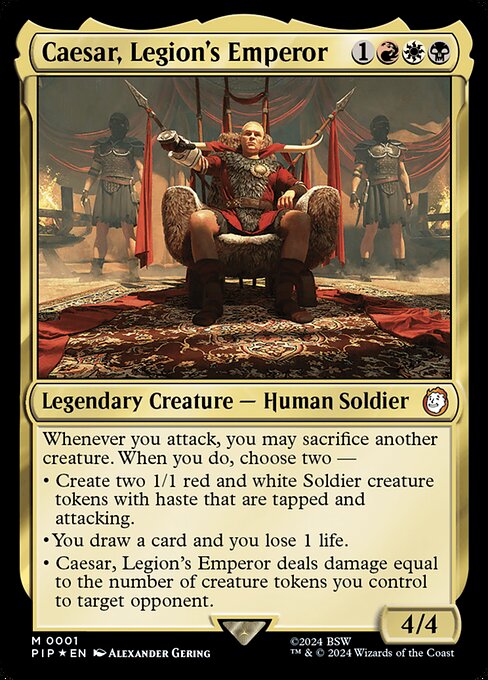
Caesar, Legion's Emperor costs {1}{R}{W}{B} and does three things at once. Whenever you attack you may sacrifice another creature, and when you do you choose two of three modes: create two 1/1 red and white Soldier tokens with haste that are tapped and attacking, or draw a card and lose 1 life, or have Caesar deal damage equal to the number of creature tokens you control to one opponent.
Take the token mode and the sacrifice has already paid for itself. You spend one body, you get two, and both of them arrive attacking.
So the deck knows what it wants to do. The stock list is good at putting bodies on the board and thin on anything that makes a wide board mean more than its own size, and it is slower than it needs to be about all of it.
100 cards, 36 lands (14 basic), 31 creatures, average mana value 3.1. Mana sources: 23 white, 24 black, 24 red.
No Game Changers and no mass land denial, so it sets no bracket floor. How brackets work →
What are the best Hail, Caesar upgrades?
In order, and the first one is free.
- Play one fewer Mountain and one more Plains. It costs nothing and it puts all three colours on the right side of the 90% line. The numbers are below.
- Cathars' Crusade. Caesar puts two creatures onto the battlefield every single attack, so the enchantment triggers twice a turn and the two new Soldiers are 3/3s before combat damage happens.
- Ashnod's Altar. The deck has no free sacrifice outlet at all. This one turns a board that is about to be wiped into colourless mana, and it pays for Martial Coup and Secure the Wastes.
- Teysa Karlov. Doubles the death triggers already sitting in the box, and quietly gives Caesar's Soldiers lifelink, which matters when you are attacking with four of them a turn.
- Battlefield Forge, Caves of Koilos and Sulfurous Springs in place of the three Temples. Same colour pairs, none of them tapped.
- Mirkwood Bats and Zulaport Cutthroat. The reach that makes sacrificing pay even on a turn when nothing gets through.
Eleven cards in and eleven out, about $35.80 at market for the adds. What leaves is further down.
The damage mode counts creature tokens, and the box makes a lot of the other kind
Caesar's third mode deals damage equal to the number of creature tokens you control. Thirteen cards in the stock list make creature tokens outright and six more copy themselves with squad, so the commander is never short of something to point at.
The trap is everything else this deck produces. Pitiless Plunderer, Kellogg, Dangerous Mind, Deadly Dispute and Rose, Cutthroat Raider all make Treasure. Survivor's Med Kit makes Food, Boomer Scrapper and Thrill-Kill Disciple make Junk, and Luck Bobblehead makes more Treasure. Not one of those is a creature token and not one of them adds a point of damage to the third mode. They are good cards doing a different job. Just don't count them when you are working out whether the attack is lethal.
The other thing worth knowing at the table is the order. Modal abilities resolve in the order printed on the card, and the token mode sits above the damage mode, so choosing both means the two Soldiers you just made are already on the battlefield and already counted.
What eleven new cards do with two Soldiers a turn
Cathars' Crusade is the one that changes the deck. Each creature entering puts a +1/+1 counter on your whole board, and Caesar's token mode is two creatures entering, so a normal attack grows everything twice. The tokens enter tapped and attacking before combat damage, which means they are 3/3s in the same combat that made them. It costs {3}{W}{W} and it is the most expensive thing this guide asks you to cast, which is a real cost in a deck that is short on double white.
Ashnod's Altar is the sacrifice outlet the box forgot. Caesar only eats a creature when you attack, once a turn, at sorcery speed in practice. The Altar eats as many as you like at instant speed, which does three things: it turns a board into mana for Martial Coup or Secure the Wastes, it converts your creatures into value in response to somebody else's wrath, and it lets you use Bastion of Remembrance without waiting for combat.
Teysa Karlov reads as a small card and is not. Bastion of Remembrance, Morbid Opportunist, Pitiless Plunderer and the new Zulaport Cutthroat all trigger on a creature dying, and Teysa makes every one of them trigger twice. Her second line hands creature tokens vigilance and lifelink. Vigilance does nothing for tokens that entered already attacking, but lifelink on four attacking Soldiers is four life a turn the box was not gaining.
Mirkwood Bats and Zulaport Cutthroat are the two cards that make a sacrifice hurt somebody. Mirkwood Bats drains for each token you create or sacrifice, so a turn where you feed Caesar a token and make two more is three triggers, which is nine damage across a four-player table before anyone blocks anything. Zulaport Cutthroat covers the same ground for nontoken creatures and gains the life back.
Village Rites is a one-mana instant that turns a creature about to die into two cards. It is in the list partly because the stock curve has only four one-drops and this deck wants something to do on turn one.
Swords to Plowshares and Unbreakable Formation are the insurance. The box runs five spot removal spells and exactly one card that protects anything, Elder Arthur Maxson, and his ability only saves himself. Unbreakable Formation for {2}{W} keeps a board of Soldiers through a wrath, and cast in your own main phase it hands out counters as well.
Then the three lands. Battlefield Forge, Caves of Koilos and Sulfurous Springs cover exactly the colour pairs the three Temples covered, so nothing changes about what the deck can cast. They just do it a turn earlier. They deal you a point of damage when you use them for coloured mana, and this deck is unusually well set up to absorb that: Impassioned Orator, Bastion of Remembrance, MacCready, Lamplight Mayor, Craig Boone, Novac Guard and now Teysa's lifelink tokens are all gaining it back.
One Mountain becomes a Plains, and all three colours clear ninety percent
This is the best change on the page and it costs nothing, so I want to show the working.
The stock mana base runs 25 black sources, 24 red and 23 white. White is the colour the deck actually leans on. 34 stock spells want at least one white pip and the cheapest of them costs one, so you want that pip by turn two, and hitting it 90% of the time on the play takes 24 sources. The box has 23.
The eleven swaps make white hungrier, because Swords to Plowshares, Unbreakable Formation and Cathars' Crusade all want it. After the swaps, 36 spells want a white pip and white is still on 23 sources, which is 89%.
Red goes the other way. Cutting Ruinous Ultimatum and Mysterious Stranger removes two of the three cards that wanted two red, and the only one left is Rose, Cutthroat Raider. Red sits on 24 sources against a requirement of 22.
So move one. Play four Mountains instead of five and six Plains instead of five, and the first-pip numbers land at 90.1% black, 91.8% red and 90.1% white. Every colour clears the bar, red gives up nothing it was using, and the change costs zero dollars.
The decklist further down is the eleven swaps and nothing else, so it still shows five of each basic. Make the Plains change yourself when you build it.
What that fix does not solve is double white. Six cards in the upgraded list want {W}{W}, and getting two white by turn three at 90% would take 36 sources in a deck that has 24. That is 69.4%, and it is not fixable inside a three-colour mana base. Treat Hour of Reckoning, Martial Coup, Captain of the Watch, Marshal's Anthem, Vault 75: Middle School and Cathars' Crusade as cards you cast when you get there rather than cards you plan a turn around.
The land count itself is fine. 36 lands against an upgraded average mana value of 3.10 sits in the normal band, so the fix here was never about how many lands. It was about how many of them enter tapped, and the three Temples take that from nine to six.
Seven mana, three doubled pips, and twenty-three white sources
Ruinous Ultimatum is the rarest and most exciting card in the box, and it is the first thing I cut. It costs {R}{R}{W}{W}{W}{B}{B}. The deck it is printed in has 23 white sources and cannot reliably produce two of them by turn three, let alone three of them alongside two red and two black at seven mana. It is a card from a different deck that happens to be sitting in this one.
Wild Wasteland goes for a related reason. It asks you to skip your draw step in exchange for exiling two cards each upkeep that you then have to play that turn. The box already has nine cards that draw, and this deck's hand is usually full of two and three drops it is holding for the right attack. Trading a guaranteed card for two that expire is the wrong trade here.
Stolen Strategy and Mysterious Stranger are five and four mana of somebody else's deck. Stolen Strategy gives you random cards from three libraries with no relation to Soldiers or sacrificing. Mysterious Stranger wants instants and sorceries in graveyards, and at a creature-heavy table it is often just a 3/2 flash body for {2}{R}{R}, which is a bad rate and two red pips the deck would rather not owe.
Yes Man, Personal Securitron gives an opponent a creature so that you can draw two cards. Ruthless Radrat is a 2/3 with menace unless you have four cards in your graveyard to exile per copy, which on turn three you do not. Butch DeLoria, Tunnel Snake grows for each other Rogue and Snake you control, and the box has four other Rogues and no Snakes at all.
Black Market is the cut I expect an argument about, so here is the reasoning. It costs five and does nothing the turn it lands. It then adds black mana at the beginning of your first main phase, which is before combat. Caesar's sacrifices all happen during the declare attackers step, so every counter this deck puts on Black Market arrives too late to be spent that turn, and the mana it eventually makes can only ever pay for precombat spells. It is a fine card in a deck that kills things on its own turn at sorcery speed. This one kills things in combat.
Then Temple of Malice, Temple of Silence and Temple of Triumph. Each one scries once and then enters tapped forever. Against a stock curve that peaks at three with 21 cards, and a commander you want online on turn four, that is a real price for one look at the top of your library.
The six lands that still enter tapped all earn it. Nomad Outpost makes all three colours, Path of Ancestry scries every time you cast a Human and 27 of the creatures are Human, Windbrisk Heights hides a card and this deck genuinely does attack with three creatures, Memorial to Glory sacrifices for two Soldiers, Myriad Landscape ramps, and Canyon Slough cycles once you have enough lands. The Temples do one thing once.
Skullclamp, and two robots I am not cutting
Skullclamp looks like a bad card in a deck full of 1/1s. Equipping it gives a creature +1/-1, so a 1/1 Soldier dies on the spot. That is the point. It costs one to cast and one to equip, and every token Caesar makes is a 1/1 that turns into two cards for one mana. In a deck that produces two of them per attack it is the best card in the box that is not Sol Ring, and it stays.
Securitron Squadron and ED-E, Lonesome Eyebot are both Robots in a deck where 27 of the 32 stock creatures are Human, which sounds like a reason to cut them until you check what actually cares. Nothing in the stock list names a creature type. Not one card. General's Enforcer wants legendary Humans specifically and White Glove Gourmand wants a Human to have died, and that is the whole extent of it, so being a Robot is not costing these two anything.
What they do is the relevant test. Securitron Squadron puts a +1/+1 counter on every creature token that enters under your control, which is two counters an attack from Caesar alone and more from Secure the Wastes or Martial Coup. ED-E gains a quest counter whenever you attack with more creatures than it has counters, and sacrifices itself to draw that many cards plus one. Both are doing exactly what the deck does.
Five board wipes, and one of them is fighting the deck
The stock list runs six mass removal spells, roughly double what a precon usually carries, and cutting Ruinous Ultimatum only takes it to five. In a deck built to flood the board that reads like a contradiction. Mostly it is not.
Hour of Reckoning destroys all nontoken creatures, and convoke means your tokens help pay for it, so it is a one-sided wrath here. Vault 75: Middle School exiles creatures with power 4 or greater on its first chapter, which your 1/1s comfortably survive and most of the table's threats do not. Martial Coup makes X Soldiers first and then destroys all other creatures, so the board you just built is the board that lives. Vault 11: Voter's Dilemma is a vote rather than a wrath, and in a four-player pod your Soldier tokens are never the creature that wins it.
That leaves The Nipton Lottery, which steals a random creature and then destroys every other creature on the table, yours included. It is the one card in the deck whose best case still costs you your board. I have left it in because a Mardu deck needs a way out of a board it cannot beat, but if your pod is creature-light it is the first thing I would cut for a twelfth add, and Blood Artist at around $3.65 is where I would put the slot.
The upgraded decklist
The full hundred after the eleven swaps, grouped by role. Hovering any card name shows the card.
“Load into the deck builder” opens this list in your account, pinned to the printings the box shipped, ready to edit or save. “Copy decklist” gives you plain text for Moxfield, Archidekt or Arena — no account needed.
Commander 1
- Caesar, Legion's Emperor




Creatures 30
- Aradesh, the Founder
- Boomer Scrapper
- Captain of the Watch
- Colonel Autumn
- Craig Boone, Novac Guard
- Desdemona, Freedom's Edge
- ED-E, Lonesome Eyebot
- Elder Arthur Maxson
- Gary Clone
- General's Enforcer
- Impassioned Orator
- Keeper of the Accord
- Kellogg, Dangerous Mind
- Legate Lanius, Caesar's Ace
- MacCready, Lamplight Mayor
- Mirkwood Bats
- Morbid Opportunist
- Mr. House, President and CEO
- Overseer of Vault 76
- Paladin Elizabeth Taggerdy
- Pitiless Plunderer
- Powder Ganger
- Rose, Cutthroat Raider
- Securitron Squadron
- Sierra, Nuka's Biggest Fan
- Teysa Karlov
- Thrill-Kill Disciple
- Wasteland Raider
- White Glove Gourmand
- Zulaport Cutthroat



Instants 10
- Anguished Unmaking
- Deadly Dispute
- Entrapment Maneuver
- Lethal Scheme
- Secure the Wastes
- Swords to Plowshares
- Unbreakable Formation
- V.A.T.S.
- Village Rites
- Wear // Tear

Sorceries 4
- Heroic Reinforcements
- Hour of Reckoning
- Martial Coup
- The Nipton Lottery
Artifacts 10
- Arcane Signet
- Ashnod's Altar
- Charisma Bobblehead
- Luck Bobblehead
- Skullclamp
- Sol Ring
- Survivor's Med Kit
- Talisman of Conviction
- Talisman of Hierarchy
- Talisman of Indulgence
Enchantments 9
- Assemble the Legion
- Bastion of Remembrance
- Battle of Hoover Dam
- Cathars' Crusade
- Fervent Charge
- Intangible Virtue
- Marshal's Anthem
- Vault 11: Voter's Dilemma
- Vault 75: Middle School
Lands 36
- Ash Barrens
- Battlefield Forge
- Canyon Slough
- Caves of Koilos
- Clifftop Retreat
- Command Tower
- Desolate Mire
- Diamond City
- Dragonskull Summit
- Evolving Wilds
- Isolated Chapel
- Memorial to Glory
- 5× Mountain
- Myriad Landscape
- Nomad Outpost
- Path of Ancestry
- 5× Plains
- Shadowblood Ridge
- Smoldering Marsh
- Sulfurous Springs
- 4× Swamp
- Tainted Field
- Tainted Peak
- Terramorphic Expanse
- Windbrisk Heights
FAQ
Do I have to sacrifice a creature every time Caesar attacks?
No. The trigger says you may sacrifice another creature, so you can attack with Caesar and decline it. You should usually take it anyway, because the token mode hands back two bodies for the one you spent.
Why cut Ruinous Ultimatum when it is the rarest card in the box?
Because the deck cannot reliably cast it. Ruinous Ultimatum costs seven with three separate doubled pips, and the stock mana base has 25 black, 24 red and 23 white sources. White is already one source short of casting a single white pip on curve, and six other cards want two white by turn three at 23 sources. A seven-mana sorcery that needs RRWWWBB is the last card in the deck that gets cast.
What do the eleven upgrades cost?
About $35.80 at market for default printings, measured in September 2026. Ashnod's Altar is roughly $15.67 of that and Cathars' Crusade about $9.36. The other nine cards total under $11 between them, and the single highest-value change in the guide, moving one Mountain to one Plains, costs nothing at all.
Is the stock deck fun to play before I change anything?
Yes. Thirteen cards in the box make creature tokens outright and six more copy themselves with squad, so the commander always has something to eat. The stock list resolves to at least $97.60 of singles. What it plays like is slow, because nine of its 36 lands enter tapped and the curve peaks at three with 21 cards.
Should I add Anointed Procession or Mondrak, Glory Dominus?
Both are the strongest possible cards here and both are left out of this guide on price. Doubling tokens doubles Caesar's damage mode directly. Anointed Procession is around $61 and Mondrak around $41, against a deck whose entire stock singles value is about $97.60, so either one roughly doubles what the deck cost. If you already own one, it is the first card in. Parallel Lives is the cheap version of the effect and it is green, so it is not legal in a Mardu identity.
Does upgrading Hail, Caesar change what bracket it can claim?
No. The stock deck contains no Game Changers, no mass land denial and no two-card infinite combo, and none of the eleven adds introduce one, so neither list sets a bracket floor at all. The upgraded deck is faster and more consistent than the box, but the things that force a deck upward are all still absent from it.
What should I feed Caesar on turn five?
A token if you have one, because the trade is one body for two and a 1/1 Soldier is the cheapest body in the deck. Failing that, take a creature that has already done its job on arrival, such as White Glove Gourmand or Wasteland Raider. Hold Skullclamp for a token rather than for a real creature, since equipping it to a 1/1 kills the token and draws two cards.