Scrappy Survivors precon upgrade guide
Twenty-four cards in this box are an Aura or an Equipment that wants to sit on a creature. Nineteen cards in this box are creatures.
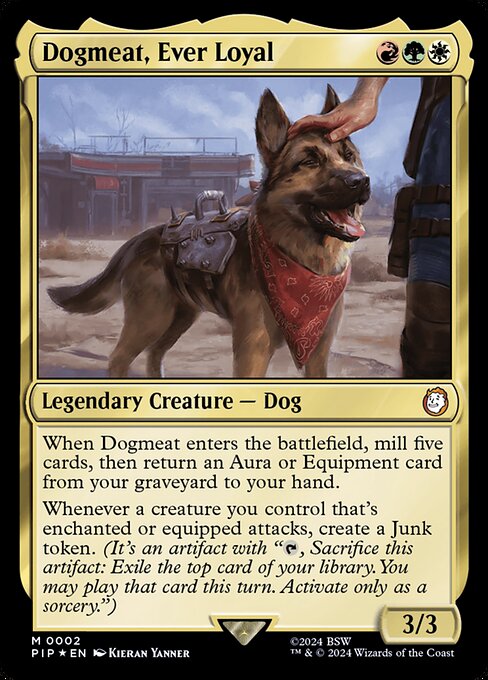
Dogmeat, Ever Loyal only pays you when a creature that’s enchanted or equipped attacks, so every one of those attachments is waiting on a body, and the box shipped five fewer bodies than attachments. Closing that gap is what most of the fifteen swaps below are doing. The rest go after three cards that clear your own board in a deck that keeps all its value on the board, and a mana base where seven lands do nothing on the turn they arrive.
100 cards, 37 lands (12 basic), 25 creatures, average mana value 2.48. Mana sources: 24 white, 23 red, 26 green.
No Game Changers and no mass land denial, so it sets no bracket floor. How brackets work →
The stock Scrappy Survivors decklist, and what it is worth →
The box brings twenty-four attachments and nineteen creatures
Fifteen Auras and thirteen Equipment, so twenty-eight attachments in a ninety-nine card deck. Four of the Auras enchant a land rather than a creature: Wild Growth, Fertile Ground, Abundant Growth and Squirrel Nest. That leaves twenty-four cards that can legally go on a creature, and nineteen creatures to put them on, counting Dogmeat himself.
The commander is what makes that arithmetic matter. His second ability reads “whenever a creature you control that’s enchanted or equipped attacks”, which is a separate trigger for each such creature. Three enchanted attackers make three Junk tokens. One creature wearing three Auras makes one. So the deck’s output is capped by how many bodies you can send, not by how much gear you drew, and the box got that ratio backwards.
There’s a second cost to being short on creatures. An Aura on a creature that dies is two cards for one, and the box clearly knows it: Cass, Hand of Vengeance returns Auras when an enchanted or equipped creature dies, Brotherhood Outcast and Super Mutant Scavenger buy an attachment back out of the graveyard, Pre-War Formalwear reanimates a cheap creature with itself attached, and Mantle of the Ancients returns the whole pile. Five cards in the box exist to undo the trade. Not one of them stops it happening.
So the shape of this upgrade is fixed before I pick a single card. More bodies, some protection on the bodies I have, and fewer attachments that were only ever going to sit on one creature.
What are the best Scrappy Survivors upgrades?
- Ardenn, Intrepid Archaeologist, $4.44. At the beginning of combat you may attach any number of Auras and Equipment you control to any target. One Equipment spread across three creatures is three Junk tokens instead of one.
- Sram, Senior Edificer, $1.99. A card for every Aura, Equipment or Vehicle spell you cast, and the upgraded list runs twenty-three of them.
- Hammer of Nazahn, $15.01. It attaches every Equipment that enters for free and makes the wearer indestructible. It’s the priciest thing on my list and it does two jobs this deck was paying full price for.
- Kor Spiritdancer, 40 cents. Draws on every Aura you cast and gets +2/+2 for each one attached to her.
- Bear Umbra, $11.85. Umbra armor means removal eats the Aura instead of the creature, and the wearer untaps all your lands when it attacks.
- Swords to Plowshares and Generous Gift, $2.02 for the pair. The box ships four pieces of targeted interaction for a four-player format.
All fifteen adds and what they cost are in the decklist further down. The fifteen cards they replace are listed here.
One Equipment, three Junk tokens
Ardenn, Intrepid Archaeologist is the single card I would buy first, and it’s $4.44. Every combat, before attackers are declared, you may move any number of Auras and Equipment you control to any target. In a deck that triggers per attacking creature, that ability converts a concentrated board into a wide one for free, every turn, at the exact moment the trigger checks.
The box already had two ways to move gear around and neither is as good. Codsworth, Handy Helper taps to attach one Aura or Equipment. Inventory Management reattaches everything you control at instant speed with split second, which is a blowout once and a dead card the rest of the time. Ardenn does the smaller version of that job every single turn and asks for nothing.
Equip costs are the other tax on going wide, and this deck pays less of it than it looks. Puresteel Paladin gives your Equipment equip {0} while you control three or more artifacts, and Junk tokens are artifacts, so the commander’s own trigger turns metalcraft on. Hammer of Nazahn attaches each Equipment as it enters. Danitha Capashen, Paragon takes {1} off every Aura and Equipment spell, and Bruenor Battlehammer makes the first equip each turn free. Between them the deck stops choosing between casting a threat and dressing one.
Five new creatures, every one of them reading the words Aura or Equipment
Creature count goes from nineteen to twenty-five, and none of the five is a body for its own sake.
Sram, Senior Edificer draws on Aura, Equipment and Vehicle spells, which in the upgraded list is twenty-three cards. Kor Spiritdancer draws on Aura casts and grows +2/+2 per Aura on her, for 40 cents. Sythis, Harvest's Hand draws on any enchantment spell, so she catches the eleven Auras and both Sagas, thirteen cards in total. Danitha Capashen, Paragon discounts every attachment and is a first strike lifelink body that’s genuinely worth dressing. Bruenor Battlehammer gives each of your creatures +2/+0 for every Equipment attached to it, with twelve Equipment in the deck to find.
Card draw goes from eight sources to eleven on that alone, which is what I want from a deck whose engine spends cards two at a time.
Umbra armor turns the two-for-one into a one-for-one
The way an Aura deck loses is that somebody kills the creature and takes two or three cards with it. Two of my adds answer that directly. Hyena Umbra costs {W} and 39 cents, Bear Umbra costs {2}{G}{G} and $11.85, and both have umbra armor: if the enchanted creature would be destroyed, the Aura is destroyed instead and the creature survives with its damage removed. Hammer of Nazahn skips the middle step and hands the wearer indestructible.
Bear Umbra is doing more than that. Untapping all your lands when the wearer attacks means you can commit your mana before combat and still hold up Heroic Intervention, which the box already runs and which covers the whole board rather than one creature.
None of this stops exile or a toughness reduction. If $11.85 for one Aura reads high, Snake Umbra is $1.31 for +1/+1, a draw trigger on damage and the same umbra armor clause, and it’s the version I’d buy first on a tighter budget.
Fifteen cards leave, and three of them clear your own board
Blasphemous Act deals 13 damage to each creature. Megaton's Fate can deal 8 to each creature. Single Combat makes every player sacrifice all but one creature. Three cards, all symmetrical, in a deck holding twenty-four attachments that need creatures to live on. Every one of them costs you more than it costs the table, because your board is where your cards went. All three go.
That does leave the deck with no way at all to reset a board, and I’m comfortable with it. The replacements are targeted: Swords to Plowshares and Generous Gift take the count of one-for-one answers from four to five, Chaos Warp handles anything a colour pie says it shouldn’t, and Heroic Intervention protects your side through somebody else’s sweeper. Playing the deck that keeps its value on the battlefield means the mass-removal slot belongs to the other three seats.
Then the attachments that were only ever going on a single creature. Almost Perfect is six mana to make one creature a 9/10. Grim Reaper's Sprint is five, or two if something already died. Brass Knuckles costs four and only grants double strike once two Equipment are on the same body. Fireshrieker is three plus an equip cost for a narrower version of the same effect. Strong Back spends three mana discounting other attachments. Acquired Mutation goads the creature it enchants, which is a fine card in a deck that wants to hand something to an opponent and a strange one here.
Idolized is the sharpest of them. It pays the enchanted creature +X/+X when it attacks alone, and attacking alone is the precise opposite of what the commander is asking for.
Squirrel Nest goes for two reasons. It’s three mana for a Squirrel a turn, and it enchants a land, so it never turns Dogmeat on. It’s also the only card in the box that wants two green pips by turn three, and with twenty-seven green sources the box gets there 76% of the time. Cutting it takes that shortage off the board entirely.
The cuts sell for $10.02 together at market, so this is close to a straight spend rather than a trade.
Seven lands that do nothing on arrival, and one with a dead ability
Scattered Groves, Sheltered Thicket, Temple of Abandon, Temple of Plenty, Temple of Triumph, Jungle Shrine and Path of Ancestry all enter tapped unconditionally. The stock deck averages 2.82 mana value, so a tapland on turn two skips a turn of the plan rather than a fraction of one.
Path of Ancestry is the one to look at hardest. It scries only when you tap it for a creature spell that shares a creature type with your commander, and your commander is a Dog. He is the only Dog in the deck. That ability fires on exactly one card in the hundred, and it’s the one you cast out of the command zone anyway.
Temple of the False God is worse and doesn’t even read as a tapland, because it produces no mana at all until you control five lands. Both of those go, along with Temple of Abandon and Temple of Plenty. Temple of Triumph and Jungle Shrine stay because three-colour fixing is worth a turn, and Scattered Groves and Sheltered Thicket stay because they cycle when you don’t need a land.
In come Battlefield Forge, Karplusan Forest and Brushland at 46 cents, 50 cents and $1.75. They enter untapped, they cover all three colour pairs between them, and they charge you a life. Lands that enter tapped drop from seven to four, untapped lands go from twenty-six to twenty-eight, land count falls from thirty-eight to thirty-seven, and average mana value drops from 2.82 to 2.48.
What I’m not fixing: Canopy Vista and Cinder Glade both want two or more basic lands, and this deck runs twelve basics across thirty-eight lands. By turn three on the play you’ve drawn two or more of them 30% of the time. Those two are conditional in practice, not just on the card. The real fix is three untapped duals with no condition written on them, and spending most of this budget on lands rather than on the engine is the wrong trade for a deck this cheap. The pain lands sidestep the question rather than answering it.
Two shortages survive the swaps and both are worth naming. Red has twenty-three sources against the twenty-four the deck wants for a single red pip on turn two, which is 89% against a 90% target and inside the noise. White wants {W}{W} by turn three for Mantle of the Ancients and Puresteel Paladin, and twenty-four white sources gets there 69% of the time. Cutting Single Combat took the third card off that list. The two survivors are worth the risk, because Mantle is the deck’s best card and Puresteel is a two-drop you are perfectly happy casting on turn four.
The five-mana Aura and the twenty-four-dollar robot both stay
Mantle of the Ancients costs five, enchants one creature, and is the best card in the ninety-nine. It returns any number of Aura and Equipment cards from your graveyard to the battlefield attached to the enchanted creature. Dogmeat mills five cards every time he enters, which fills that graveyard for you, and the two-for-one problem above supplies the rest.
Codsworth, Handy Helper is $24.27, the most expensive card in the box that has a market price at all. He taps for {W}{W} restricted to Auras and Equipment, taps to move an attachment, and gives your commander ward {2}. He’s a Robot rather than a Human, which matters not at all here, for a reason worth a paragraph of its own.
Fifteen of the nineteen creatures in the box are Human, 79% of them. Not one card in the hundred asks you to choose a creature type or reads the word Human. The Human count is set dressing, which is why nothing on my add list is a Human and why being off-type is no reason to touch Codsworth, Mister Gutsy or Super Mutant Scavenger. It’s also why Path of Ancestry had nothing to offer.
Three more survive on their text rather than their cost. Rancor is the one Aura in the deck that can’t be traded down, because it returns to your hand from the graveyard. All That Glitters gets +1/+1 for each artifact and enchantment you control, and Junk tokens are artifacts, so the commander’s trigger grows it. Pip-Boy 3000 costs one mana and either draws or adds a counter every time the wearer attacks.
The upgraded decklist
All hundred cards with the fifteen swaps applied. Hover a name anywhere on this page to see the card and its price.
“Load into the deck builder” opens this list in your account, pinned to the printings the box shipped, ready to edit or save. “Copy decklist” gives you plain text for Moxfield, Archidekt or Arena — no account needed.
Commander 1
- Dogmeat, Ever Loyal



Creatures 24
- Ardenn, Intrepid Archaeologist
- Armory Paladin
- Bighorner Rancher
- Brotherhood Outcast
- Bruenor Battlehammer
- Cait, Cage Brawler
- Cass, Hand of Vengeance
- Codsworth, Handy Helper
- Commander Sofia Daguerre
- Crimson Caravaneer
- Danitha Capashen, Paragon
- Duchess, Wayward Tavernkeep
- Gunner Conscript
- Ian the Reckless
- Kor Spiritdancer
- Mister Gutsy
- Moira Brown, Guide Author
- Preston Garvey, Minuteman
- Puresteel Paladin
- Sram, Senior Edificer
- Super Mutant Scavenger
- Sythis, Harvest's Hand
- Three Dog, Galaxy News DJ
- Veronica, Dissident Scribe




Instants 8
- Break Down
- Chaos Warp
- Generous Gift
- Heroic Intervention
- Inventory Management
- Path to Exile
- Swords to Plowshares
- Valorous Stance
Sorceries 1
- Open the Armory
Artifacts 16
- Agility Bobblehead
- Arcane Signet
- Basilisk Collar
- Behemoth Sledge
- Bloodforged Battle-Axe
- Champion's Helm
- Explorer's Scope
- Hammer of Nazahn
- Junk Jet
- Masterwork of Ingenuity
- Perception Bobblehead
- Pip-Boy 3000
- Pre-War Formalwear
- Silver Shroud Costume
- Sol Ring
- Swiftfoot Boots
Enchantments 13
- Abundant Growth
- All That Glitters
- Animal Friend
- Bear Umbra
- Fertile Ground
- Hyena Umbra
- Mantle of the Ancients
- Rancor
- Sticky Fingers
- Vault 101: Birthday Party
- Vault 21: House Gambit
- Well Rested
- Wild Growth
Lands 37
- Ash Barrens
- Battlefield Forge
- Brushland
- Buried Ruin
- Canopy Vista
- Cinder Glade
- Clifftop Retreat
- Command Tower
- Evolving Wilds
- Exotic Orchard
- 4× Forest
- Jungle Shrine
- Junktown
- Karplusan Forest
- Mossfire Valley
- 4× Mountain
- 4× Plains
- Roadside Reliquary
- Rogue's Passage
- Rootbound Crag
- Scattered Groves
- Scavenger Grounds
- Sheltered Thicket
- Sungrass Prairie
- Sunpetal Grove
- Sunscorched Divide
- Temple of Triumph
- Terramorphic Expanse
FAQ
Does Dogmeat make one Junk token per attack, or one per creature?
One per creature. The trigger reads whenever a creature you control that’s enchanted or equipped attacks, so it checks each attacking creature on its own. Send three creatures carrying one Aura or Equipment each and you get three Junk tokens. Pile three Auras onto one creature and you get one. That is the whole reason this guide buys bodies and re-attachment rather than more gear.
Do the Auras that enchant a land turn Dogmeat on?
No. Wild Growth, Fertile Ground and Abundant Growth all enchant a land, and the Junk trigger needs an enchanted or equipped creature to attack. They are still live for his other ability, because the enters-the-battlefield trigger returns an Aura or Equipment card from your graveyard to your hand and those are Aura cards. They just never make Junk.
Why cut Blasphemous Act when nothing else in the deck sweeps a board?
Because the board it sweeps is mostly yours. Twenty-four of the cards in the box are attachments that do nothing once the creature underneath them is gone, so a symmetrical sweeper cashes two or three of your cards in for one of everybody else’s. The upgraded list answers big creatures one at a time instead, with five pieces of targeted removal plus Chaos Warp, and it keeps its own board alive with Heroic Intervention and two umbra armor Auras.
Do Junk tokens count toward Puresteel Paladin’s metalcraft?
They do. A Junk token is an artifact token, so every one your commander makes counts toward the three artifacts Puresteel Paladin is asking for, and the deck already runs Sol Ring, Arcane Signet, two Bobbleheads and twelve Equipment. Equip {0} on all of it is one of the cheapest ways this deck goes wide, and the commander sets it up by doing what it was going to do anyway.
Is Scrappy Survivors worth playing straight out of the box?
Yes, with one caveat. Every card in it is on theme, the Junk tokens give a stalled board something to do, and the deck wins through attacking rather than through an engine nobody at the table can follow, which makes it a good deck to hand a new player. The caveat is the one this whole guide is about: it cannot get its attachments onto enough creatures. If you want to know what the ninety-nine are worth as singles before you buy, that number lives on the Scrappy Survivors decklist page rather than here, because it moves every night.
What bracket does Scrappy Survivors sit in after these swaps?
The same one it shipped in. Neither the box nor the fifteen new cards includes a Game Changer, mass land denial, an extra-turn chain or a two-card combo, so the floor does not move. The one thing worth flagging is Open the Armory, a targeted tutor the box did not have. It finds an Aura or Equipment, it is not a Game Changer, and it does not change the number this deck can honestly claim.
What do the fifteen upgrades cost?
$49.32 at September 2026 market prices for default printings. Hammer of Nazahn at $15.01 and Bear Umbra at $11.85 are more than half of that between them, and ten of the fifteen cards are under $2. The fifteen cards they replace are worth $10.02 together, so the real outlay is a little under $40.