Lorehold Spirit precon upgrade guide
This commander doesn't want a full graveyard. It wants an emptying one, and the box ships twenty-five cards that can do the emptying.
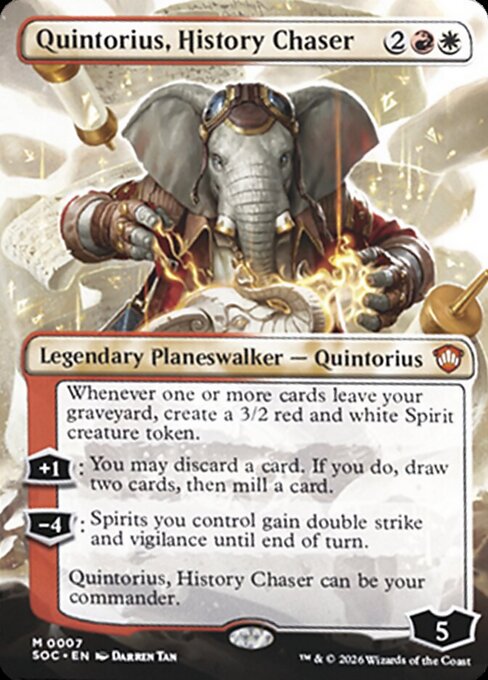
Quintorius, History Chaser is a planeswalker you cast for four mana, and the line that decides the deck isn't a loyalty ability. “Whenever one or more cards leave your graveyard, create a 3/2 red and white Spirit creature token” has no cost, no limit and no once-each-turn clause. Every reanimation, every graveyard exile, every card you bottom or shuffle away is a body. The box understands that — twenty-five of its ninety-nine cards can make a card leave your graveyard, and seven more pay you a second time when one does. What it doesn't do is make it happen early. Nine of the twenty-five cost two mana or less. Seven cost five or more, which is more than the commander.

Upgraded list: 100 cards, 36 lands (17 basic), 34 creatures, average mana value 2.95. Mana sources: 35 white, 28 red. No Game Changers and no mass land denial, so the deck sets no bracket floor. How brackets work →
What are the best Lorehold Spirit upgrades?
Six cards, in the order I'd buy them. Each is argued further down.
- Bennie Bracks, Zoologist — draws a card at each end step you made a token, not just your own, and five cards in this deck make tokens at instant speed. It's also the priciest thing on this page.
- Spectator Seating — a red-white dual that enters tapped only if you have fewer than two opponents, which in Commander is never.
- Reito Lantern — {3} to bottom a card from a graveyard, with no tap symbol in the cost. Every spare three mana becomes another 3/2.
- Junktroller — the same effect once a turn for free, on a 0/6 wall that blocks what your tokens can't.
- Intangible Virtue — thirty cents, and the whole token stream becomes 4/3 with vigilance.
- Relic of Progenitus — one mana, and tapping it at your own graveyard is a Spirit every turn.
The rest, and what comes out for them, is further down the page. Nothing on this list is a Game Changer and nothing in the box is either, so the upgraded deck sets no bracket floor, the same as the box.
The trigger is “leave”, and half this deck is about “fill”
Milling yourself makes no Spirits. Discarding makes no Spirits. Cards going into the graveyard is setup, and the token arrives only when something goes back out.
The box is generous with the setup half. The commander's own +1 discards a card and mills another, Millikin taps for mana by milling, Perpetual Timepiece mills two, Faithless Looting and Seize the Spoils each turn a card into two, and Fields of Strife will surveil for four mana. None of that puts a creature on the battlefield by itself.
Here is the other half, sorted by what it costs you to fire it. Two lands: Mistveil Plains and Emeria, the Sky Ruin. Two one-drops: Currency Converter and Faithless Looting. Five two-drops, five three-drops, four four-drops, five five-drops and two six-drops.
Six of the twenty-five ask nothing of you but the turn arriving. Squee, Goblin Nabob returns himself to your hand at every upkeep, for free, forever. Mistveil Plains bottoms a card for one white mana. Advanced Reconstruction exiles one at random in your first main phase. Quintorius, Loremaster exiles one at your end step and makes its own 3/2 alongside the commander's. Serra Paragon lets you replay a permanent once each turn. Emeria, the Sky Ruin returns a creature every upkeep once you control seven Plains — and sixteen of the box's lands carry the Plains type, so that's a clock rather than a wish.
The other nineteen want something first: an attack that connects, a discard, or five to six mana. That gap is what this list is trying to close.
Name Spirit, because it's the only type this deck manufactures
Patchwork Banner is the one card in the box that makes you choose a creature type. Nineteen of thirty-six creatures are Spirits. Cleric comes second at eight, and three of those eight are Spirit Clerics you'd be covering anyway. All four Knights are Spirit Knights.
The tiebreaker isn't the count in the ninety-nine. It's that every 3/2 the commander makes is a Spirit, so Spirit is the only creature type in this deck whose numbers go up while you're playing.
Four cards already point that way. Hofri Ghostforge gives Spirits +1/+1, trample and haste. Vanguard of the Restless gives them +1/+1 for each time you've cast your commander from the command zone. Quintorius, Field Historian gives them +1/+0 and repeats the commander's trigger, so every card that leaves your graveyard makes two tokens instead of one. The commander's own −4 hands them double strike and vigilance.
Balefire Liege isn't on that list and pumps the tokens harder than any of it. It gives other red creatures +1/+1 and other white creatures +1/+1, and the tokens are red and white, so they collect both. A 3/2 becomes a 5/4 off one card.
One card in this deck wants two red mana. The pip count says five.
Twenty-seven red sources against thirty-four white, in thirty-seven lands. The deck is less red than that split makes it look.
Five cards read as wanting {R}{R} by turn three. Read the costs and exactly one does: Atsushi, the Blazing Sky, at {2}{R}{R}. Balefire Liege costs {2}{R/W}{R/W}{R/W}, and hybrid pips are payable in white, so it can be cast without a red source at all.
The other three are the set's new split cards, and they're worth understanding on their own terms. Kirol, History Buff, Lorehold Archivist and Naktamun Lorespinner each become prepared when a condition is met — and while a card is prepared, you may cast a copy of the spell on its back face, which unprepares it. So Kirol, History Buff costs {R}{W} and Pack a Punch costs {1}{R}{W}, printed on one card. Each half wants a single red. Adding the halves together is what makes them read as double-red cards, and nothing in a game ever asks you to pay both at once.
White is where the real shortfall is, and it's a small one. Ten cards genuinely want {W}{W} by turn three and Moonshaker Cavalry wants {W}{W}{W}. Thirty-four sources gets you a second white by turn three 88.2% of the time on the play, against the thirty-six sources you'd want for 90%.
Those percentages come from the same hypergeometric model as the site's calculators, run against this deck's exact source counts. Mana Base Calculator → if you want to check a different curve, or Deck Mana Audit → to run your own list through it.
So the mana fix here is white sources and untapped lands. Chasing red would be fixing a problem the deck doesn't have.
Eight lands enter tapped, and two of them aren't there for mana
Mistveil Plains taps, with one white mana, to put a card from your graveyard on the bottom of your library. That's a token, at instant speed, every turn, off a land. Emeria, the Sky Ruin returns a creature every upkeep once you have seven Plains. Both always enter tapped and both are staying, because neither is really a land in this deck.
The other six — Glittering Massif, Temple of Triumph, Lotus Field, Fields of Strife, Lorehold Campus and Sacred Peaks — are lands. Lotus Field is the one that also eats two more of them on the way in.
Sunscorched Divide is the odd case, because it enters untapped and then charges {1} to produce {R}{W}. On the turn a spare mana is the thing you don't have, it makes none at all.
What I'd cut
Thirteen cards. The board wipe first, because it's the one I'd take out of the box before the first game.
A sweeper that kills every token you've made
Wave of Reckoning has each creature deal damage to itself equal to its power. The commander's Spirits are 3/2, so all of them die. So do Quintorius, Loremaster's, and so does everything Ceaseless Conflict just handed you, because they're the same 3/2. This deck's entire output is creatures whose power is bigger than their toughness, which makes Wave of Reckoning a symmetrical wipe that isn't symmetrical at all.
The box ships two other cards that clear a board and I'm keeping both. Ceaseless Conflict destroys all creatures and gives you a 3/2 for each nontoken one you lost. Tragic Arrogance lets you choose what everybody keeps, and your commander is a planeswalker, so it's on the list of things you're allowed to keep.
The three most expensive ways to trigger the commander
Sun Titan at six, Angel of Indemnity at six, Guardian Scalelord at five. Each returns something from your graveyard, and in isolation each is fine. In a deck that already has twenty-five ways to do it, six mana is a lot to pay for the twenty-sixth. Guardian Scalelord doesn't even do it on arrival — it has to attack first.
Losing these three empties the six-drop slot entirely and takes the average mana value from 3.21 to 2.95.
Three cards doing a job this deck doesn't have
Claim Jumper searches only when an opponent controls more lands than you, so it's blank on the boards where you're doing well. Secret Rendezvous draws you three cards and an opponent three cards. Bitterthorn, Nissa's Animus is Equipment in a deck whose creatures show up as a stream of identical 3/2s, and the +1/+1 lands on one of them.
Anger, and the card that keeps exiling it
Anger sits in your graveyard granting your creatures haste as long as you control a Mountain, which reads like a free ability in a deck that fills its own graveyard on purpose.
Advanced Reconstruction is the problem. It exiles a card from your graveyard at random at the beginning of every one of your first main phases, and Anger is a legal target for that every single turn. You may play the exiled card that turn, so it isn't lost — it just isn't haste any more. Hofri Ghostforge already gives the Spirits haste, and Hofri is staying.
Five lands
Lotus Field, Sunscorched Divide, Sacred Peaks, Lorehold Campus and Fields of Strife. Sacred Peaks has no text beyond entering tapped. Lorehold Campus charges {4} to scry one. Fields of Strife charges {2}{R}{W} to surveil one, which is four mana to put a card in the graveyard in a deck that would rather take one out.
What I'd add
Three artifacts that turn spare mana into Spirits
Reito Lantern costs {2}, then {3} to put a card from a graveyard on the bottom of its owner's library. There's no tap symbol in that activation cost, so it isn't once a turn. Nine spare mana in a late turn is three 3/2s.
Junktroller does the same thing once a turn for nothing, on a 0/6 Defender. Four mana for a wall is a real price, and a 0/6 blocks most of what a table of Commander decks attacks with while your own board is a pile of 2-toughness tokens.
Relic of Progenitus is one mana and taps to exile a card from any graveyard.
All three can point at somebody else's graveyard instead, which is the part I like: the same tap that makes you a Spirit takes a reanimation target off an opponent, and neither half costs extra.
The card that draws on everyone's end step
Bennie Bracks, Zoologist draws you a card at the beginning of each end step where you created a token that turn. In a four-player game that clause is worth four times what it looks like, and this deck can actually meet it — Mistveil Plains, Reito Lantern, Remorseful Cleric, Perpetual Timepiece and Lorehold Charm all work at instant speed, so a Spirit on each opponent's turn costs one white mana and a tapped land.
It has convoke, which a board of 3/2s pays without noticing. At around eleven dollars it's the expensive card on this page, and it's the one I'd buy first.
Two payoffs for a board of 3/2s
Intangible Virtue makes every token 4/3 with vigilance. The toughness matters more than the power — 4/3 lives through the three-damage sweepers that a 3/2 doesn't — and vigilance means the same board attacks and blocks.
Goblin Bombardment gives the stream reach and an answer to exile removal, and it does something specific with Hofri Ghostforge. Sacrifice a nontoken creature: Hofri exiles it from your graveyard, that exile triggers your commander for a 3/2, and Hofri hands you a Spirit copy of the creature on top. One sacrifice, two new bodies and a damage.
Four lands and two rocks
Spectator Seating enters tapped only if you have fewer than two opponents, so in a pod it's an untapped dual with no drawback. Inspiring Vantage covers the first three turns, Sundown Pass covers every turn from the third on, and Sunbaked Canyon is untapped for a life and cashes itself in for a card once the game has gone long.
Talisman of Conviction and Boros Signet are the acceleration. The box runs seven accelerants against the eight to twelve I'd want, and both of these are also white sources, which is the pip that was actually short.
Loyal Retainers rounds it out at three mana: sacrifice it, return a legendary creature from your graveyard to the battlefield. There are eleven legendary creatures in the box to aim it at, and the return is a token as well as a body.
The cards that look like cuts and aren't
Most of the box's creatures aren't Spirits, and that reads worse than it is, because the deck's Spirit count comes from tokens rather than from the creature slots. Eighteen cards look cuttable on type or on cost and I'm keeping every one. Here they are.
Squee, Goblin Nabob is the one I'd defend hardest. He's a 1/1 Goblin for three mana, which is a terrible rate, and he returns himself from your graveyard to your hand at every upkeep. In this deck that's a free 3/2 Spirit every turn for the rest of the game, with no mana spent and no card spent. The worst body in the box is attached to its best engine.
Teshar, Ancestor's Apostle returns a creature with mana value 3 or less from your graveyard whenever you cast a historic spell, and twenty-three cards in the ninety-nine are historic — artifacts, legends, and the commander itself every time you recast it. Serra Paragon is an Angel, Hofri Ghostforge is a Dwarf and Teshar is a Bird; all three are the engine, and none of them cares what Patchwork Banner is set to.
Both other Quintorius cards are five-mana Elephants that read as overpriced. Quintorius, Loremaster exiles a card from your graveyard at your end step and makes a 3/2 of its own, so with the commander out that's two Spirits a turn on a timer nobody can interact with. Quintorius, Field Historian just runs the commander's trigger again, doubling every token you were already going to get.
Balefire Liege is the +2/+2 from earlier. Tragic Arrogance is the wipe I argued for keeping above. Millikin taps for mana by milling, which is both of the things this deck does, on a two-drop.
Conspiracy Theorist and Containment Construct are flagged as off-type and they're the cheapest enablers in the box. Both turn a discard into an exile from your graveyard, which is a token and a card you can still cast that turn. The commander's +1 discards every time you use it, so neither of them sits idle.
All three split cards stay. Lorehold Archivist prepares itself once you have three artifact or creature cards in your graveyard, and Restore Relic exiles one of them to make a token copy — a card that turns your graveyard into a permanent, and the only one in the box that wants the graveyard full. Kirol, History Buff prepares whenever a card leaves your graveyard, which is the deck's core trigger read back at you. Naktamun Lorespinner prepares when any player is down to one card, and its back half is Wheel of Fortune.
Two of the taplands are on the list and staying for the same reason as Emeria and Mistveil Plains, though a weaker one: Glittering Massif is a dual that cycles for {2} when you don't need a land, and Temple of Triumph scrys on the way in. Neither is exciting. Both are better than the four lands I did cut, and I'd rather stop at thirty-six lands than at thirty-four.
Moonshaker Cavalry isn't on the shortlist at all and I want to say why it survives anyway, because eight mana in a precon usually shouldn't. It's a 6/6 flier that gives your creatures flying and +X/+X where X is how many creatures you control, and a deck that has spent six turns making 3/2s is precisely the deck that ends a game with it.
What this list gives up
Cards that can empty your graveyard go from twenty-five to twenty-two, which sounds like the wrong direction. It isn't: the three I cut were the six-, six- and five-mana ones, and the three artifacts replacing them all fire without attacking. The count that decides games — enablers that trigger on your own schedule, with no attack and no discard — goes from six to nine.
Creature count drops from thirty-six to thirty-four and the Spirit share goes up, 53% to 56%. Legendary creatures go from eleven to twelve.
The mana moves the way you'd expect and not by much. White sources go from thirty-four to thirty-five and the turn-three double white from 88.2% to 89.5%; red goes twenty-seven to twenty-eight. What changes properly is when the lands are usable: always-tapped drops from eight to four, and two of the four survivors are Mistveil Plains and Emeria, which are engine pieces wearing a land's type line. Land count comes down by one, to thirty-six.
The curve gets a full mana value cheaper in the places that hurt. Six-drops go from two to zero, five-drops from eleven to nine, two-drops from sixteen to twenty-one, and the average from 3.21 to 2.95.
The box prices at $68.34 and the upgraded list at $95.23. The thirteen adds are about thirty-eight dollars of cards and the thirteen cuts give eleven of it back. Nothing changes about the bracket: the box has no Game Changers and no mass land denial, this list adds neither, so the deck still sets no floor and can be played wherever the box could.
The upgraded decklist
All 100 cards with the thirteen swaps applied. Hover any name to see the card.
“Load into the deck builder” opens this list in your account, pinned to the printings the box shipped, ready to edit or save. “Copy decklist” gives you plain text for Moxfield, Archidekt or Arena — no account needed.
Commander 1
- Quintorius, History Chaser

Creatures 34
- Ao, the Dawn Sky
- Atsushi, the Blazing Sky
- Augusta, Order Returned
- Balefire Liege
- Bennie Bracks, Zoologist
- Conspiracy Theorist
- Containment Construct
- Drumbellower
- Excava, the Risen Past
- Guardian of Faith
- Hofri Ghostforge
- Junktroller
- Kami of Ancient Law
- Karmic Guide
- Kirol, History Buff // Pack a Punch
- Laelia, the Blade Reforged
- Lorehold Archivist // Restore Relic
- Loyal Retainers
- Millikin
- Moonshaker Cavalry
- Naktamun Lorespinner // Wheel of Fortune
- Quintorius, Field Historian
- Quintorius, Loremaster
- Relic Retriever
- Remorseful Cleric
- Selfless Spirit
- Serra Paragon
- Skyclave Apparition
- Spirit of Resilience
- Squee, Goblin Nabob
- Teshar, Ancestor's Apostle
- Vanguard of the Restless
- Venerable Warsinger
- White Orchid Phantom

Instants 3
- Lorehold Charm
- Path to Exile
- Swords to Plowshares
Sorceries 7
- Ceaseless Conflict
- Faithless Looting
- Fateful Tempest
- Rip Apart
- Seize the Spoils
- Sevinne's Reclamation
- Tragic Arrogance
Artifacts 13
- Arcane Signet
- Archaeomancer's Map
- Boros Signet
- Currency Converter
- Fellwar Stone
- Mind Stone
- Patchwork Banner
- Perpetual Timepiece
- Reito Lantern
- Relic of Progenitus
- Sol Ring
- Staff of the Storyteller
- Talisman of Conviction
Enchantments 6
- Advanced Reconstruction
- Goblin Bombardment
- Intangible Virtue
- Monologue Tax
- Primary Research
- Tocasia's Welcome
Lands 36
- Battlefield Forge
- Clifftop Retreat
- Command Tower
- Emeria, the Sky Ruin
- Exotic Orchard
- Fabled Passage
- Furycalm Snarl
- Glittering Massif
- Inspiring Vantage
- Mistveil Plains
- 6× Mountain
- 11× Plains
- Radiant Summit
- Rugged Prairie
- Spectator Seating
- Study Hall
- Sunbaked Canyon
- Sundown Pass
- Temple of Triumph
- Terramorphic Expanse
- Turbulent Steppe
FAQ
Does milling myself make Spirit tokens?
No, and it's the most common way to misread this commander. The trigger is on cards leaving your graveyard, so milling, discarding and surveil only fill it. Something has to take a card back out — a reanimation spell, a graveyard exile, or a bottom-of-library effect like Mistveil Plains. The commander's own +1 discards and mills, which is setup for the trigger rather than the trigger itself.
Can Quintorius, History Chaser really be your commander?
Yes — the card says so in its own rules text, which is the only way a planeswalker is ever allowed to lead a deck. It works normally in every other respect: it costs {2}{R}{W}, it returns to the command zone when it dies, and commander tax applies each time you recast it. The catch is that it sits on the battlefield as a planeswalker, so opponents can attack it, and the token trigger only works while it's there.
What does “prepared” do on the Secrets of Strixhaven split cards?
While a permanent is prepared, you may cast a copy of the spell printed on its other face, and doing so unprepares it. The permanent itself stays on the battlefield. Lorehold Archivist becomes prepared at your upkeep if there are three or more artifact or creature cards in your graveyard; Kirol, History Buff becomes prepared whenever a card leaves your graveyard; Naktamun Lorespinner becomes prepared when any player is down to one card in hand, and the spell on its back is Wheel of Fortune.
Which creature type should I name with Patchwork Banner?
Spirit, and by a wider margin than the creature counts suggest. Nineteen of the thirty-six creatures are Spirits against eight Clerics, and three of those Clerics are Spirit Clerics you'd cover either way. The reason it isn't close is the tokens — every 3/2 the commander makes is a Spirit, so it's the only type whose count grows while you play. Naming Cleric instead would cover Hofri Ghostforge, both other Quintorius cards, Kirol and Teshar, and nothing else.
Should I put Divine Visitation in this deck?
I wouldn't. It turns your tokens into 4/4 Angels, which is more stats and switches off four cards at once: Hofri Ghostforge, Vanguard of the Restless and Quintorius, Field Historian all pump Spirits by name, and the commander's −4 gives double strike to Spirits. Anointed Procession does what you actually want — twice the tokens, still Spirits — but it costs more than the box does.
What's the cheapest upgrade here that changes games?
Reito Lantern, at under thirty cents. Its activated ability has no tap symbol in the cost, so it isn't limited to once a turn: three mana is a 3/2, nine mana is three of them, and every spare mana in a long turn becomes board. Junktroller and Intangible Virtue sit in the same price bracket and both do real work.
How many lands should this deck run after the swaps?
Thirty-six, down one from the box's thirty-seven, at an average mana value of 2.95. The count matters less here than which lands they are: the box's problem was eight lands entering tapped, and four of those are gone. Two of the four that stay — Mistveil Plains and Emeria, the Sky Ruin — are engine pieces that happen to be lands, and I'd play them tapped every time.
Do these swaps move the deck up a bracket?
No. The box ships no Game Changers and no mass land denial, none of the thirteen adds is a Game Changer either, so the upgraded list still sets no bracket floor and belongs at the same tables the box did. Goblin Bombardment is the only add a pod might read as a step up, and it's a two-mana enchantment doing what a token deck was going to do anyway.