Peace Offering precon upgrade guide
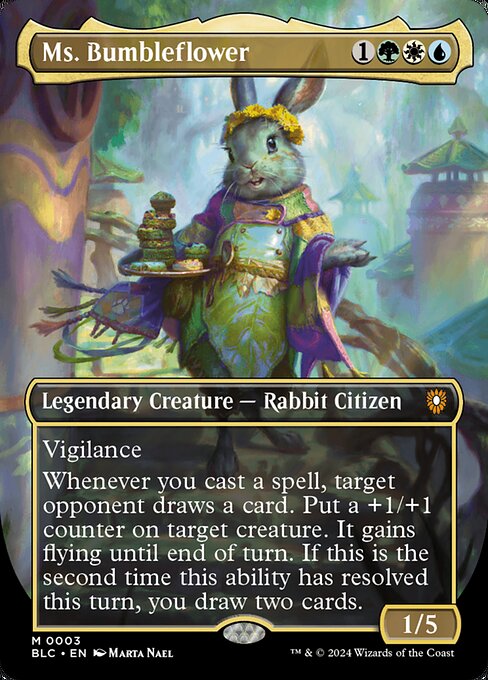
Fourteen of the sixty nonland cards in this box hand an opponent cards. Ms. Bumbleflower does that for free, on every spell you cast, and she does not ask permission first.
Her trigger has two halves and they are not worth the same. The first half is a tax: every spell you cast, target opponent draws a card. You do not get to decline it. The second half is the deck. If the ability resolves a second time in a turn, you draw two cards. Cast two spells, get paid.
The box built for the half it cannot avoid and left the half it wins with short of fuel. Five one-drops. Twenty-two cards at four mana or more. Seven lands that always enter tapped. Fourteen swaps, about $80, and the deck stops paying twice for the same effect.
100 cards, 38 lands (12 basic), 26 creatures, average mana value 2.84. Mana sources: 25 white, 25 blue, 27 green.
No Game Changers and no mass land denial, so it sets no bracket floor. How brackets work →
Best Peace Offering upgrades, ranked
If you buy nothing else, buy the top two. Every swap is argued below, and the cut list is spread across the next three sections rather than dumped in one.
- Hardened Scales ($2.86). The commander puts a +1/+1 counter on a creature every time you cast a spell. This makes it two counters. Fifteen cards in the upgraded list touch +1/+1 counters, so it is almost never a dead draw.
- Three shocklands for the three Temples. Temple Garden, Hallowed Fountain and Breeding Pool cost around $7 to $10 each depending on printing, and they take the box from seven always-tapped lands to three.
- Branching Evolution ($7.55). Doubling rather than incrementing, and it stacks with Hardened Scales: one spell then puts four counters on something.
- Mystic Remora ($12.77). You are already arming the table. Remora charges them four mana to cast what you gave them, or you draw.
- Path to Exile, Beast Within, Swan Song. Stock spot removal is four cards, the lowest count in the box. These three are also one and three mana, which matters for reasons the next section explains.
- Botanical Sanctum ($1.76). The box runs two of the three GWU fastlands and skipped this one.
Six cards pay for something you already get
Fourteen nonland cards in this box give an opponent cards. Eight of them earn it. Selvala, Explorer Returned turns the parley into mana and life. Communal Brewing converts the cards drawn into +1/+1 counters on your creatures. Long River's Pull and Peerless Recycling get strictly better when you promise the gift. Kwain, Itinerant Meddler is a tap outlet you choose to point somewhere.
Six of them just give.
- Rites of Flourishing draws each opponent an extra card every turn and draws you one. In a four-player game that is a three-to-one trade against you, every turn cycle, for three mana. The extra land drop is real, but this deck has 38 lands and nothing that cares about playing two.
- Ghirapur Orrery refills an empty-handed opponent with three cards. With 23 draw effects in the box, you are never the player it refills.
- Secret Rendezvous is three mana for three cards each. Nothing in the box punishes the opponent for holding them.
- Tenuous Truce hands one player a card per turn and sacrifices itself the moment either of you attacks the other. Two mana for a truce that a goaded creature can break on your behalf.
- Intellectual Offering is five mana for three cards each. The untap clause wants a board you have not built yet at five mana.
- Coveted Jewel gives three cards and the artifact itself to whoever connects with you once.
Cutting these is not an argument against generosity. Mangara, the Diplomat draws you a card whenever an opponent casts their second spell in a turn, and a table with more cards does cast more spells. Sunscorch Regent grows on every opponent's spell. The point is narrower: the commander already supplies more of that than the deck can convert, so these six slots buy nothing.
After the swaps, eight cards still hand opponents cards. That is the deliberate number.
You get paid on the second spell, not the first
Read the trigger once more: if this is the second time this ability has resolved this turn, you draw two cards. It says turn, not your turn. Two instants at an opponent's end step draws you two cards on their clock.
The box shipped 11 instants and 5 one-drops. That is a deck that casts one spell a turn and shrugs.
So four more cuts, three of them five-drops and none of them easy to cast alongside a second spell:
- Body of Knowledge and Perplexing Test, five mana each. The Test also bounces your own board, and you are the player with the most creatures.
- Promise of Loyalty, five mana, and a symmetrical wipe in a deck running 27 creatures. Every opponent keeps their best one.
- Martial Impetus, an aura you put on somebody else's creature and then hope about.
In come six instants and four cheap permanents: Path to Exile, Swan Song, Snakeskin Veil, Beast Within, Heroic Intervention, Inspiring Call, plus Hardened Scales, Mystic Remora, Branching Evolution and Nature's Lore.
The result: instants go from 11 to 15, one-drops from 5 to 10, and average mana value drops from 3.21 to 2.84. Cards at five mana or more fall from 13 to 8. Spot removal moves from 4 to 6, which is the first time the deck can answer a threat and still hold up a second spell.
Two cards in the box were waiting for this and nobody fed them. Jolrael, Mwonvuli Recluse makes a 2/2 Cat whenever you draw your second card in a turn, which is precisely what the commander's second trigger does. Forgotten Ancient and Managorger Hydra grow on any player's spell, so they were always fine. The counter doublers turn them from a body into a threat.
The box owns two of the three fastlands
This mana base is better than it looks and worse than it plays. Every GWU painland is here: Adarkar Wastes, Brushland, Yavimaya Coast. Every checkland: Glacial Fortress, Sunpetal Grove, Hinterland Harbor. Every filter land: Skycloud Expanse, Sungrass Prairie, Flooded Grove. Complete cycles, three times over.
Then the fastlands. Seachrome Coast and Razorverge Thicket are in the box; Botanical Sanctum is not. It costs $1.76.
What drags is the seven lands that always enter tapped, in a deck whose commander costs three and whose plan is two spells a turn. I cut four: the three Temples and Thriving Grove. In go the three shocklands and Botanical Sanctum. Always-tapped lands go from 7 to 3, and Seaside Citadel survives because a tri-land is worth one slow turn.
Two honest costs come with that. Green sources drop from 28 to 27, white from 27 to 25 and blue from 26 to 25, so the double-blue check on turn three gets slightly worse: 74.2% down to 71.8% for the three cards that want two blue pips. And Nature's Lore is on the list partly because it puts a Forest card onto the battlefield untapped, which now means Temple Garden or Breeding Pool. It misses Botanical Sanctum, which has no basic land type.
The white side improves, for a reason worth naming. Secret Rendezvous was the only turn-three double-white spell in the deck. Cutting it moves the white check out to turn four, which nudges it from 76.4% to 77.7% even after losing two white sources.
Three keeps that contradict something I just said
Wizard Class is a one-mana enchantment that mostly sits there, and a normal builder cuts it. It stays because level three reads whenever you draw a card, put a +1/+1 counter on target creature, and this deck draws a lot. More to the point, it is a one-drop in a deck that needs a cheap second spell, which is the card type I spent this whole upgrade buying.
Swiftfoot Boots looks like the single-creature problem I just used to cut Martial Impetus. It is not doing equipment work here. It keeps a three-mana commander on the table, and without her this deck does very little.
Snakeskin Veil is my own add and it also protects exactly one creature. The difference is one green mana, a counter at instant speed, and hexproof through a removal spell, all on the same card.
The best card for this deck is one I left out
Rhystic Study is the correct card here and it is not on the list. It costs $69.31, which is very nearly the price of the entire fourteen-card list above, and it takes a deck the bracket checker currently floors at Bracket 1 straight to Bracket 3, because one Game Changer is one Game Changer.
That is a real decision rather than a budget dodge. If you want the strongest version of Ms. Bumbleflower, buy Rhystic Study first and tell your table the bracket moved. Smothering Tithe ($61.30) and Cyclonic Rift ($39.37) sit behind it with the same caveat. If you want the deck to stay where the box put it, the fourteen swaps here leave the floor at Bracket 1 with no Game Changers at all.
The upgraded decklist
Every card name on this page is hoverable: point at one to see the card.
“Load into the deck builder” opens this list in your account, pinned to the printings the box shipped, ready to edit or save. “Copy decklist” gives you plain text for Moxfield, Archidekt or Arena — no account needed.
Commander 1
- Ms. Bumbleflower




Creatures 25
- Baird, Steward of Argive
- Bloodroot Apothecary
- Chasm Skulker
- Coiling Oracle
- Faeburrow Elder
- Forgotten Ancient
- Jolly Gerbils
- Jolrael, Mwonvuli Recluse
- Kalonian Hydra
- Kwain, Itinerant Meddler
- Loran of the Third Path
- Managorger Hydra
- Mangara, the Diplomat
- Mr. Foxglove
- Octomancer
- Psychosis Crawler
- Realm-Cloaked Giant // Cast Off
- Rishkar, Peema Renegade
- Selvala, Explorer Returned
- Sphinx of Enlightenment
- Spore Frog
- Steelburr Champion
- Sunscorch Regent
- Triskaidekaphile
- Twenty-Toed Toad




Planeswalkers 1
- Tamiyo, Field Researcher
Instants 15
- An Offer You Can't Refuse
- Beast Within
- Broken Wings
- Generous Gift
- Heroic Intervention
- Illusionist's Gambit
- Inspiring Call
- Long River's Pull
- Path to Exile
- Peerless Recycling
- Perch Protection
- Riot Control
- Snakeskin Veil
- Swan Song
- Swords to Plowshares
Sorceries 6
- Cultivate
- Farseek
- Nature's Lore
- Tempt with Bunnies
- Tempt with Discovery
- Wear Down
Artifacts 6
- Arcane Signet
- Fellwar Stone
- Mind Stone
- Sol Ring
- Swiftfoot Boots
- Thought Vessel
Enchantments 8
- Branching Evolution
- Communal Brewing
- Fisher's Talent
- Hardened Scales
- Hoofprints of the Stag
- Mystic Remora
- Simic Ascendancy
- Wizard Class
Lands 38
- Adarkar Wastes
- Botanical Sanctum
- Breeding Pool
- Brushland
- Canopy Vista
- Command Tower
- Evolving Wilds
- Exotic Orchard
- Flooded Grove
- 4× Forest
- Glacial Fortress
- Hallowed Fountain
- Hinterland Harbor
- 4× Island
- Overflowing Basin
- 4× Plains
- Prairie Stream
- Razorverge Thicket
- Reliquary Tower
- Seachrome Coast
- Seaside Citadel
- Skycloud Expanse
- Sungrass Prairie
- Sunpetal Grove
- Temple Garden
- Terramorphic Expanse
- Thriving Heath
- Thriving Isle
- Yavimaya Coast
FAQ
Does upgrading Peace Offering change its bracket?
Not with the fourteen swaps on this page. The box floors at Bracket 1 because it contains no Game Changers, and none of the adds here are on that list, so the upgraded deck floors at Bracket 1 as well. The moment you add Rhystic Study, Smothering Tithe or Cyclonic Rift, the floor becomes Bracket 3. That is the biggest fork in upgrading this deck, and it is a table conversation more than a deckbuilding one.
Can Ms. Bumbleflower's second trigger happen on someone else's turn?
Yes, and it is the most underused line in the deck. The ability counts resolutions per turn, not per your turn. Cast two instants during an opponent's end step and the second resolution draws you two cards. The stock deck ships 11 instants; the list here runs 15 for exactly this reason.
What does this upgrade cost?
Eleven of the fourteen adds come to $55.98 at market prices for their default printings. The three shocklands are the rest and run roughly $7 to $10 each depending on which printing you buy, so the whole list lands around $80. The two cards doing the most work, Hardened Scales and Botanical Sanctum, cost $2.86 and $1.76.
Is it bad to give three opponents extra cards?
It is a cost you accepted by playing this commander, so the real question is how much of it you buy on purpose. The box runs 14 nonland cards that hand opponents cards on top of the commander's own trigger. This list keeps 8 of them, the ones attached to a payoff: mana from Selvala, Explorer Returned, counters from Communal Brewing, a better spell from Long River's Pull. The six cut are the ones that give with nothing coming back.
Do I have to buy shocklands, or is there a cheaper mana fix?
Botanical Sanctum at $1.76 is the cheapest real improvement and I would buy it whatever else you do. Beyond that, the honest budget answer is to cut the three Temples for basic Forest, Plains and Island. You lose some fixing and gain speed, and with 12 basics already in the deck the two battle lands, Canopy Vista and Prairie Stream, get more reliable as a side effect. The shocklands are better. They are not required.
How does Peace Offering compare to the other Bloomburrow decks?
Out of the box this one is the slowest: a single board wipe, four pieces of spot removal, and 22 cards at four mana or more. What it has instead is a commander who draws two cards a turn for free once you build for it. Upgraded, the ceiling is higher than the stock list suggests, and the deck stops depending on opponents leaving it alone.
Is the sealed deck worth buying?
The singles come to at least $96.10 across 99 of the 100 cards, and the mana base carries much of that: complete painland, checkland and filter-land cycles in green, white and blue. If you want a starting point for a counters deck that also draws cards, those lands plus Kalonian Hydra make it a reasonable buy before you spend a dollar upgrading.