Squirreled Away precon upgrade guide
Thirty-one cards in this box make a token. Eight of them make the one Hazel doubles.
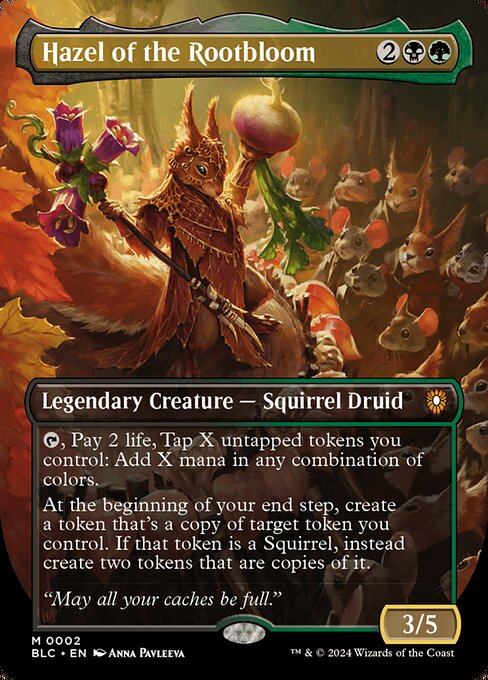
Hazel of the Rootbloom copies a token at the beginning of your end step, and if that token is a Squirrel she makes two copies instead of one. That second clause is the reason to play her. The box hands it to you switched off most of the time: Food, Treasure, Blood, Rats, Wolves, Pests, Spiders and a lone Goat all copy once and go home. Both of the cards that turn the clause permanently on are already in the ninety-nine, and one of them looks exactly like the sort of card a first-time upgrader cuts.
100 cards, 38 lands (17 basic), 32 creatures, average mana value 3.18. Mana sources: 32 black, 33 green.
No Game Changers and no mass land denial, so it sets no bracket floor. How brackets work →
Eight of the thirty-one token makers make a Squirrel
I resolved the shipped decklist and counted every card whose text creates a token: 31 of the 99. Eight of those make a Squirrel. They are Chatterfang, Squirrel General, Chatterstorm, Chitterspitter, Deep Forest Hermit, Nested Shambler, Rootcast Apprenticeship, Squirrel Nest and Swarmyard Massacre. The other twenty-three make something else, mostly Food (5 cards) and Treasure (4).
So the commander's headline ability runs at half strength about three-quarters of the time, and nothing in the box tells you that.
The creature census points at the same gap from the other side. Thirty creatures, nine of them Squirrels, 30% of the bodies. No creature type reaches half the deck, which is the profile of a goodstuff pile rather than a typal one. That reading is wrong here, though not for the reason the type line suggests: this deck's tribe arrives as tokens, and a token has no card in the list to be counted.
Both fixes are already in the ninety-nine
Chatterfang, Squirrel General says that if one or more tokens would be created under your control, those tokens plus that many 1/1 green Squirrel creature tokens are created instead. That is not a Squirrel payoff. It is a rule that converts all 31 of the token makers into Squirrel makers at once. Stack it with the commander and a free end-step trigger produces four bodies: copy a Squirrel token, Hazel makes two, Chatterfang adds two more.
Maskwood Nexus reaches the same place from the other direction. Creature tokens you control become every creature type, so the Wolves, the Rats, the Pests, the Spiders and the Goat all read as Squirrels for the doubling clause, and for Squirrel Sovereign, Honored Dreyleader, Chitterspitter and The Odd Acorn Gang.
Chatterfang is easy to cut for the same reason people cut Equipment: his activated ability pumps one creature for {B}. That reads the bottom line of the card and skips the middle one. He is the second-best card in the box and he stays.
Three more survive the same objection, and all three are attachments in a deck that goes wide:
- Skullclamp. One creature at a time, true. The average creature here is a 1/1 token, which makes this one mana to draw two cards, on repeat, for as long as the tokens keep coming.
- Sword of the Squeak. It attaches itself for free whenever a Squirrel enters, and it gets +1/+1 for every creature you control with base power or toughness 1. On a board of 1/1 tokens, that number is the whole board.
- Squirrel Nest. It enchants a land rather than a creature. A Squirrel every turn is a Squirrel the commander then doubles.
Nested Shambler belongs in the same paragraph for a different reason. It leaves behind Squirrels equal to its power, and Skullclamp sets its power to 2 on the way to killing it: one mana, draw two, two Squirrels.
Five cards, in the order I would buy them
- Ashnod's Altar ($15.67). A free sacrifice outlet that turns every token into two colourless mana. It answers the ramp problem below, it converts a Second Harvest turn into real mana, and it lets the drain package fire on demand rather than waiting on combat.
- Primal Vigor ($14.78). Every token you make arrives doubled, before the commander doubles it again.
- Ohran Frostfang ($7.47). Your creatures gain deathtouch and draw you a card each time they connect. A board of 1/1 tokens with deathtouch is one nobody can block profitably.
- Pitiless Plunderer ($4.08). Every creature death makes a Treasure, which is mana and also another token for the end-step copy.
- Blood Artist ($3.65). The box already runs Zulaport Cutthroat, Bastion of Remembrance and Nadier's Nightblade. This is the fourth copy of the effect that turns somebody else's board wipe into your win.
Two better token doublers exist and I skipped both on price: Parallel Lives at $38.97 and Doubling Season at $34.41, against a box whose singles come to $124.95. Primal Vigor does most of the job for under half that, and its symmetry is a real cost in a four-player pod rather than a technicality. If the budget goes up, Grave Pact ($32.45) and Dictate of Erebos ($17.67) are the next two cards in, ahead of either doubler. Guardian Project ($15.17) looks like it belongs and does not: it triggers on nontoken creatures entering, and this deck's creatures are mostly tokens.
The commander's mana ability needs the board it is meant to pay for
Hazel's first ability taps her, taps X untapped tokens and costs 2 life, to add X mana. Read on its own that is a mana engine. Read in sequence it is the last step rather than the first: the tokens have to already exist, they have to be untapped, and every one you tap is one that is not attacking or blocking.
The box leans on that ability anyway. It ships 4 ramp sources where a green deck this size usually runs 8 to 12, behind a commander who costs {2}{B}{G} and produces nothing until the turn after she resolves.
So I added the three cheapest pieces of ramp that also fix colour. Nature's Lore and Three Visits each put a Forest onto the battlefield untapped, and both of them can find Overgrown Tomb, because it is typed Swamp Forest. Sakura-Tribe Elder ramps, blocks something on the way, and then dies on your schedule, which this deck is paid for in seven different places. That moves ramp from 4 to 6: still under the usual range, and on purpose. The real acceleration here is a Treasure off Pitiless Plunderer, not a fifth signet.
Green wants thirty-six sources and the box brings thirty-three
Running the shipped list through the same hypergeometric maths as the mana base calculator: green needs 36 sources to have GG available on turn 3 at 90%, and the box has 33, which lands at 86.9%. Eight cards want that second green pip, and one of them is Second Harvest, the best card in the deck.
The tapped lands are the other half of it. Nine of the 38 enter tapped whatever you do, and Golgari Rot Farm additionally returns a land you control to your hand. Against a four-mana commander whose payoff is a once-per-turn trigger, a land that costs you a turn and then costs you a land is the worst card in the mana base by a distance.
I replaced four of them with lands that make the same two colours without the delay: Overgrown Tomb, Deathcap Glade, Darkbore Pathway and Nurturing Peatland. Always-tapped lands drop from 9 to 5, untapped rise from 27 to 29, and green sources stay at 33. That last number is the point. My first version of this list cut five tapped lands and replaced only three, which quietly took green down to 31 and pushed turn-3 GG from 86.9% to 83.9%. Land swaps have to be quality for quality here, or the mana base pays for the upgrade.
One more change costs nothing at all. The box runs 9 Forests and 8 Swamps. Make it 10 and 7. After the swaps black holds 32 sources against a single double-black card in the entire list, and it wants 30, so black can spare one. Green is the colour that is short.
The one sweeper is a card this deck cannot cast
Decree of Pain destroys all creatures and draws a card for each one. In a deck built to hold the widest board at the table, the player it hurts most is the one casting it: eight mana to destroy the board you spent the game assembling. The {3}{B}{B} cycling mode is no escape either, because -2/-2 to everything also clears your side. It is the only wipe in the box and it is the single card here I would never want to draw.
The other thirteen cuts sort into three piles.
Mana the deck cannot reliably make. Casualties of War costs {2}{B}{B}{G}{G}. Once the rest of the cuts are made it is the only card in the deck asking for two black and two green, and the mana is already three sources short on the green half of that.
Triggers that never see this board. Ogre Slumlord makes a Rat when another nontoken creature dies, and this deck's creatures are overwhelmingly tokens. Scurry of Squirrels makes token copies with myriad and then exiles them at end of combat, which happens before your end step, so the commander never gets to copy one. Moonstone Eulogist needs an opponent's creature to die before it makes anything, and it is the last double-black card in the list.
Too slow for the payoff. Wolfwillow Haven asks five mana and its own sacrifice for a single Wolf. Gourmand's Talent needs two more activations before it creates anything. Insatiable Frugivore is four mana for a Food. Rootcast Apprenticeship is four mana at sorcery speed and its best mode is a smaller Second Harvest. Windgrace's Judgment is five mana for removal in a deck already carrying ten pieces of it.
Four lands leave alongside them, all of them covered above: Golgari Rot Farm, Jungle Hollow, Temple of Malady and Haunted Mire.
What the fourteen swaps actually moved
Average mana value falls from 3.31 to 3.18 and the land count stays at 38. Always-tapped lands go 9 to 5. Ramp goes 4 to 6. Creatures go 30 to 32 while the Squirrel count on the creature list goes 9 to 8, which is the argument in miniature: the deck gets less Squirrel on paper and a great deal more Squirrel on the battlefield.
The bracket does not move. Both lists sit at a Bracket 1 floor with no Game Changers in either, and that is worth saying plainly, because roughly $70 of upgrades buys a much better deck and not a different bracket. Bracket describes what is in a deck, not how well it has been built.
Prices, as of September 2026: the box's singles come to at least $124.95 and the upgraded list to at least $185.75. Both are floors, because a couple of the default printings carry no market price at all, and this site shows nothing rather than guessing.
The upgraded decklist
The full hundred after the fourteen swaps. Hover any card name to see the card and its current price.
“Load into the deck builder” opens this list in your account, pinned to the printings the box shipped, ready to edit or save. “Copy decklist” gives you plain text for Moxfield, Archidekt or Arena — no account needed.
Commander 1
- Hazel of the Rootbloom



Creatures 31
- Academy Manufactor
- Arasta of the Endless Web
- Beledros Witherbloom
- Blood Artist
- Chatterfang, Squirrel General
- Chittering Witch
- Deep Forest Hermit
- End-Raze Forerunners
- Gilded Goose
- Haywire Mite
- Hazel's Brewmaster
- Honored Dreyleader
- Morbid Opportunist
- Mycoloth
- Nadier's Nightblade
- Nested Shambler
- Ohran Frostfang
- Pitiless Plunderer
- Plaguecrafter
- Poison-Tip Archer
- Prosperous Innkeeper
- Ravenous Squirrel
- Sakura-Tribe Elder
- Skyfisher Spider
- Squirrel Sovereign
- Tendershoot Dryad
- The Odd Acorn Gang
- Tireless Provisioner
- Toski, Bearer of Secrets
- Woe Strider
- Zulaport Cutthroat





Planeswalkers 1
- Garruk, Cursed Huntsman
Instants 7
- Cache Grab
- Deadly Dispute
- Plumb the Forbidden
- Putrefy
- Saw in Half
- Second Harvest
- Tear Asunder
Sorceries 6
- Chatterstorm
- Maelstrom Pulse
- Nature's Lore
- Shamanic Revelation
- Swarmyard Massacre
- Three Visits
Artifacts 10
- Arcane Signet
- Ashnod's Altar
- Chitterspitter
- Golgari Signet
- Idol of Oblivion
- Maskwood Nexus
- Skullclamp
- Sol Ring
- Sword of the Squeak
- Talisman of Resilience
Enchantments 6
- Bastion of Remembrance
- Beastmaster Ascension
- Binding the Old Gods
- Moldervine Reclamation
- Primal Vigor
- Squirrel Nest
Lands 38
- Barren Moor
- Bojuka Bog
- Command Tower
- Darkbore Pathway // Slitherbore Pathway
- Deathcap Glade
- Evolving Wilds
- Exotic Orchard
- 9× Forest
- Grim Backwoods
- Llanowar Wastes
- Necroblossom Snarl
- Nurturing Peatland
- Oran-Rief, the Vastwood
- Overgrown Tomb
- Path of Ancestry
- 8× Swamp
- Swarmyard
- Tainted Wood
- Terramorphic Expanse
- Tranquil Thicket
- Twilight Mire
- Viridescent Bog
- Woodland Cemetery
FAQ
Do I need Chatterfang for Squirreled Away to work?
No, but he is the single biggest reason the deck holds together. Chatterfang, Squirrel General turns every token creation into a Squirrel creation, which is what makes Hazel of the Rootbloom copy two tokens instead of one. He already comes in the box. Maskwood Nexus does a similar job by making your creature tokens count as Squirrels, so between the two of them you have redundancy without buying anything.
Does upgrading Squirreled Away change its Commander bracket?
No. The stock list and the upgraded list both sit at a Bracket 1 floor, because neither one contains a Game Changer. Around $70 of upgrades buys a noticeably stronger deck without moving it up a bracket, since bracket is determined by which cards are in a deck rather than by how well the deck is tuned.
What do the fourteen recommended cards cost?
About $69.80 at market prices for thirteen of the fourteen, in September 2026. The fourteenth, Overgrown Tomb, has no market price on its default printing, so treat that figure as a floor. The most expensive single card is Ashnod’s Altar at $15.67 and eight of the fourteen are under $5.
Why cut Decree of Pain when it is the deck’s only board wipe?
Because this deck is the one with the widest board. Decree of Pain kills all creatures, and in a token deck that means spending eight mana to destroy the board you spent the game assembling. Its cycling mode gives every creature -2/-2, which also wipes your side. A sweeper that is worse for you than for the table is not interaction, it is a liability.
Is Hazel’s mana ability actually worth using?
Sometimes, and later than you would think. Tapping X untapped tokens and paying 2 life to add X mana requires the board you were building the tokens for, and every token tapped is one not attacking or blocking. It is best saved for a single explosive turn, usually to cast Second Harvest or End-Raze Forerunners. It is not the deck’s ramp plan, which is why the upgrade list adds real ramp instead.
Is Squirreled Away good enough to play straight out of the box?
It is playable and it is coherent, which is more than several precons manage. Thirty-one of its ninety-nine cards make tokens and it has four separate drain effects to convert them. The weaknesses are structural rather than card quality: four ramp sources against a typical eight to twelve, nine lands that always enter tapped, and green sitting three sources short of a comfortable double-green turn three.