Enhanced Evolution precon upgrade guide
Two Islands. That is what this box ships to cast a {3}{B}{G}{U} commander with. The fourteen mutate creatures Otrimi, the Ever-Playful exists to return are the costlier problem: the cheapest of them mutates for three, and six want five or six.
Enhanced Evolution is the Sultai deck from Commander 2020, and resolving the shipped decklist card by card turns up three decks sharing one box. Fourteen creatures in the 99 have mutate, which is Otrimi's plan. Ten spells have {X} in their mana cost, which is Zaxara, the Exemplary's plan. She's the box's alternate commander, and she makes a Hydra whenever you cast one. And three Impetus Auras go on other people's creatures to goad them, which is Commander 2020's cross-deck theme and nobody's plan here. Under all of it sit 37 lands: ten always enter tapped, and only two of the eighteen basics are Islands, in a deck whose commander needs blue to be cast either way.
These sixteen swaps commit the deck to the mutate half and fix the mana that has to cast it.
100 cards, 36 lands (18 basic), 41 creatures, average mana value 3.44. Mana sources: 18 blue, 21 black, 25 green.
No Game Changers and no mass land denial, so it sets no bracket floor. How brackets work →
The stock Enhanced Evolution decklist, and what it is worth →
What are the best Enhanced Evolution upgrades?
Ranked by what they do for this deck per dollar. The cut list pays for the slots.
- Brokkos, Apex of Forever ($2.25): a 6/6 trample that can be cast from your graveyard using its mutate cost, so it's the one mutate creature Otrimi never has to spend a trigger on.
- Dirge Bat ($0.31): flash, flying, and a mutate trigger that destroys a creature or planeswalker. Mutate it onto the attacking pile after blockers are declared and the blocker is gone.
- Pollywog Symbiote ($0.22): every creature spell with mutate costs {1} less, and casting one draws a card, then discards one. The discard is how mutate cards reach the graveyard for Otrimi to bring back.
- Sea-Dasher Octopus ($1.49): mutates for {1}{U} at instant speed and draws a card whenever the pile connects, on top of Otrimi's own trigger.
- Parcelbeast ($0.22): mutates for {G}{U} and taps to put the top card of your library onto the battlefield if it's a land, or into your hand if it isn't.
- Nature's Lore ($2.12): an untapped Forest for two mana, in a deck with eleven of them and no two-mana ramp spell at all.
- Farseek ($0.52): the ramp spell that fixes: it finds an Island, a Swamp, or Sunken Hollow, which is both.
- Gemrazer ($0.45): reach, trample, and Reclamation Sage's job as a mutate trigger for {1}{G}{G}.
- Drowned Catacomb ($1.22): with Hinterland Harbor, Woodland Cemetery, Yavimaya Coast and Underground River: five duals that enter untapped, replacing five lands that never do.
- Zagoth Mamba ($0.13): a one-mana body to mutate onto on turn two, and every mutate onto it afterwards gives an opposing creature -2/-2.
Mysterious Egg and Rampant Growth are the other two. Every add is argued below.
Fourteen mutate creatures, and none of them mutate before turn three
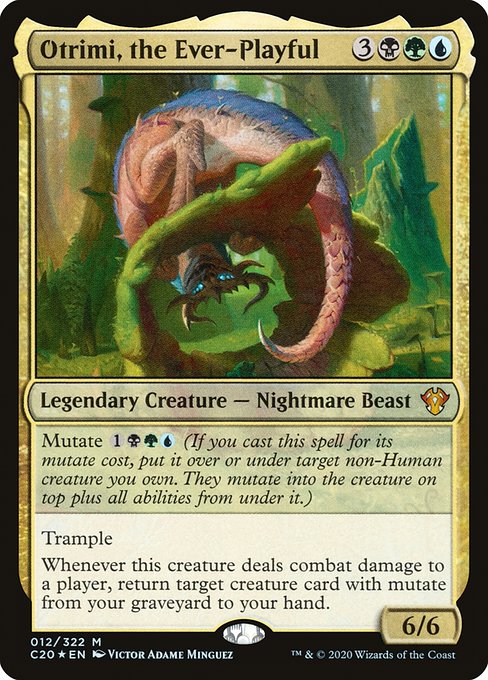
Otrimi's trigger reads “return target creature card with mutate from your graveyard to your hand”. Not any creature, but a mutate creature. In the box that's fourteen cards out of 99, and they're the deck. Otrimi himself mutates for {1}{B}{G}{U} onto any non-Human creature you own, has trample so the pile connects through a chump block, and rebuys one of the fourteen every time it does.
The trouble is what those fourteen cost to mutate. The cheapest mutate cost in the box is three, and only Insatiable Hemophage and Migratory Greathorn have it. Six of the fourteen mutate for five or six mana (Mindleecher, Chittering Harvester and Trumpeting Gnarr at five, Souvenir Snatcher, Archipelagore and Auspicious Starrix at six) and the average across all fourteen is 4.5. So the deck's first mutate happens on turn three at the earliest, and its typical one waits for turn five, on a base creature that has been standing around since turn two doing nothing.
The swaps take the two six-mana mutates out and put five cheaper ones in. Parcelbeast and Sea-Dasher Octopus mutate for two. Gemrazer mutates for three. Dirge Bat costs six to mutate but has flash, which is a different kind of card. Brokkos mutates for five and comes back from the graveyard on his own. Seventeen mutate creatures after the swaps, average mutate cost 4.1, and with Pollywog Symbiote on the battlefield every one of them costs one less. Gemrazer, Hemophage and Greathorn become two-mana mutates and the octopus becomes a one-mana one.
One rule does a lot of work here: a creature spell cast for its mutate cost is still a creature spell. Beast Whisperer draws a card off it, Lifecrafter's Bestiary draws for {G}, Masked Admirers comes back from the graveyard for {G}{G}, and Pollywog Symbiote loots. The box shipped three of those four and never said why they were there.
Where the pile goes
Mutate needs a non-Human creature to land on, and this box is nearly all non-Human: 38 of its 39 creatures qualify. The one exception is Cazur, Ruthless Stalker, a Human Warrior, and he's a cut, so every creature in the upgraded list is a legal target.
Which target matters more than the count, because the pile keeps every ability of every card in it. Ukkima, Stalking Shadow can't be blocked, so Otrimi on top of Ukkima is a 6/6 that connects every combat and returns a mutate card every time. When that pile eventually leaves the battlefield, Ukkima's ability deals damage equal to its power to a player, so the pile's power rather than a 2/2's. Zaxara, the Exemplary under the pile hands it deathtouch, and trample plus deathtouch means one damage to each blocker and the rest to the player. Predator Ooze makes the pile indestructible and grows it every attack. Hungering Hydra can't be blocked by more than one creature. Trygon Predator, Wydwen, the Biting Gale, Dreamtail Heron and Mindleecher fly.
Wydwen deserves a sentence on her own. For {U}{B} and a life she returns to your hand, and when a mutated creature goes to hand, every card in the pile goes with it. That turns a removal spell aimed at your six-card stack into six cards back in hand, each one a creature spell again for Beast Whisperer when you recast it. Otrimi can go back to the command zone instead if you'd rather.
The adds bring their own bases. Mysterious Egg costs one, so it's on the battlefield before anything in the box can mutate, and it puts a +1/+1 counter on itself every time it does. Zagoth Mamba costs one as well and turns every later mutate into a -2/-2. Neither is a card you'd play in another deck. Here they're the turn-one play that makes a turn-two Parcelbeast or a turn-three Gemrazer possible.
Two Islands in a Sultai deck
The box's eighteen basics are eleven Forests, five Swamps and two Islands. Blue reaches seventeen sources once the duals, Command Tower, the rocks and the two lands that fetch basics are counted, against the 24 a deck wants to cast a blue spell on turn two 90% of the time. Seventeen gets there 79.2%. Black has twenty-one sources (86.3%), and green 24 (90.1%), the only one of the three that clears the line. And Otrimi's mutate cost is {1}{B}{G}{U}: all three colours, on turn four, with blue as the one most likely to be missing.
Ten of the 37 lands always enter tapped. Three of them are bouncelands and one is Myriad Landscape, and those four pay for the turn they cost. The other six don't: Soaring Seacliff, Dismal Backwater, Jungle Hollow and Thornwood Falls enter tapped for a life point or a turn of flying, Mortuary Mire enters tapped to put a creature card from your graveyard on top of your library, which is the opposite of what a graveyard full of mutate cards wants, and Temple of the False God is a colourless land that does nothing before your fifth land in a deck that's short on colour. Those six leave, and five duals that enter untapped take their place: Hinterland Harbor, Woodland Cemetery, Drowned Catacomb, Yavimaya Coast and Underground River. The three check-lands ask for a basic type, and Sunken Hollow is an Island and a Swamp, so it switches on Drowned Catacomb by itself.
The sixth slot becomes a spell, because the deck also gains three two-mana ramp spells it didn't have. Nature's Lore puts a Forest onto the battlefield untapped. Rampant Growth finds any basic, and Farseek finds an Island, a Swamp or Sunken Hollow, and is the one of the three that fixes blue rather than adding to green. After the swaps: 36 lands, five that always enter tapped instead of ten, four conditional ones instead of one, and blue at eighteen sources.
Eighteen is still short, and the honest fix costs nothing: two more Islands in place of two Forests would put blue at twenty and green at 23, and green can afford it. The list below ships the box's basics as printed so it matches what's in the box, and that swap is yours to make from the basics pile. The land I'd buy first after this page is Zagoth Triome, at $23.19. It enters tapped, but it's a Forest, so Nature's Lore puts it onto the battlefield untapped and Farseek can find it too, which would make all three ramp spells fixers. That's the only card on this page I skipped on price rather than on merit.
Sixteen out, and six of them are lands
Sixteen. Three are the goad Auras, two are the six-mana mutates, three are creatures the plan doesn't use, one is the only Human, one is a mana rock that enters tapped, and six are lands.
- Predatory Impetus: five mana to enchant an opponent's creature so it attacks someone else. The deck's plan is one big pile of its own. The table's creatures are their problem.
- Psychic Impetus: the same Aura at three mana with a scry 2 attached. The scry doesn't buy the slot back.
- Parasitic Impetus: the third copy, draining two a turn from whoever you enchanted. Three Auras for other people's creatures is the C20 cross-deck theme, and it's the one this deck can least afford.
- Archipelagore: seven mana as a creature, six to mutate, and it taps down creatures. The box's most expensive card at either cost.
- Souvenir Snatcher: six mana to mutate for a stolen noncreature artifact. Otrimi rebuys it, and you still don't want to cast it.
- Heroes' Bane: a five-mana 4/4 without mutate that pays four more mana to double itself. Otrimi can't return it, and nothing in the deck cares that it's a Hydra.
- Illusory Ambusher: a five-mana flash blocker that draws when it's dealt damage. The deck attacks with one creature and would rather that creature had mutate.
- Capricopian: the player you attack can pay {2} to redirect it and grow it. In a deck that attacks with one pile, that's a card that hands the defending player your attack step, so it never goes in the pile.
- Cazur, Ruthless Stalker: the box's only Human, which makes him the only creature Otrimi can't mutate onto. His partner clause tutors Ukkima, who's staying, but a four-mana 3/3 that can't join the pile isn't the way to find her.
- Manascape Refractor: a three-mana rock that enters tapped. Its best trick is a second Rogue's Passage activation, and the two-mana ramp spells replacing it don't enter tapped.
- Soaring Seacliff: enters tapped for one turn of flying, and it's a mono-blue land in a deck with seventeen blue sources that would rather have a dual.
- Dismal Backwater, Jungle Hollow, Thornwood Falls: the three gain-lands. A life each for a tapped turn, replaced by duals that enter untapped for the same two colours.
- Mortuary Mire: enters tapped, and its trigger takes a creature card out of the graveyard Otrimi reads from and costs you a draw to get it.
- Temple of the False God: colourless, and it doesn't tap for anything until you control five lands. The deck's problem is colour.
Eight creatures, three ramp spells, five untapped lands
The mutate package (Brokkos, Dirge Bat, Gemrazer, Parcelbeast, Sea-Dasher Octopus and Pollywog Symbiote) and the two one-drops are argued above. The rest:
- Nature's Lore: a Forest onto the battlefield untapped for two mana. The box has no ramp spell cheaper than Kodama's Reach at three.
- Rampant Growth: any basic, tapped, for two. With Farseek and Nature's Lore that's three two-mana ramp spells where there were none.
- Farseek: the fixer of the three: Island, Swamp or Sunken Hollow, and Zagoth Triome if you buy it.
- Hinterland Harbor: untapped with a Forest or an Island on the battlefield, which is nearly always with eleven Forests.
- Woodland Cemetery: the same for Swamp or Forest.
- Drowned Catacomb: Island or Swamp, and Sunken Hollow counts as both.
- Yavimaya Coast: green or blue, untapped from turn one, for a point of damage.
- Underground River: blue or black on the same terms, and the dearest land in the list at $1.89.
The sixteen come to $13.07 at market prices for the default printings. The most expensive card in them is Brokkos at $2.25.
Twenty-three cards have a case against them. These beat it.
Twenty-three cards in the box have a case against them. These kept surviving it.
- Find // Finality: the card's mana value is eight, but you never pay eight. Find is two mana for two creature cards back from the graveyard, which in this deck is two mutate cards without waiting for Otrimi to connect. Finality is six mana for two counters on your pile and then -4/-4 to every creature, which a 6/6 survives and the rest of the table's board doesn't.
- Tidal Barracuda: a four-mana 3/4 Fish that lets everyone cast spells at instant speed looks like a card for a different deck. Its second line is the one that matters: your opponents can't cast spells during your turn. Mutate's failure mode is a removal spell in response, and on your turn it can't happen.
- Silent Arbiter: one attacker and one blocker per combat is a restriction on the whole table, and this deck attacks with one pile anyway. The pile faces one blocker at most, and everyone else's swarm faces the same rule when they come at you. It's also $11.98, the most valuable card in the 99 after Deadly Rollick.
- Chittering Harvester, Auspicious Starrix, Pouncing Shoreshark: five- and six-mana mutates that stay because their triggers scale. Harvester makes each opponent sacrifice a creature every time the pile mutates, Starrix flips permanents off the top equal to the number of times the pile has mutated, and Shoreshark has flash and bounces a blocker. Souvenir Snatcher and Archipelagore cost the same and do less.
- Mindleecher: the {B}{B} in its printed cost is one of the pips the mana check complains about, and it's irrelevant: you mutate it for {4}{B}, a single black pip, and it exiles the top card of every opponent's library for you to play.
- Deadly Rollick: nothing about the card argues for cutting it. It's here because it's $26.52, a quarter of what the box is worth, and it's free to cast whenever Otrimi is on the battlefield.
Seventeen mutate creatures, and not one Human left
Creatures go 39 to 41, mutate creatures fourteen to seventeen, and Humans one to none, so every creature in the deck can be mutated onto. Average mana value falls from 3.68 to 3.44: the box kept seventeen cards at five mana or more and the upgraded list keeps thirteen, while two-drops go six to ten and one-drops four to five.
Lands go 37 to 36, always-tapped lands ten to five, and conditional ones one to four. Blue sources move seventeen to eighteen, green 24 to 25, and black stays at twenty-one. The basics swap above is where the next two blue sources are. Counting rocks, dorks and land-search spells, ramp goes seven to nine, with Fertilid, Migratory Greathorn, Yavimaya Dryad and now Parcelbeast putting lands onto the battlefield on top of that.
Draw goes seven to nine with Sea-Dasher Octopus and Pollywog Symbiote, and that count leaves out the commander, who is the deck's real card advantage. Spot removal goes eight to ten with Dirge Bat and Gemrazer. The two wipes, Deadly Tempest and Gaze of Granite, both stay. The bracket floor doesn't move: no Game Changers in either list, Bracket 1 either way.
The money: the box resolves to $109.09 at Scryfall market prices and the upgraded hundred to $114.41. The sixteen adds are $13.07 of that, and the only card this page wanted and didn't buy is Zagoth Triome.
The upgraded decklist
The full hundred after the sixteen swaps. Hover any name to see the card and its current prices.
“Load into the deck builder” opens this list in your account, pinned to the printings the box shipped, ready to edit or save. “Copy decklist” gives you plain text for Moxfield, Archidekt or Arena, with no account needed.
Commander 1
- Otrimi, the Ever-Playful




Creatures 40
- Auspicious Starrix
- Beast Whisperer
- Boneyard Lurker
- Boneyard Mycodrax
- Brokkos, Apex of Forever
- Cavern Whisperer
- Chittering Harvester
- Cold-Eyed Selkie
- Dirge Bat
- Dreamtail Heron
- Fertilid
- Gemrazer
- Genesis Hydra
- Glowstone Recluse
- Hungering Hydra
- Insatiable Hemophage
- Masked Admirers
- Migratory Greathorn
- Mindleecher
- Mulldrifter
- Mysterious Egg
- Parcelbeast
- Pollywog Symbiote
- Pouncing Shoreshark
- Predator Ooze
- Reclamation Sage
- Sawtusk Demolisher
- Sea-Dasher Octopus
- Shriekmaw
- Silent Arbiter
- Tidal Barracuda
- Trumpeting Gnarr
- Trygon Predator
- Ukkima, Stalking Shadow
- Vastwood Hydra
- Vorapede
- Wydwen, the Biting Gale
- Yavimaya Dryad
- Zagoth Mamba
- Zaxara, the Exemplary






Planeswalkers 1
- Nissa, Steward of Elements
Instants 4
- Beast Within
- Deadly Rollick
- Krosan Grip
- Putrefy
Sorceries 13
- Animist's Awakening
- Deadly Tempest
- Dredge the Mire
- Farseek
- Find // Finality
- Gaze of Granite
- Kodama's Reach
- Migration Path
- Mind Spring
- Nature's Lore
- Profane Command
- Rampant Growth
- Villainous Wealth

Artifacts 4
- Arcane Signet
- Bonder's Ornament
- Lifecrafter's Bestiary
- Sol Ring
Enchantments 1
- Propaganda
Lands 36
- Blighted Woodland
- Command Tower
- Darkwater Catacombs
- Dimir Aqueduct
- Drowned Catacomb
- Endless Sands
- Exotic Orchard
- 11× Forest
- Golgari Rot Farm
- Hinterland Harbor
- 2× Island
- Llanowar Wastes
- Myriad Landscape
- Opulent Palace
- Rogue's Passage
- Simic Growth Chamber
- Sunken Hollow
- 5× Swamp
- Underground River
- Woodland Cemetery
- Yavimaya Coast
FAQ
Does Otrimi return any creature from the graveyard, or only mutate cards?
Only creature cards with mutate. That's fourteen of the box's 99 and seventeen after these swaps. Hydras, Mulldrifter and Shriekmaw never come back this way. Brokkos, Apex of Forever is the exception in the other direction, because he casts himself from the graveyard using his mutate cost, so he doesn't need the trigger at all.
Does the bracket change after the swaps?
No. Neither the box nor the upgraded list runs a Game Changer, mass land denial, extra turns or a nonland tutor, so both sit at Bracket 1. Paste either list into the bracket checker for the card-by-card accounting.
What happens to a mutated pile when it dies?
Every card in it goes to the graveyard together, and if Otrimi was in the pile you can send him to the command zone instead. The mutate creatures that just hit the graveyard are exactly what his trigger returns, so the deck rebuilds the next pile out of the last one. If the pile is bounced rather than destroyed, every card goes to your hand instead, which is why Wydwen, the Biting Gale stays.
Can Otrimi be cast for his mutate cost from the command zone?
Yes. He mutates for {1}{B}{G}{U} onto a non-Human creature you own, and commander tax applies to that cost the same way it applies to the six-mana one. If the target is gone by the time he resolves, he enters as a normal 6/6 instead. Other creatures can mutate onto him too, because he's a Nightmare Beast rather than a Human.
Why aren't Vadrok, Cubwarden or Nethroi in the adds?
Colour identity. Ikoria printed one Apex per three-colour wedge, and Brokkos is the Sultai one, so he's here. Vadrok, Apex of Thunder, Nethroi, Apex of Death, Snapdax, Apex of the Hunt and Illuna, Apex of Wishes each carry red or white and can't go in a Sultai deck. Cubwarden is white for the same reason. Every green, blue or black mutate creature worth a slot is in the list above.
Should Zaxara, the Exemplary be the commander instead?
She's a real option and the box was built to allow it: ten spells with {X} in their cost make a Hydra apiece with her in command. But that's a different deck, and this page builds the other one. Zaxara stays in the 99 as a mana dork that taps for two and as one of the best creatures to mutate onto, since deathtouch under a trample pile means a single point of damage to each blocker and the rest to the player.
Why does a Sultai deck ship with two Islands?
It's how the box's eighteen basics split (eleven Forests, five Swamps, two Islands) and it leaves blue at seventeen sources, the lowest of the three colours, in a deck whose commander needs blue at either of his costs. The swaps raise it to eighteen with untapped duals and add Farseek to find Islands, and two more Islands in place of Forests from your own basics pile would take it to twenty.
What do the sixteen adds cost?
$13.07 at market prices for the default printings, with Brokkos at $2.25 the dearest card in the list. The box resolves to $109.09 and the upgraded hundred to $114.41. Zagoth Triome was left out at $23.19, and it's the first card to buy if you keep going.