Timeless Wisdom precon upgrade guide
Thirty-one of these hundred cards carry a cycling ability, and the commander makes the first cycle each turn cost nothing. The engine isn’t what needs fixing here. The mana base and the removal are.
Most precons ship a theme and forget to support it. Timeless Wisdom does the opposite. The cycling package is genuinely deep, with thirty-one cards that cycle, seven more pay you off every time you do it, and the commander makes the first one each turn cost nothing. What the box skimped on is duller and easier to fix: the mana base is slower than it looks, and there are three pieces of spot removal in a deck that wants five to ten.
So this list barely touches the engine. Almost all the money goes into lands.
100 cards, 39 lands (15 basic), 20 creatures, average mana value 3.62. Mana sources: 23 white, 25 blue, 23 red.
Bracket floor 3 (Upgraded). How brackets work →
What are the best Timeless Wisdom upgrades?
In the order I’d buy them, with the reasoning below:
- Raugrin Triome: the only land in Jeskai colours that fixes all three and cycles. It enters tapped, which in this deck is close to free.
- Hallowed Fountain, Sacred Foundry, Steam Vents: they replace three lands that entered tapped and bounced a land. The source counts don’t move. The turns do.
- Astral Slide: the deck already runs Astral Drift. This is the other half of the pair, and it costs about seventy cents.
- Swords to Plowshares, Generous Gift, Chaos Warp: the stock deck has three pieces of spot removal. These take it to six.
- Improbable Alliance and Irencrag Pyromancer: both read “whenever you draw your second card each turn”, which is Gavi’s own trigger, word for word.
- Shark Typhoon: a cycling card that ends games, for the turns where the tokens haven’t.
- Idol of Oblivion: you make a token most turns once Gavi is out. This draws a card for it.
Twelve cards come out to make room. The cut list is below.
Fifteen lands enter tapped, and ten of them are spells
Thirty-nine lands, fifteen of which enter tapped, is the sort of mana base you’d normally start dismantling. Here it’s mostly correct, and the reason is that ten of those fifteen cycle.
A Secluded Steppe is not an ordinary tapland. When you need a land it’s a land, and when you don’t it’s a card, for {W}, or for nothing at all if it’s your first cycle of the turn. The flood that punishes a thirty-nine-land deck doesn’t arrive, because ten of the lands stop being lands the moment you have enough.
That leaves five that enter tapped and don’t cycle, and those are where the actual cost is. Three of them (Azorius Chancery, Boros Garrison and Izzet Boilerworks) also return a land to your hand, so they cost a tapped turn and a land drop to produce two mana. In a deck that wants to hit its drops and hold up a cycling cost, that’s the worst shape a land can have. They come out.
The other two stay, and I’ll say why further down.
The free cycle is your second card, and the second card is the token
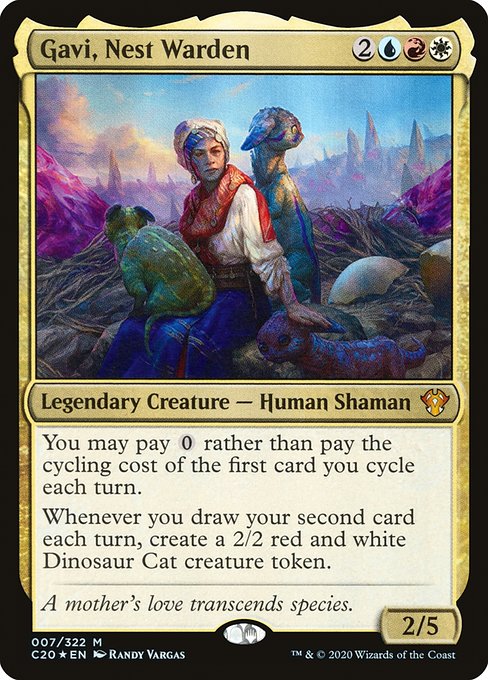
Gavi has two abilities and they only look independent. The first lets you pay {0} instead of a cycling cost, once a turn. The second makes a 2/2 Dinosaur Cat whenever you draw your second card in a turn.
Your draw step is the first card. So the free cycle is the second, and the token is free too, every turn, from the turn she lands, without spending mana or a card you wouldn’t have spent anyway. Everything else the deck does is built on top of that one loop.
Which is also why the expensive cycling costs in the box matter less than they look. Dismantling Wave cycles for {6}{W}{W} and Decree of Justice for {2}{W}. As your first cycle of the turn, both cost the same nothing. The deck wants cheap cycling cards for the second cycle each turn, and the printed cost on the first one is a number you never pay.
Seven cards then read that loop and do something with it: Curator of Mysteries, Valiant Rescuer, Savai Thundermane, Crystalline Resonance, Astral Drift, Drake Haven and Lightning Rift all trigger on any cycle, not just their own. A separate five (Nimble Obstructionist, Vizier of Tumbling Sands, Dismantling Wave, Decree of Justice and Slice and Dice) carry a bonus that only fires when you cycle that card. It’s worth knowing which is which when you’re deciding what to pitch.
Three enchantments that cost three and don’t cycle
Martial Impetus, Psychic Impetus and Shiny Impetus go on other players’ creatures, hand them a stat boost and goad them. Commander 2020 put a set of these in every deck in the cycle.
The objection here isn’t that goading is bad. It’s that this deck spends its mana in small, repeated amounts: a cycling cost on the second cycle, {1} for a Drake Haven token, {1} for a Lightning Rift trigger, {2} for Savai Thundermane, and it does that every single turn. A three-mana enchantment that does nothing the turn it lands is competing for exactly the resource the engine runs on.
In a deck where thirty-one cards cycle, the question I’d ask about any card is whether it does something when you cycle. These three don’t, and they cost three.
Three auras, five creatures, four lands
- Martial Impetus, Psychic Impetus, Shiny Impetus: three mana each, no interaction with the engine, as above.
- Agitator Ant: it hands every opponent two +1/+1 counters a turn. You’re making 2/2s for free. You don’t need to fund the other side of the table to do it.
- Isperia, Supreme Judge: {2}{W}{W}{U}{U} is the single greediest cost in the box. The deck has 22 white sources and 24 blue, and gets a double-white cast on curve about 70% of the time and a double-blue one about 69%. Isperia wants both at once, at six mana.
- Herald of the Forgotten: eight mana. It does return cycling permanents from the graveyard, which is real, but this deck already has thirteen cards costing six or more.
- Mercurial Chemister: five mana for an ability you can’t use until your next turn.
- Portal Mage: a three-mana redirect that needs a combat step to matter.
- Azorius Chancery, Boros Garrison, Izzet Boilerworks: tapped, and they take a land back with them.
- Temple of the False God: it produces nothing until you have five lands, and colourless mana in a three-colour deck when it finally does.
Where the fifty dollars goes
- Raugrin Triome ($15.25): all three colours on one land, with cycling {3} for the games where you’ve drawn enough of them. Yes, it enters tapped. So do ten lands you’re keeping.
- Hallowed Fountain ($7.11), Sacred Foundry ($9.76), Steam Vents ($10.96): straight upgrades on the three bounce lands, two life at a time.
- Astral Slide ($0.73): Astral Drift is already in the deck and this is its twin. Every cycle exiles a creature until end of turn, which blanks a blocker or answers something that just resolved.
- Swords to Plowshares ($1.16), Generous Gift ($0.94), Chaos Warp ($0.32): the removal the box didn’t ship.
- Improbable Alliance ($0.17) and Irencrag Pyromancer ($0.41): both trigger on drawing your second card each turn. That’s Gavi’s condition, so anything that turns her on turns them on, and the Pyromancer’s three damage is removal you’re getting for free.
- Shark Typhoon ($1.83): cycle it for X and get an X/X flier at instant speed. It’s the deck’s only real way to convert a long game into damage in one card.
- Idol of Oblivion ($1.93): a card each turn you made a token, which once Gavi is out is most of them.
That’s $50.57 if you buy the cheapest paper printing of each, as those stood on 6 September 2026.
Why $43 of the $51 is lands
The spells on that list come to $7.49 together. The four lands come to $43.08, and that ratio is a fact about Jeskai rather than about this deck being badly built.
Amonkhet printed five cycling duals: lands that tap for two colours and cycle when you’d rather have a card. They’re close to the perfect land for a Gavi deck and they cost about twenty cents each. But they were printed in allied pairs: Irrigated Farmland, Fetid Pools, Canyon Slough, Sheltered Thicket and Scattered Groves. Jeskai is one allied pair and two enemy ones, so exactly one of the five is legal here, and Commander 2020 already put it in the box.
That’s the whole reason the mana costs what it does. There is no cheap version of this land in these colours, so you either pay for a Triome and some shocklands or you keep playing the bounce lands.
Three cards I left off on price rather than on merit. Arid Mesa ($31.97) and Flooded Strand ($15.45) would fix better than anything on the list, and Arid Mesa alone costs more than two thirds of it. Solitude ($34.89) is the best white removal spell you could put in this deck and costs more than the eight non-land adds put together. If the budget isn’t the constraint, those three are the next purchases.
The nineteen-dollar badger stays, and so does the six-drop
Surly Badgersaur reads like a four-mana creature that pumps itself, and it’s the most expensive card in the box at $19.26. It stays. Cycling is discarding, and the reminder text is “Discard this card: Draw a card”, so every cycle triggers it. Discard a creature and it grows, discard a land and you get a Treasure, discard anything else and it fights something. In a deck three pieces of removal short, that third mode is the one that matters.
Sun Titan is a six-mana 6/6 with no evasion, which is usually a cut. Not here: it returns permanents of mana value three or less, and this deck’s payoffs are Drake Haven, Lightning Rift, Astral Drift, Astral Slide, Crystalline Resonance and Improbable Alliance. Every one of them in range.
Chandra, Flamecaller costs six and her zero ability discards your hand. That’s a drawback in most decks and an outlet in this one, with Surly Badgersaur and Brallin, Skyshark Rider both reading discards. She’s also the deck’s fourth board wipe when a game gets away from you.
Mystic Monastery and Myriad Landscape enter tapped and don’t cycle, which is the exact profile I just cut three lands for. The Monastery survives because it taps for all three colours and this deck is short on every one of them. Cutting it would make the problem I’m spending $43 to fix slightly worse. Myriad Landscape is closer to the line, and it’s the first land I’d change if you want a fifth dual.
Cryptic Trilobite looks like an {X}{X} creature with a fiddly ability. Its mana can only be spent on activated abilities, and cycling is an activated ability, so it’s a mana source pointed directly at the thing this deck does with mana.
What the swaps moved
Lands stay at thirty-nine. The ones that enter tapped go from fifteen to thirteen, and eleven of those thirteen now cycle, up from ten of fifteen. Average mana value drops from 3.80 to 3.62, and the eight-drop is gone.
Spot removal goes from three to six, which moves it from short to normal for a Commander deck. Card draw stays high, twenty-seven to twenty-eight, and that’s the point of the deck rather than a problem with it.
Colour sources barely move: 22 white, 24 blue and 22 red before, and one more of each after. The three bounce lands were producing two colours each, and the shocklands replacing them produce two colours each. What changed is that they arrive untapped and don’t take a land with them. The extra source in each colour is Raugrin Triome taking the slot of Temple of the False God. If you were hoping the swaps would fix the double-pip percentages, they don’t. Those improve here by removing the two greediest costs in the deck rather than by adding sources, which is why Isperia, Supreme Judge and Herald of the Forgotten are on the cut list.
The bracket floor is Bracket 3 before and after, set by the single Game Changer in the box, Fierce Guardianship.
Check this against your own build
If you’ve already changed the deck, the numbers above won’t match yours. The Deck Mana Audit takes a decklist and reports the same colour-source and curve figures for your version, and the bracket checker tells you which bracket it can honestly claim.
The upgraded decklist
The full hundred after the swaps. Hover any card name to see the card.
“Load into the deck builder” opens this list in your account, pinned to the printings the box shipped, ready to edit or save. “Copy decklist” gives you plain text for Moxfield, Archidekt or Arena, with no account needed.
Commander 1
- Gavi, Nest Warden




Creatures 19
- Akim, the Soaring Wind
- Brallin, Skyshark Rider
- Cryptic Trilobite
- Curator of Mysteries
- Eternal Dragon
- Ethereal Forager
- Irencrag Pyromancer
- Nimble Obstructionist
- Niv-Mizzet, the Firemind
- Psychosis Crawler
- Rooting Moloch
- Savai Thundermane
- Shabraz, the Skyshark
- Spellpyre Phoenix
- Sun Titan
- Surly Badgersaur
- The Locust God
- Valiant Rescuer
- Vizier of Tumbling Sands





Planeswalkers 1
- Chandra, Flamecaller
Instants 7
- Chaos Warp
- Fierce Guardianship
- Generous Gift
- Hieroglyphic Illumination
- Neutralize
- Swords to Plowshares
- Zenith Flare
Sorceries 8
- Akroma's Vengeance
- Boon of the Wish-Giver
- Decree of Justice
- Descend upon the Sinful
- Dismantling Wave
- Migratory Route
- Slice and Dice
- Windfall
Artifacts 11
- Abandoned Sarcophagus
- Arcane Signet
- Azorius Signet
- Bonder's Ornament
- Boros Signet
- Commander's Sphere
- Fluctuator
- Idol of Oblivion
- Izzet Signet
- Raugrin Crystal
- Sol Ring
Enchantments 14
- Astral Drift
- Astral Slide
- Cast Out
- Crystalline Resonance
- Drake Haven
- Hoofprints of the Stag
- Improbable Alliance
- Lightning Rift
- New Perspectives
- Ominous Seas
- Reconnaissance Mission
- Shark Typhoon
- Spirit Cairn
- Tectonic Reformation
Lands 39
- Ash Barrens
- Command Tower
- Desert of the Fervent
- Desert of the Mindful
- Desert of the True
- Drifting Meadow
- Exotic Orchard
- Forgotten Cave
- Hallowed Fountain
- Hostile Desert
- Irrigated Farmland
- 5× Island
- Lonely Sandbar
- 6× Mountain
- Myriad Landscape
- Mystic Monastery
- 4× Plains
- Prairie Stream
- Raugrin Triome
- Reliquary Tower
- Remote Isle
- Sacred Foundry
- Secluded Steppe
- Shivan Reef
- Skycloud Expanse
- Smoldering Crater
- Steam Vents
FAQ
Does Gavi’s free cycle work on the cycling lands?
Yes. Gavi, Nest Warden lets you pay {0} rather than the cycling cost of the first card you cycle each turn, and she doesn’t care what the card is. That covers the ten cycling lands, and it covers landcycling too. Ash Barrens, Migratory Route and Eternal Dragon’s plainscycling all qualify. Thirty-one cards in the stock deck carry a cycling ability of some kind.
Which card triggers the Dinosaur Cat token?
The second card you draw in a turn. Your draw step is the first, so the free cycle is normally the second, and the token arrives for no mana at all. That’s also why the deck wants cheap cycling cards rather than expensive ones: the first cycle each turn costs nothing regardless, so the cost printed on it is wasted value.
Fierce Guardianship sets the bracket floor. Should it come out?
Only if your table wants a Bracket 2 deck. It’s the single Game Changer in the box and it’s why both the stock and the upgraded list floor at Bracket 3. Cutting it drops the floor to 2 and costs you a free counterspell you’ll usually have the commander out for. The swaps here don’t change the floor either way.
Why do thirteen lands still enter tapped after the upgrade?
Because eleven of them cycle. A Desert of the True is a land when you need a land and a free card when you don’t, which isn’t the same card as an ordinary tapland. The swaps cut three that enter tapped without cycling (Azorius Chancery, Boros Garrison and Izzet Boilerworks, which also bounce a land) and leave the ones that earn it.
How much does this upgrade cost, and where does the money go?
About $50.57 if you buy the cheapest paper printing of each, as those stood on 6 September 2026, and $43.08 of that is four lands. The eight spells together come to $7.49. Jeskai is an awkward colour identity for cheap cycling lands: of the five Amonkhet cycling duals, which sell for around twenty cents each, only Irrigated Farmland is legal here, and it’s already in the box.
Is Surly Badgersaur worth keeping at nineteen dollars?
Yes, and it stays in the list. Cycling is discarding, so every cycle triggers it: a discarded creature grows it, a discarded land makes a Treasure, and a discarded noncreature nonland card makes it fight something. That last mode is removal in a deck the stock list left three pieces of spot removal short. It’s also the most expensive card in the box.
Should Brallin and Shabraz lead the deck instead of Gavi?
They’re a legal alternative (both are in the stock 99 and they partner with each other) but they change the deck rather than upgrade it. Brallin, Skyshark Rider pays off discarding and Shabraz, the Skyshark pays off drawing, so a cycle triggers both. What you lose is the free cycle itself, which is the only thing making the engine cost nothing.