Eldrazi Unbound precon upgrade guide
Fifteen cards in this box cost seven mana or more, which in almost any other precon is the problem to fix. Here it’s the plan. Thirteen swaps take that number to twenty-one.
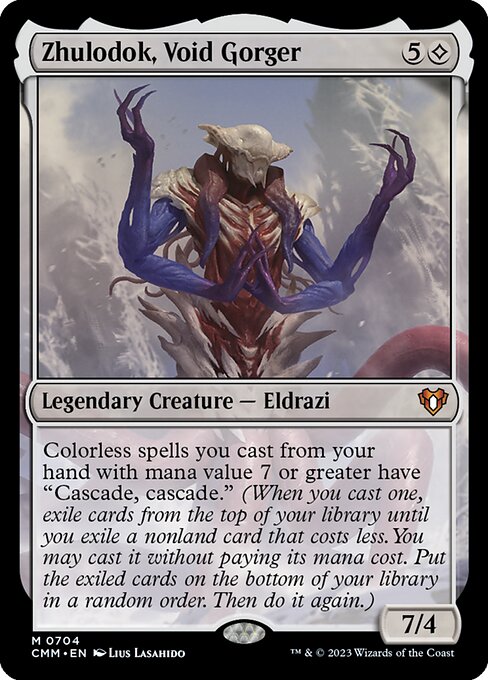
Zhulodok, Void Gorger costs {5}{C} and gives colorless spells you cast from your hand with mana value 7 or greater “cascade, cascade”. Cast one of those fifteen and two more spells come off the top of your library for free.
The catch is arithmetic. Six mana for the commander, seven for the cheapest thing it rewards, and Commander Masters bridged that gap with thirteen ramp pieces. Those same thirteen cards are most of what your cascades find.
100 cards, 38 lands (15 basic), 30 creatures, average mana value 5.39. Colorless deck: no colored sources to count.
No Game Changers and no mass land denial, so it sets no bracket floor. How brackets work →
What are the best Eldrazi Unbound upgrades?
Ordered by impact rather than by price. The top five entries are $75.99 of the $101.23, and the seven cards under them cost $25.24 together.
- Ugin, the Spirit Dragon ($10.97): mana value 8, so it cascades twice on the way down, and its minus ability exiles every permanent that’s one or more colors up to a mana value you choose. Your side of the table is entirely colorless. Nothing you control is a legal target.
- Ugin's Labyrinth ($12.74): exile a colorless card with mana value 7 or greater from your hand as it enters and it taps for {C}{C}. Twenty-one cards in the upgraded list qualify, and its second ability hands the exiled one back later.
- Conduit of Ruin ($4.09) and Sanctum of Ugin ($3.25): $7.34 for the only two cards in the deck that go looking for a payload. The Sanctum triggers on exactly the condition the commander does.
- Ulamog, the Ceaseless Hunger ($24.08) exiles two permanents when you cast it, so it pays off before anyone gets to answer the body.
- Void Winnower ($20.86): your opponents can’t cast spells with even mana values, and zero is even.
- Wurmcoil Engine ($11.12), Thought-Knot Seer ($5.15) and Reality Smasher ($0.71) are three cards worth having when a cascade puts them onto the battlefield for nothing.
- Karn Liberated ($3.48), Spine of Ish Sah ($0.38), Scour from Existence ($0.24) and Basalt Monolith ($4.16): $8.26 between them, and three of the four are removal that also switches the commander on.
Thirteen cards come out to make room. That list is further down.
Cascade reads fifteen cards, and only out of your hand
Sort the ninety-nine by mana value and the top fifteen are the deck: Rise of the Eldrazi and It That Betrays at twelve, Metalwork Colossus at eleven, Ancient Stone Idol, Flayer of Loyalties and Kozilek, the Great Distortion at ten, Artisan of Kozilek and Phyrexian Triniform at nine, Darksteel Monolith at eight, then All Is Dust, Bane of Bala Ged, Desecrate Reality, Kaldra Compleat, Meteor Golem and Not of This World at seven.
Three words in the commander’s text do most of the work of ruling things out: from your hand.
Free spells that a cascade finds are cast from exile, so they don’t cascade again. One cast, two free spells, and it stops there. Mystic Forge lets you cast colorless spells off the top of your library, and those don’t trigger the commander either. That card stays in my list, because looking at the top of your library every turn is worth three mana, but it sits next to the engine rather than inside it.
Darksteel Monolith is the exception running the other way, and with Zhulodok on the battlefield it’s the best card in the box. Once each turn you may pay {0} instead of the mana cost for a colorless spell you cast from your hand. From your hand. Rise of the Eldrazi for nothing, cascading twice, is the ceiling of what this deck does.
What a cascade off a seven-drop can actually find
Cascade exiles cards until it hits a nonland card that costs less than the spell that triggered it. Sixty-one of the ninety-nine are nonland cards. Forty-six of those cost under seven, and that pool of forty-six is everything a cascade off a seven-drop is allowed to give you.
Thirteen of the forty-six are ramp.
Five more have mana value zero because they’re X-spells: Everflowing Chalice, Endless One, Hangarback Walker, Stonecoil Serpent and Omarthis, Ghostfire Initiate. Cast without paying a mana cost, X is zero. Three of them arrive as 0/0 creatures and die immediately, and the Chalice arrives with no counters and taps for nothing.
A cascade stops at the first card it may legally cast whether or not you cast it, so a zero-drop ends the cascade even when you decline. Turn nine, All Is Dust off the top of your curve, and the two free spells you were promised come back a Mind Stone and a dead Endless One.
One more restriction changes how you sequence a turn: a cascade off a seven-drop can never find your other seven-drops. They get exiled past it and shuffled to the bottom. Cast the most expensive thing you can afford instead, because Rise of the Eldrazi at twelve finds every card in the deck except It That Betrays.
Six more payloads, and a land that turns one into mana
Six of the thirteen adds cost seven or more, which takes the trigger count from fifteen to twenty-one. Ulamog, the Ceaseless Hunger and Void Winnower are the two you most want to draw. Ugin, the Spirit Dragon is the one that beats a board this deck otherwise loses to: its minus ability only exiles permanents that are one or more colors, and after these swaps every card here is colorless, lands included.
The other three are removal with a large mana value attached. Karn Liberated exiles a permanent every other turn, Spine of Ish Sah destroys one and returns to your hand when it dies, and Scour from Existence exiles anything at instant speed. In a normal deck those are overcosted answers. Here each one is an answer plus two free spells.
Ugin's Labyrinth is the add I’d least like to argue away. The deck’s problem is that it needs thirteen mana across two turns while its hand fills with cards it can’t cast yet. The Labyrinth takes one of those cards, exiles it face up, taps for two colorless for the rest of the game, and gives the card back when you’re ready for it. It turns the deck’s worst property into its best one.
Sanctum of Ugin does something no other card in the box does: it triggers on casting a colorless spell with mana value 7 or greater, which is the commander’s condition word for word, and turns itself into any colorless creature in your library. Conduit of Ruin is the same idea a turn earlier, with a {2} discount on your first creature spell each turn attached. It comes with a trap worth knowing. It puts the creature it finds on top of your library, and if you cast a seven-drop before you draw it, your own cascade exiles it past and buries it at the bottom. Draw the card first, cascade second.
Wurmcoil Engine, Thought-Knot Seer, Reality Smasher and Basalt Monolith answer the other half of the problem. They cost six, four, five and three, so they trigger nothing. They’re what the cascades find instead of a Mind Stone.
Two cards I left out on price, both of which belong here on merit. Kozilek, Butcher of Truth is $45.51: a ten-drop that draws four cards as it’s cast, which is the effect this deck is shortest of. Eye of Ugin is $58.91 and carries a second problem beyond the money, in that it doesn’t tap for mana at all, a real cost in a deck counting to thirteen. If you already own either, play it. The Butcher goes in over Basalt Monolith.
The seven-drop in this box that costs nothing
Zhulodok is a 7/4. That number matters more than it looks.
Not of This World counters a spell or ability targeting a permanent you control, and it costs {7} less if the target is a creature with power 7 or greater. Your commander qualifies by exactly one point. It reads like a seven-mana counterspell, and in this deck it’s the free one, which is most of the answer to a table that kills your commander on sight. Kaldra Compleat is the other seven-drop that looks worse than it is: living weapon means it brings its own creature, so it needs nothing else on the battlefield to be a 5/5 first striker with trample and indestructible.
Two of the five zero-drops stay. Hangarback Walker and Stonecoil Serpent are poor cascade hits and good draws, and I’d rather keep two cards I want in an opening hand than optimise a pool of forty. Stonecoil Serpent also has protection from multicolored, which blanks a surprising amount of removal in this format.
Temple of the False God is the one land left in my list that can be a blank card, and I know it. Five lands is a low bar for a deck heading to thirteen mana, so it comes online around turn five, and what it produces (two colorless) is what every spell in the deck wants.
Three zero-drops, two walls and eight other slots
The zero-drops go first, because the cascade pool is the argument. Everflowing Chalice, Endless One and Omarthis, Ghostfire Initiate all cost {0} when something else pays for them, and Omarthis wants a +1/+1 counters deck that this box only half builds.
Ornithopter of Paradise is the sharpest cut on the list. It taps for one mana of any color, colorless is not a color, and so its mana cannot pay a single {C} in this deck. Ten cards after the swaps have at least one {C} pip, starting with the commander and Rise of the Eldrazi, which asks for three of them.
Then two walls and two four-drops:
- Crashing Drawbridge and Suspicious Bookcase are two-mana defenders whose abilities want more mana on the turns you have none spare.
- Myriad Construct sacrifices itself the moment anyone targets it, which is a strange thing to run beside cards you were hoping to keep.
- Scaretiller is four mana for a tapped land drop, next time this creature taps.
Ugin's Mastery looks like synergy from a distance. It manifests the top card of your library whenever you cast a colorless creature spell, and manifesting a twelve-drop turns it into a 2/2 you would have to pay twelve mana to flip face up. Fireshrieker and Spatial Contortion leave for the ordinary reason: both need a specific creature already on the battlefield, and this deck spends most of its turns with an empty one.
And two lands. Guildless Commons enters tapped and returns a land you control to your hand, which is two turns of tempo in a deck that’s already the slowest at the table. Ruins of Oran-Rief also enters tapped and pays you back a single +1/+1 counter. Ugin's Labyrinth and Sanctum of Ugin take those two slots, so the land count holds at thirty-eight while the number that always enters tapped falls from three to one.
Average mana value goes up, and that’s the point
Stock, this deck averages 4.59 mana across its sixty-one nonland cards. After the swaps it averages 5.39, and the count of cards that trigger the commander goes from fifteen to twenty-one. Every other precon guide on this site argues the curve in the other direction. This one is the exception, and the commander is the whole reason.
The rest of the movement is quieter. Ramp drops from thirteen pieces to twelve, which puts it back inside the normal band rather than above it. Spot removal goes from eight to ten. Card draw is unchanged at eight. The zero-mana-value bucket falls from five cards to two, which improves the cascade pool without adding anything to it.
Eldrazi go from ten of thirty-one creatures to fourteen of thirty. That’s still short of a typal deck, and it isn’t trying to be one, but it moves a land: Eldrazi Temple taps for two colorless toward colorless Eldrazi spells, and the number of cards that mana can pay for goes from twelve to sixteen once you add All Is Dust and Not of This World, which are Eldrazi without being creatures.
Five sweeper effects reads high for a hundred-card deck. Two of them are Ugin, the Spirit Dragon and Karn Liberated doing it slowly, one permanent at a time, and a third is Calamity of the Titans, which needs a colorless creature revealed from your hand to set the size. The deck isn’t drowning in wraths.
Bracket floor is 1 before and after. No Game Changers in the box, none on the add list. Rise of the Eldrazi takes an extra turn and Conduit of Ruin is a tutor, and neither of those sets a floor on its own.
Check the mana on your own build
Every figure here comes from resolving the shipped decklist card by card. A colorless deck has the easiest mana base in Commander and one of the hardest curves, so the number to watch is the second one. Enter this deck’s 5.39 average mana value in the land count tool to see what thirty-eight lands is really buying, and paste your own list into the Deck Mana Audit for the same read on it.
The upgraded decklist
All hundred cards after the swaps. Hover a name to see the card.
“Load into the deck builder” opens this list in your account, pinned to the printings the box shipped, ready to edit or save. “Copy decklist” gives you plain text for Moxfield, Archidekt or Arena, with no account needed.
Commander 1
- Zhulodok, Void Gorger


Creatures 29
- Abstruse Archaic
- Ancient Stone Idol
- Artisan of Kozilek
- Bane of Bala Ged
- Burnished Hart
- Conduit of Ruin
- Duplicant
- Endbringer
- Flayer of Loyalties
- Geode Golem
- Hangarback Walker
- It That Betrays
- Kozilek, the Great Distortion
- Matter Reshaper
- Metalwork Colossus
- Meteor Golem
- Oblivion Sower
- Palladium Myr
- Phyrexian Triniform
- Reality Smasher
- Skittering Cicada
- Solemn Simulacrum
- Soul of New Phyrexia
- Steel Hellkite
- Stonecoil Serpent
- Thought-Knot Seer
- Ulamog, the Ceaseless Hunger
- Void Winnower
- Wurmcoil Engine











Planeswalkers 3
- Karn Liberated
- Ugin, the Ineffable
- Ugin, the Spirit Dragon
Instants 5
- Desecrate Reality
- Not of This World
- Scour from Existence
- Titan's Presence
- Warping Wail

Sorceries 3
- All Is Dust
- Calamity of the Titans
- Rise of the Eldrazi
Artifacts 21
- Basalt Monolith
- Darksteel Monolith
- Dreamstone Hedron
- Endless Atlas
- Forsaken Monument
- Hedron Archive
- Investigator's Journal
- Kaldra Compleat
- Lightning Greaves
- Mazemind Tome
- Mind Stone
- Mirage Mirror
- Mystic Forge
- Perilous Vault
- Sol Ring
- Spine of Ish Sah
- Thought Vessel
- Thran Dynamo
- Transmogrifying Wand
- Unstable Obelisk
- Worn Powerstone
Lands 38
- Arcane Lighthouse
- Arch of Orazca
- Blast Zone
- Bonders' Enclave
- Eldrazi Temple
- Forge of Heroes
- Geier Reach Sanitarium
- Mage-Ring Network
- Mirrorpool
- Reliquary Tower
- Rogue's Passage
- Sanctum of Ugin
- Scavenger Grounds
- Sea Gate Wreckage
- Shrine of the Forsaken Gods
- Temple of the False God
- Tomb of the Spirit Dragon
- Tyrite Sanctum
- Ugin's Labyrinth
- Urza's Mine
- Urza's Power Plant
- Urza's Tower
- War Room
- 15× Wastes
FAQ
Do the free spells from cascade cascade again?
No, and this is the first thing to get straight. Zhulodok grants cascade to colorless spells you cast from your hand. A spell cascade finds is cast from exile, so it gets nothing. One seven-drop out of your hand gives you two free spells and that’s the end of it. The same wording is why Mystic Forge, which lets you cast colorless spells off the top of your library, doesn’t trigger the commander at all.
Could Kozilek, the Great Distortion lead the deck instead?
Legally, yes. It’s already in the ninety-nine and it’s legendary. It’s a different deck rather than a better one, and it’s slower where it matters: {8}{C}{C} against Zhulodok’s {5}{C}, so your commander tax hurts twice as much and you lose four turns of setup. What you get is a hand refilled to seven on cast and a counterspell attached to it, because discarding a card with mana value X counters a spell with mana value X, and this deck’s hand is full of large numbers. If you want to play it that way, keep the fifteen big spells and drop the second-tier ramp. The cascades aren’t there to protect any more.
Which card should I cast first with Zhulodok on the battlefield?
The most expensive one you can pay for. A cascade only finds nonland cards that cost strictly less than the spell that triggered it, so casting a seven-drop exiles every other seven-drop past and shuffles it to the bottom of your library. Rise of the Eldrazi at mana value twelve can find all but one card in the deck. If Darksteel Monolith is on the battlefield, that’s your best turn in the game: it lets you pay {0} for one colorless spell from your hand each turn, and the spell still counts as cast from hand, so it still cascades twice.
Does this upgrade change the deck’s bracket?
It doesn’t. The floor is Bracket 1 before and after, because there are no Game Changers in the box and none on the add list. Two cards get looked at and neither moves the number: Rise of the Eldrazi takes an extra turn, and Conduit of Ruin searches your library for a colorless creature. A single extra-turn spell attached to a twelve-mana sorcery and one creature tutor don’t set a floor on their own. Run your own version through the bracket checker to see the same reasoning applied to it.
What do the thirteen adds cost?
$101.23, taken from the market price of each card’s default printing on 6 September 2026. It is top-heavy: Ulamog, the Ceaseless Hunger ($24.08), Void Winnower ($20.86) and Ugin's Labyrinth ($12.74) are $57.68 of it, and Wurmcoil Engine ($11.12) and Ugin, the Spirit Dragon ($10.97) take the top five to $79.77. The remaining eight cards cost $21.46 together and three of them are under a dollar. Against a sealed box whose singles come to $259.98, spending a hundred to add six payloads and two lands is proportionate. Spending twenty on the cheap eight is where the value is.
Why isn’t Eye of Ugin on the add list?
Two reasons, and the price is only the first. At $58.91 it costs more than half of everything else here put together. The second is that it doesn’t tap for mana, and a deck built to reach thirteen mana can’t easily afford a land that produces none. Its discount is also narrower than it looks: it reduces colorless Eldrazi spells, which after these swaps is fourteen of the thirty creatures rather than all of them. Ugin's Labyrinth does the accelerating job at a fifth of the price and taps for two.