Jump Scare! precon upgrade guide
Zimone manifests dread on the first land of a turn and turns a card face up on the second, and this box has one card that grants an extra land drop, at six mana.
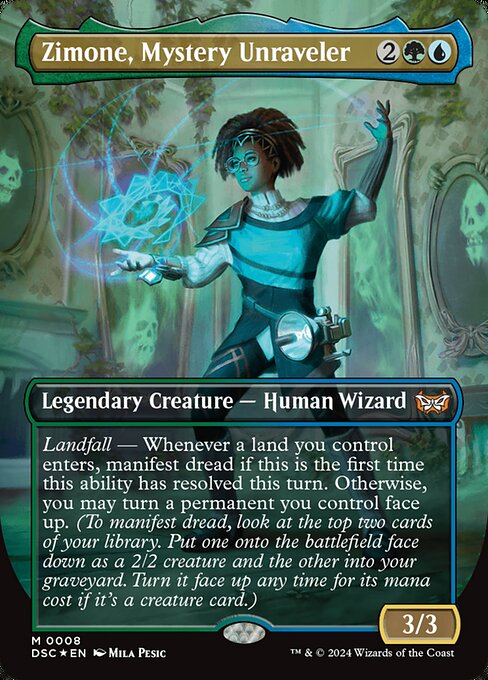
Zimone, Mystery Unraveler has one landfall trigger with two jobs. The first time it resolves in a turn, you manifest dread. Every later time, you may turn a permanent you control face up, and because an effect does the turning, you don't pay the card's mana cost. A creature card sitting on the table as a face-down 2/2 becomes itself for nothing, and every card that cares about that fires: Growing Dread adds a +1/+1 counter, Trail of Mystery adds +2/+2 until end of turn, Temur War Shaman lets the creature fight, and Deathmist Raptor comes back from the graveyard. So the second land of a turn is worth more than the first.
The box is generous with lands and stingy with places to put them. Eleven nonland cards can put a land onto the battlefield, from Rampant Growth to Yedora, Grave Gardener, three lands fetch one, and Simic Growth Chamber hands a land back to be played again. Four cards put basic lands into your hand instead: Cultivate, Trail of Mystery, Yavimaya Elder and Ash Barrens. A land in hand mostly waits for the single land drop. Growth Spiral and Eureka Moment can put one onto the battlefield, and only one card in the 99 lets you play a second land, Aesi at six mana. Three of the adds below are extra-drop cards, which takes the count from one card to four.
100 cards, 38 lands (18 basic), 36 creatures, average mana value 4.07. Mana sources: 29 blue, 29 green.
No Game Changers and no mass land denial, so it sets no bracket floor. How brackets work →
What are the best Jump Scare! upgrades?
Land drops first, because they set how often the second half of the trigger fires, then the payoffs, an answer and two lands. Prices are October 2026 market prices at the cheapest released printing, which can be a promo.
- Azusa, Lost but Seeking ($11.46). You may play two additional lands on each of your turns, for three mana. With three lands in hand, a turn is three land entries, which is a manifest and up to two turn-overs.
- Oracle of Mul Daya ($2.21). One additional land a turn, and you play lands from the top of your library with the top card revealed. At $2.21 it's the cheapest extra-drop card in the list.
- Dryad of the Ilysian Grove ($9.31). One additional land a turn, and your lands are every basic land type, so each one taps for green or blue. It's the only add that touches the green shortage in the mana section.
- Rampaging Baloths ($0.28). Whenever a land enters under your control, you get a 4/4 Beast. It costs six, and it's the payoff the box doesn't have: the stock landfall cards draw, make a 1/1, scry or tap a creature.
- Courser of Kruphix ($1.66). Lands from the top of the library again, so the extra drops aren't spent only on cards in hand, plus 1 life for every land that enters.
- Pongify ($2.21). Destroy target creature for {U}, at instant speed, and its controller gets a 3/3 Ape. It's the cheapest answer in the deck, so it fits in the same turn as the land drops.
- Fabled Passage ($0.65). A free basic fetch that is also two landfalls, argued in the mana section.
- Breeding Pool ($9.15). A Forest Island that enters untapped for 2 life. Buy it last, because it's reprinted in Star Trek on 13 November 2026.
Why the second land of the turn is the one that counts
A fetch land is two landfalls from one land drop. Evolving Wilds entering is the first, the basic it finds is the second, and whichever trigger resolves first manifests dread while the other turns it over. Crack the land with its trigger still on the stack and the fetched land's trigger resolves ahead of it: you manifest, then flip what you just manifested if it's a creature card. Terramorphic Expanse does the same, and Myriad Landscape gives the most triggers of the three, because it puts two basic lands that share a type onto the battlefield at once, so one activation is two more triggers.
The stock deck can do this whenever a ramp spell lands beside the land drop. What it can't do is keep doing it. Past that point the lands in your hand queue behind a single drop, and every extra-drop card removes one place in that queue. Azusa, Lost but Seeking adds two, Oracle of Mul Daya and Dryad of the Ilysian Grove add one each, and with Aesi the deck holds up to five extra land drops across four cards, where the box held one.
Once the lands arrive, something has to pay for them. The stock payoffs are Aesi (draw a card), Tatyova (draw and gain 1), Scute Swarm (a 1/1 Insect, or a copy of itself once you control six lands) and Retreat to Coralhelm (scry 1 or tap a creature). Rampaging Baloths is a 4/4 for each land, and Courser of Kruphix gains 1 life for each land that enters. Together they take the landfall cards, the commander aside, from four to six.
Six spells and two lands to cut
Body of Knowledge is a five-mana creature as big as your hand, and it draws as many cards as the damage it takes. The whole point of this list is to empty your hand onto the battlefield, so it's sized by the thing the deck is trying to get rid of. Zimone's Hypothesis puts a +1/+1 counter on a creature, then returns every creature with odd or even power to its owner's hand. That includes yours, and the face-down 2/2s the commander makes are all even. At five mana it's a coin flip on an opposing board, and one of the two flips takes your face-down cards home.
Aether Gale needs six different targets to be cast at all, so on a thin board it sits in your hand, and when it does resolve it returns permanents rather than answering them. Cackling Counterpart costs {1}{U}{U} to copy a creature you control, and a token copy of a face-down creature is a plain 2/2 with no name and no abilities. Many of this deck's creatures spend time face down. After the swaps only Counterspell and Dig Through Time need {U}{U}, and Biomass Mutation can pay its hybrid cost in either color.
Sandwurm Convergence is an eight-mana enchantment that makes a 5/5 Wurm at the beginning of each of your end steps and stops fliers attacking you. It's a fine card at eight, but Rampaging Baloths makes a 4/4 for each land that enters and costs six. Skaab Ruinator exiles three creature cards from your graveyard as it's cast, and with 32 creature cards in the 99, a graveyard that fills one card at a time takes a long while to hold three.
The two lands are in the next section, since they're replaced by lands.
Two tapped lands out, and what green still lacks
Mosswort Bridge enters tapped for green only, and its hideaway card plays free only when your creatures have total power 10 or more. Thornwood Falls enters tapped, gains 1 life and makes green or blue. Breeding Pool makes the same two colors, comes in untapped when you pay 2 life as it arrives, and because it's an Island, Castle Vantress and Hinterland Harbor enter untapped when it's out. Fabled Passage takes the other slot. It fetches a basic land and untaps it if you control four or more lands afterwards, counting the new one but not the Passage, and like the other fetches it's two landfalls for one land drop.
Always-tapped lands go from seven to five. That's a small effect, and it isn't the mana problem. This box has 29 green sources, and 19 spells ask for two green pips, which is 80.4% on the play by turn three and 7 sources short of the 90% line. The swaps leave that where it was. Twenty spells ask for it afterwards, because Courser of Kruphix and Rampaging Baloths come in and only Sandwurm Convergence goes. Blue is better off. The cuts take the spells that ask for {U}{U} from eight to three, and the sources go from 28 to 29. Both counts include Biomass Mutation, whose hybrid cost the checker reads as either color.
Dryad of the Ilysian Grove is the only add that moves it, by making every land you control tap for green while it lives. If you want it fixed on paper, trade two of the nine Islands for Forests by hand. Green goes from 29 sources to 31 and from 80.4% to 83.9%, and blue drops from 29 to 27, which is still 93.0% for one {U} by turn two. The catch is that Castle Vantress wants an Island, so leave the other seven alone.
Flagged for a cut, and staying
Beanstalk Giant // Fertile Footsteps reads as a seven-drop and isn't played as one. For three mana the adventure puts a basic land onto the battlefield untapped, which is a landfall, and the Giant comes back later as a creature as big as your land count. Dig Through Time costs eight on paper, but every card exiled from the graveyard pays for {1} of it, and manifest dread puts a card in the graveyard each time. Ezuri's Predation makes a 4/4 for each creature your opponents control, and each fights a different one of them. The fights go both ways, so it clears small boards and trades with large ones, and it's the box's answer to a wide board. Oversimplify is the sweeper, but it gives every player a Fractal as large as the power they lost.
Hydra Omnivore is an 8/8 for six, and when it deals combat damage to an opponent it deals that much damage to each other opponent. That damage is not combat damage, and one connection is damage to the whole table. Curator Beastie, Whisperwood Elemental and Primordial Mist keep the face-down cards coming without needing a land, and Temur War Shaman turns every creature Zimone flips face up into a fight. These are the plan, so they stay at five and six mana.
Ashaya, Soul of the Wild is the flagged card I'd defend hardest. Nontoken creatures you control are Forest lands, and a creature that arrives while she's out enters as a land, so every creature spell you cast is a landfall. That includes the face-down 2/2s the commander manifests, which are nontoken creatures, so with Ashaya out each manifest triggers the commander again. Creatures already on the battlefield when she arrives trigger nothing, because a permanent becoming a land isn't a land entering. Yedora, Grave Gardener is the other route. A creature it returns comes back face down as a Forest land, which does enter. The tapped lands that stay are the ones that earn it: Simic Growth Chamber returns a land to be played again, and Myriad Landscape is the multi-trigger land above.
Where I'd spend the next $30
Exploration ($29.58) is next in line once the eight are in. It's one mana for one additional land drop, and I held it back because it costs more than the six spells combined and Oracle of Mul Daya does the same job for $2.21. Misty Rainforest ($35.98) finds a Forest or an Island, so it can fetch Breeding Pool, and it's the last card I'd buy. Fabled Passage does most of the work for $0.65, with no life payment. Cyclonic Rift ($29.75) and Fierce Guardianship ($59.21) are Game Changers, and either one takes the bracket floor to 3.
What changes once the eight swaps are in
The deck stays at 38 lands, and the average mana value goes from 4.21 to 4.07. Cards costing five or more go from 25 to 22, and cards costing six or more stay at 14. Always-tapped lands go from seven to five and conditional lands from three to four. The bracket floor stays at 1.
The upgraded decklist
Zimone and the 99 with all eight swaps made, sorted by card type. Hovering any name shows the card.
“Load into the deck builder” opens this list in your account, pinned to the printings the box shipped, ready to edit or save. “Copy decklist” gives you plain text for Moxfield, Archidekt or Arena, with no account needed.
Commander 1
- Zimone, Mystery Unraveler



Creatures 35
- Aesi, Tyrant of Gyre Strait
- Arixmethes, Slumbering Isle
- Ashaya, Soul of the Wild
- Augur of Autumn
- Azusa, Lost but Seeking
- Beanstalk Giant // Fertile Footsteps
- Citanul Hierophants
- Courser of Kruphix
- Curator Beastie
- Deathmist Raptor
- Dryad of the Ilysian Grove
- Giggling Skitterspike
- Glitch Interpreter
- Greater Tanuki
- Hydra Omnivore
- Kefnet the Mindful
- Kheru Spellsnatcher
- Kianne, Corrupted Memory
- Multani, Yavimaya's Avatar
- Oracle of Mul Daya
- Overgrown Zealot
- Rampaging Baloths
- Rashmi, Eternities Crafter
- Sakura-Tribe Elder
- Scute Swarm
- Shigeki, Jukai Visionary
- Shriekwood Devourer
- Tatyova, Benthic Druid
- Temur War Shaman
- Thunderfoot Baloth
- Trygon Predator
- Whisperwood Elemental
- Worldspine Wurm
- Yavimaya Elder
- Yedora, Grave Gardener






Instants 8
- Beast Within
- Biomass Mutation
- Counterspell
- Dig Through Time
- Eureka Moment
- Growth Spiral
- Pongify
- Reality Shift


Sorceries 7
- Cultivate
- Disorienting Choice
- Explosive Vegetation
- Ezuri's Predation
- Oversimplify
- Overwhelming Stampede
- Rampant Growth
Artifacts 4
- Arcane Signet
- Scroll of Fate
- Simic Signet
- Sol Ring
Enchantments 7
- Experimental Lab // Staff Room
- Growing Dread
- Primordial Mist
- Retreat to Coralhelm
- They Came from the Pipes
- Trail of Mystery
- Wilderness Reclamation
Lands 38
- Ash Barrens
- Breeding Pool
- Castle Vantress
- Command Tower
- Drownyard Temple
- Evolving Wilds
- Fabled Passage
- Flooded Grove
- 9× Forest
- Hinterland Harbor
- 9× Island
- Myriad Landscape
- Overflowing Basin
- Quandrix Campus
- Reliquary Tower
- Simic Growth Chamber
- Tangled Islet
- Temple of Mystery
- Temple of the False God
- Terramorphic Expanse
- Vineglimmer Snarl
- Yavimaya Coast
FAQ
Does a fetch land give Zimone two triggers?
Yes. The fetch land entering is a landfall, and the land it finds entering is a second one. Whichever trigger resolves first manifests dread and the other turns a permanent face up, so crack it while the first trigger is on the stack and the fetched land's trigger resolves ahead of it. Evolving Wilds, Terramorphic Expanse and Fabled Passage each give you that pair from one land drop. Myriad Landscape puts two basics onto the battlefield at once, so activating it adds two more triggers.
Do I pay for a card when Zimone turns it face up?
No. The trigger turns the permanent over as an effect, so its mana cost is never asked for, unlike the special action that lets you pay a manifested creature's cost at any time you have priority. The exception is a manifested instant or sorcery: you reveal it to show what it is, it stays face down, and nothing that triggers on a card being turned face up fires. Growing Dread, Trail of Mystery, Temur War Shaman and Deathmist Raptor all trigger when a creature is turned over.
What does upgrading Jump Scare! cost?
$36.93 for all eight adds at October 2026 market prices, using the cheapest released printing of each. Azusa ($11.46), Dryad of the Ilysian Grove ($9.31) and Breeding Pool ($9.15) are $29.92 of that, and the other five cards together are $7.01. Breeding Pool is reprinted in Star Trek on 13 November 2026, so its price may fall.
Does Ashaya make my creatures trigger Zimone?
From the turn she arrives, yes, for creatures that enter after her. Nontoken creatures you control are Forest lands, and her ruling says creature cards you cast then enter the battlefield as lands, so each one is a landfall for Zimone, Aesi and Rampaging Baloths. Creatures already on the battlefield when she arrives trigger nothing, because a permanent that is already there becoming a land isn't a land entering, and tokens aren't affected. Yedora is a separate route. A creature it returns comes back as a face-down Forest land, which does enter.
What bracket is the Jump Scare! precon?
The checker puts the box at a floor of Bracket 1, since nothing in the 99 is a Game Changer or destroys other players' lands in bulk. Nothing I'm adding does either, so the swaps leave the floor alone. Two blue cards people often reach for, Cyclonic Rift and Fierce Guardianship, are both Game Changers, and one of either would lift the floor to Bracket 3.
Should I buy Exploration or Oracle of Mul Daya first?
Oracle of Mul Daya, at $2.21. Exploration gives one additional land drop for {G}, and Oracle gives that same drop for {3}{G} plus the right to play lands from the top of your library, with the top card revealed. Exploration costs $29.58, which is why it waits until the eight are in rather than being one of them.