Creative Energy precon upgrade guide
Nine creatures in this box pay off when they enter the battlefield and eight pay off when they attack. Satya can only ever use the first nine.
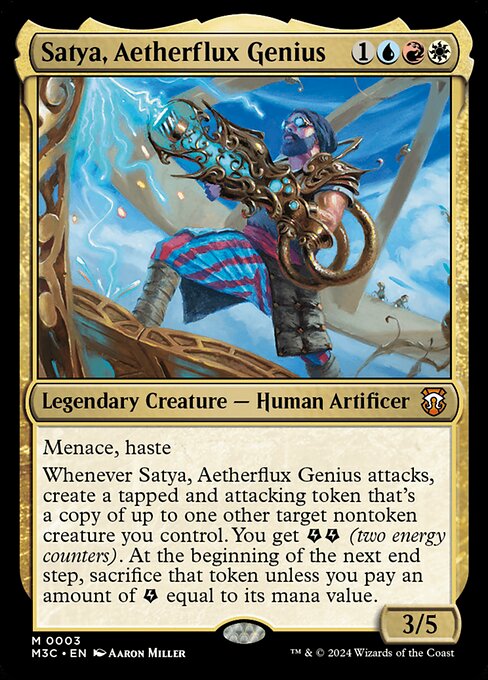
Satya, Aetherflux Genius copies one of your creatures every time she attacks, hands you two energy, and asks for the copy back at the next end step unless you pay energy equal to its mana value. The copy is created tapped and attacking. It was never declared as an attacker, so an ability that reads whenever this creature attacks never sees it.
That carve-out lands on some of the best cards in the deck. Goldspan Dragon, Lightning Runner, Blaster Hulk and Myr Battlesphere all hang their payoff on attacking, and copying one gets you a body and nothing else. Combustible Gearhulk, Skyclave Apparition and Solemn Simulacrum hand over their trigger every single time.
100 cards, 38 lands (20 basic), 26 creatures, average mana value 3.28. Mana sources: 29 white, 26 blue, 23 red.
Bracket floor 3 (Upgraded). How brackets work →
The best Creative Energy upgrades
In the order I would buy them, at market prices for the default printings:
- Galvanic Discharge ($0.35) and Harnessed Lightning ($0.26). Removal denominated in the currency this deck already prints. Both give you three energy and let you spend as much of it as the kill needs, so a dead two-drop leaves you a counter in profit and a turn with no target still banks three.
- Guide of Souls ($2.89). A life and an energy counter every time another creature enters. Satya makes one enter on every attack.
- Five untapped lands, $1.93 for the set. Cascade Bluffs, Rugged Prairie, Glacial Fortress, Clifftop Retreat and Sulfur Falls, in place of the three Temples and the two bounce lands.
- Get Lost ($4.07), Generous Gift ($0.71), Fateful Absence ($0.40). The box ships one spot removal spell. These are three of the other four.
- Palace Jailer ($0.23) and Charming Prince ($0.33). Cheap bodies whose triggers survive being copied, which is the whole job description here.
- Fable of the Mirror-Breaker ($6.65) and Combat Celebrant ($2.04). A second copy engine and a second combat step.
Fifteen cards, $19.86 all in. That is a small number for a precon upgrade and it is not restraint: this deck is held back by its shape rather than by a missing shelf of staples. What comes out is further down.
Which creatures Satya can actually copy
Twenty-six nontoken creatures in the stock list can be copy targets. Nine carry an enters-the-battlefield trigger, and those are the ones the commander was built for. Combustible Gearhulk copied is another three cards, or another face full of damage. Skyclave Apparition copied is a second permanent exiled. Angel of Invention and Cayth, Famed Mechanist both fabricate again.
Solemn Simulacrum is the sweetest of them, because the sacrifice clause is upside. Copy it, fetch a land, decline to pay the energy, and the token dies at end of turn and draws you a card. The keep tax is a cost on every other creature in the deck. On this one it is the payoff.
Against that, eight creatures hang their text on attacking. Aethergeode Miner copied gives you no energy. Overclocked Electromancer copied does not double its power. Razorfield Ripper copied does not grow. Two cards sit in both groups: Myr Battlesphere still makes four Myr when the copy arrives, and Aetherstorm Roc still gives an energy, because those are entry triggers wearing an attacking body.
One more catches people out. Amped Raptor copied gives you its two energy but no cascade, because the second sentence checks whether you cast it from your hand and a token was never cast at all.
Satya charges energy to keep what she copies
Two energy per attack, and a bill equal to the copy's mana value at the end step. A two-drop copy is free. A five-drop copy costs three out of storage on top of the two you just earned.
The stock deck sits on the wrong side of that line. Five of its twenty-six copy targets cost two or less; twelve cost five or more. So most copies are rentals: take the trigger, take the combat damage, let the token go at end of turn. There is nothing wrong with renting, but it means the deck rarely builds a board out of its commander, and the energy it hoards goes to big activated abilities instead of to keeping creatures.
The swaps move that to seven cheap creatures out of twenty-four, and add two engines that make renting cheaper. Guide of Souls pays an energy when the token arrives and Aetherstorm Roc pays another, so attacking with both on board makes Satya's trigger worth four energy. That keeps a four-drop copy for nothing.
Thirty-four cards in the stock hundred have energy somewhere in their rules text, Satya included. The resource was never scarce here. What it lacked was anything cheap to spend on.
One removal spell in a hundred cards
Swords to Plowshares is the entire interactive suite. The roles report puts spot removal at 1 against a normal band of 5 to 10, with three wipes underneath it, so the deck's answer to a problem permanent is to wait until the problem is a whole board and then reset. Farewell is a fine card and it should not be the plan.
Galvanic Discharge and Harnessed Lightning are the first two I would buy for any deck that cares about energy. Both read: choose a target, get three energy, then pay as much of it as you like to deal that much damage. Kill a three-toughness creature and you have come out even on counters. Draw one on a turn with no target and it is still three energy toward a keep. Sixty-one cents for the pair.
Get Lost, Fateful Absence and Generous Gift cover what red damage cannot: an indestructible threat, an enchantment, a land. All three are instants, and in a deck that wants mana untapped on other people's turns that matters more than the small consolation each one hands back.
After the swaps the roles report reads 5 spot removal, inside its band for the first time.
Six taplands, and why the obvious fix is the wrong one
The stock base is 38 lands, 20 of them basic, with six entering tapped no matter what: three Temples, Izzet Boilerworks, Azorius Chancery and Mystic Monastery. Five more are conditional, and those conditions are trivially met in a deck with 20 basics, so this is a real six rather than a scary-looking eleven.
The instinct is to reach for fastlands. Inspiring Vantage, Spirebluff Canal and Seachrome Coast cover all three colour pairs, they are cheap, and they are wrong. Each reads enters tapped unless you control two or fewer other lands, and this is a 38-land deck with a stock average mana value of 3.85. From turn four onward a fastland is a Temple that cost more.
Check lands go the other way. Glacial Fortress, Clifftop Retreat and Sulfur Falls want a matching land already on the battlefield, and with ten Plains, five Islands, five Mountains and a stack of duals that is nearly always true by the time it matters. They run 28 to 36 cents each. Beside them, Cascade Bluffs and Rugged Prairie never enter tapped at all.
Always-tapped goes from six to one. Untapped goes from 27 to 29, conditional from five to eight.
There is a cost, and it is worth stating plainly. White sources drop from 31 to 29 and blue from 28 to 26, which moves double white on turn three from 83.9% to 80.4%, and double blue on turn four from 83.7% to 79.8%. I will take three points of pip consistency for five lands that arrive ready. The source counter also treats a filter land as colourless, because it needs a coloured mana going in, so those printed numbers understate what Rugged Prairie and Cascade Bluffs actually do for the double-pip turns they are being docked on.
Mystic Monastery is the one tapland I kept. It is the only land in the deck that makes all three colours, and where every colour has double-pip demands that buys back the turn it costs.
Red is the thing these swaps do not fix. It stays at 23 sources against the 36 that would make double red on turn three a 90% proposition, and the hypergeometric check puts it at 66.7%. Grenzo, Havoc Raiser is one of five cards that still want double red, alongside Goldspan Dragon, Combustible Gearhulk, Aether Refinery and Lightning Runner. That was six before the cuts. The honest fix is not another land, it is casting fewer of them, and five is a number I can live with in a deck this white by pip count.
Eight of the ten spells I cut cost five or more
The top of this curve is where the box spent its budget and it does not pay. Blaster Hulk at eight, Legion Loyalty at eight, Myr Battlesphere at seven and Aethersquall Ancient at seven are four cards you cast on the turn the game was already decided, and two of the four are attack triggers Satya cannot copy anyway.
Coveted Jewel draws three and then offers itself to whoever swings at you unblocked, in a deck whose creatures spend their turns tapped and attacking. Stone Idol Generator wants five mana and six energy at sorcery speed for one large token. Hourglass of the Lost is a mana rock that charges rent before it does the interesting thing.
Silverquill Lecturer gives your creature spells demonstrate, which copies them for you and for an opponent of your choosing. Five mana to hand somebody else a free creature every time you deploy one is a strange fit in a deck already trying to out-body the table.
Brudiclad, Telchor Engineer turns every token you control into a copy of your best one, and Satya makes exactly one token per attack. There is no second token deck hiding underneath this one. Razorfield Ripper attaches to a single creature among twenty-six.
The five lands are the three Temples and the two bounce lands. Curve after all of it: the eight-drops go from three to one, the sevens from two to none, average mana value from 3.85 to 3.28, and ramp from 13 down to 11 and out of the flagged range.
Why the expensive energy cards stay
Four cards survived a pass that took most of their neighbours, and each has an obvious objection worth answering.
Aether Refinery costs six and does nothing on the turn it lands. It also doubles every energy you get for the rest of the game, which turns Satya's two into four, which is a free keep on a four-drop copy. Nothing else in the deck changes the exchange rate.
Gonti's Aether Heart is six mana and asks eight energy for its extra turn, which reads like a trap. The line people skip is the first one: two energy for every artifact that enters, and there are 25 artifacts in the upgraded list. It refills what it is asking for.
Lightning Runner costs five, and its attack trigger is exactly the kind Satya cannot copy. That is not why it is here. An extra combat phase is an extra Satya attack, which is another copy and another two energy, and it untaps your board on the way through.
Aetherstorm Roc looks like a four-mana flier that puts a counter on itself. The middle line is the card: an energy counter whenever this or another creature you control enters, which covers every token Satya makes and every creature you cast.
What I ranked and skipped
Four cards would improve this deck and did not make the list on proportionality. Smothering Tithe at $64.01 and Esper Sentinel at $59.32 each cost about three times the entire list above. Cyclonic Rift at $39.37 is the strongest card named on this page and would be the first thing I added if the ceiling moved. Ocelot Pride at $40.92 is genuinely on-plan next to Guide of Souls, since the token trigger feeds its life gain, and it still costs twice the rest of the list combined.
Buy the Rift first if you want to spend more here. None of it changes the arguments above.
The upgraded decklist
The hundred cards after the fifteen swaps. Hover any name to see the card.
“Load into the deck builder” opens this list in your account, pinned to the printings the box shipped, ready to edit or save. “Copy decklist” gives you plain text for Moxfield, Archidekt or Arena — no account needed.
Commander 1
- Satya, Aetherflux Genius




Creatures 25
- Aethergeode Miner
- Aetherstorm Roc
- Aethertide Whale
- Amped Raptor
- Angel of Invention
- Aurora Shifter
- Burnished Hart
- Cayth, Famed Mechanist
- Charming Prince
- Combat Celebrant
- Combustible Gearhulk
- Fable of the Mirror-Breaker // Reflection of Kiki-Jiki
- Goldspan Dragon
- Grenzo, Havoc Raiser
- Guide of Souls
- Lightning Runner
- Overclocked Electromancer
- Palace Jailer
- Professional Face-Breaker
- Roil Cartographer
- Salvation Colossus
- Skyclave Apparition
- Solemn Simulacrum
- Sphinx of the Revelation
- Whirler Virtuoso




Instants 8
- Akroma's Will
- Fateful Absence
- Galvanic Discharge
- Generous Gift
- Get Lost
- Glimmer of Genius
- Harnessed Lightning
- Swords to Plowshares
Sorceries 6
- Austere Command
- Confiscation Coup
- Farewell
- Jolted Awake
- Localized Destruction
- Tezzeret's Gambit

Artifacts 20
- Aether Refinery
- Aethersphere Harvester
- Aetherworks Marvel
- Arcane Signet
- Bespoke Battlewagon
- Bident of Thassa
- Coalition Relic
- Conversion Apparatus
- Decoction Module
- Filigree Racer
- Gonti's Aether Heart
- Izzet Generatorium
- Midnight Clock
- Sol Ring
- Solar Transformer
- Talisman of Conviction
- Talisman of Creativity
- Talisman of Progress
- Unstable Amulet
- Wayfarer's Bauble
Enchantments 2
- Era of Innovation
- Scurry of Gremlins
Lands 38
- Adarkar Wastes
- Aether Hub
- Battlefield Forge
- Cascade Bluffs
- Castle Vantress
- Clifftop Retreat
- Command Tower
- Demolition Field
- Frostboil Snarl
- Furycalm Snarl
- Glacial Fortress
- 5× Island
- 5× Mountain
- Mystic Gate
- Mystic Monastery
- 10× Plains
- Port Town
- Prairie Stream
- Rugged Prairie
- Shivan Reef
- Sulfur Falls
FAQ
Does a creature Satya copies trigger its own attack ability?
No. The token is created tapped and attacking, which is not the same as being declared as an attacker, so nothing that reads “whenever this creature attacks” ever fires on it. Enters-the-battlefield triggers fire normally, which is why this guide leans the deck toward those. Nine creatures in the stock list have one; eight have an attack trigger instead.
How much does this Creative Energy upgrade cost?
$19.86 for all fifteen cards, at market prices for the default printings. Five of those are lands and they come to $1.93 between them. The cheapness is the finding rather than a budget rule: what this deck needs is a lower curve, more interaction and fewer taplands, and none of those cost money.
Should I pay the energy to keep Satya's token, or let it die?
Let it die unless the body is doing something the trigger already did not. You paid nothing for the enters-the-battlefield effect and nothing for the combat damage, and the bill at end step is the copy's full mana value against the two energy the attack paid you. Keeping is worth it on cheap creatures, on Aethergeode Miner and Charming Prince, and on anything you intend to copy again next turn. On Solemn Simulacrum you actively want the token to go, since it draws you a card on the way out.
What bracket does Creative Energy sit in?
Bracket 3, before and after these swaps, and for a single reason: Farewell is on the Game Changers list and Bracket 2 allows none. Cut it and the deck has an honest claim to Bracket 2. Nothing else added here moves the floor.
Is Creative Energy worth playing out of the box?
It functions, and it will beat the other three Modern Horizons 3 decks at a kitchen table often enough. What it does badly is interact: one spot removal spell in a hundred cards means any opposing threat that matters has to be answered by a wipe or not at all. If you play it stock, mulligan toward Swords to Plowshares and expect to be reactive with Farewell.
How much energy does the deck actually make?
Thirty-four cards in the stock hundred have energy in their rules text, the commander included, so production was never the constraint. The problem is the price list: most of the box's payoffs want six or eight counters at once, and the fifteen swaps here add cheap ways to spend two or three.