Graveyard Overdrive precon upgrade guide
Eight cards in this box can trigger the ability printed on its own commander. Everything below follows from that number.
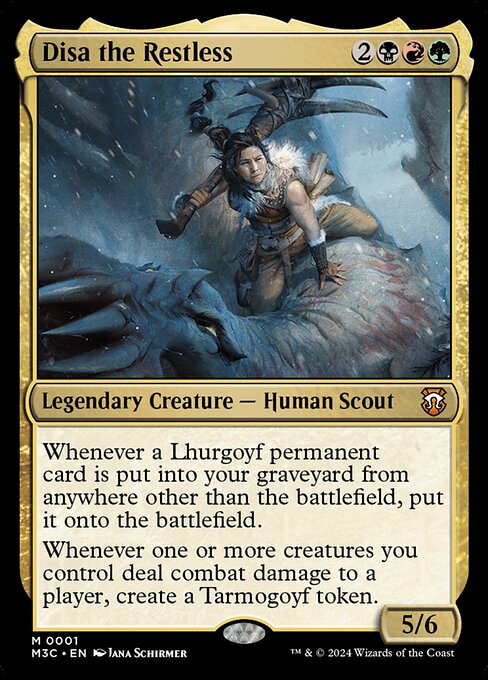
Disa the Restless has two abilities and only one of them works unassisted. The second is free money: whenever your creatures connect, you get a Tarmogoyf token. The first is the one the deck is named after. Whenever a Lhurgoyf permanent card is put into your graveyard from anywhere other than the battlefield, you put it onto the battlefield. Mill a Lhurgoyf, keep the Lhurgoyf. It is the best thing this commander does, and the box hardly lets you do it.
100 cards, 37 lands (12 basic), 35 creatures, average mana value 3.34. Mana sources: 22 black, 21 red, 23 green.
No Game Changers and no mass land denial, so it sets no bracket floor. How brackets work →
The stock Graveyard Overdrive decklist, and what it is worth →
Eight cards in ninety-nine
Resolving the shipped decklist gives the exact set of cards that can set Disa off, and there are eight. Pyrogoyf, Polygoyf, Barrowgoyf, Necrogoyf, Mortivore and the original Lhurgoyf are the creatures. Two more count because Disa asks for a permanent card rather than a creature card: Tarmogoyf Nest is a Kindred Enchantment and Altar of the Goyf is a Kindred Artifact. Both are Lhurgoyfs, and both come down free off a mill.
The Tarmogoyf tokens are not on that list, and that catches people. They carry the Lhurgoyf type, so the instinct is that Disa feeds herself. She doesn’t. A token is not a card, and when one dies it leaves the battlefield, which the ability excludes twice over.
Eight live cards in a ninety-nine card deck is 8.1% of the list. Put that through the same hypergeometrics our draw calculators run and the box’s own mill looks thin:
- Stitcher's Supplier mills three. Chance of at least one Lhurgoyf: 22.5%.
- Grisly Salvage puts five in the yard: 35.0%.
- Deadbridge Chant, the biggest mill in the box at ten cards, reaches 58.7%.
A six-mana enchantment is a coin flip on the commander’s headline ability. That is this deck’s real problem, and it isn’t a power problem. It’s a density problem, which is far cheaper to fix.
The four-mana artifact already in the box
Maskwood Nexus reads like a leftover from a different product. Its first line makes your creatures every creature type, and this deck has no type to care about: nothing reaches half the creature count, and the biggest share is Lhurgoyf itself at 19%. Cutting it is the obvious call, and it’s wrong.
The line that matters is the second one. Creature cards you own that aren’t on the battlefield are also every creature type. Every creature card in your library and your graveyard becomes a Lhurgoyf permanent card, and Disa stops caring which one you milled.
In the upgraded list that takes her live count from eleven to thirty-seven, and the same three outlets change character completely:
- Mill three: 22.5% → 75.9%.
- Mill five: 35.0% → 91.0%.
- Mill ten: 58.7% → 99.3%.
Under a Nexus, Grisly Salvage reads “put up to five creatures onto the battlefield” nine times in ten. There is no second copy of that effect in these colours, either; Arcane Adaptation is blue. Maskwood Nexus is the best card in this box and keeping it costs nothing.
What are the best Graveyard Overdrive upgrades?
In buying order, with the caveat that the first one is already in your box:
- Maskwood Nexus, free. Don’t cut it. It is the difference between a 22.5% mill and a 75.9% one.
- Buried Alive, $2.27. Three creature cards from library to graveyard for three mana. That’s three Disa triggers on demand, or a tutor for the Lhurgoyfs when she isn’t out.
- Stinkweed Imp, $1.61. Dredge 5 swaps a draw for the biggest repeatable mill in the deck, every turn, for no mana.
- Underrealm Lich, $8.87. Every draw becomes look at three, keep one, bin two. It fixes the card selection and the graveyard at once.
- Altar of Dementia, $19.34. A free sacrifice outlet that mills you for the creature’s power at instant speed, and a Tarmogoyf token is usually a five or a six.
All thirteen swaps are in the decklist below. What I’d take out is further down.
Three more Lhurgoyfs, and why there is no fourth
Raising the hit rate directly is the other half of the fix, and it’s nearly free. Jund has fourteen Lhurgoyf permanent cards in paper and eight of them are already in this box. Of the six left over, exactly three belong here:
- Tarmogoyf ($5.20), a two-mana body that sits at 4/5 or bigger in a deck actively filling graveyards.
- Nethergoyf ($3.89) costs one and comes back with escape, so it’s a Lhurgoyf that returns after the first time you bin it.
- Terravore ($0.30) counts land cards in all graveyards, and this deck mills its own lands, cycles five of them and cracks two fetches.
The others genuinely don’t work here, which is worth saying because they look like obvious includes. Cosmogoyf counts cards you own in exile, and this deck exiles almost nothing, so it would be a 0/1 most turns. Magnivore counts sorceries in all graveyards and the upgraded list runs seven. Detritivore is a suspend spell that destroys lands, which is a different deck and a worse table.
Three adds move the live count from eight to eleven and the mill-three number from 22.5% to 30.0%. That’s a real gain and a small one. It is exactly why the Nexus matters, and why the rest of the budget goes to volume instead.
Mill that happens more than once
Nearly all of the box’s graveyard filling is one-shot. Stitcher's Supplier, Grisly Salvage, Grapple with the Past, Faithless Looting and Deadbridge Chant each fire once and then they’re a card in the yard. Dakmor Salvage dredges two, and what else repeats is thin: Liliana, Death's Majesty adds two a turn, Grist, the Hunger Tide one, and Coram, the Undertaker and Barrowgoyf both have to connect first.
Six of the thirteen adds are engines rather than events:
- Stinkweed Imp (dredge 5) and Golgari Thug ($0.36, dredge 4) turn a draw step into a mill of four or five, then return themselves to be dredged again.
- Life from the Loam ($5.13) dredges three and hands back the cycling lands you already binned, which is the other reason those lands stay.
- Nyx Weaver ($0.34) mills two on your upkeep with no attack, no death and no mana.
- Underrealm Lich converts every draw for the rest of the game.
- Altar of Dementia turns any creature, including the tokens Disa hands you for free, into a mill for its power.
Then there’s Buried Alive, which does the opposite of all of that and rolls no dice at all. Three creature cards go from your library to your graveyard. With Disa on the battlefield you name three Lhurgoyfs and all three arrive. With a Maskwood Nexus out you name the three best creatures in the deck and get every one of them, for three mana. Entomb fetches one card where this fetches three, and costs eight times as much.
One piece of technique that costs nothing: with Grisly Salvage you usually want to decline the card. Taking a Lhurgoyf to hand means paying full price for it later; leaving it in the graveyard means Disa puts it onto the battlefield now.
Between those engines and the two draw spells, the deck’s card draw count moves from 7 to 12, which is the difference between sitting below the normal band and inside it.
Four of the twelve taplands cycle
The stock mana base is 39 lands with 12 that always enter tapped, and the reflex is to cut taplands. That reflex would gut this deck. Four of the twelve are cycling lands, so they’re spells when you’re flooded and lands when you’re not. Dakmor Salvage turns a draw into two more cards in the graveyard, every turn, out of the mana base. Raging Ravine is a threat. Savage Lands is the best fixing in a three-colour deck the numbers already call short on sources, and Temple of Malady covers black and green, the two colours doing the work.
Three lands are only tapped: Temple of Malice, Temple of Abandon, and Myriad Landscape, which also makes nothing but colourless mana in a deck asking for double black by turn four and double green by turn three. Those three leave, Llanowar Wastes ($0.66) arrives, and the deck lands on 37 lands with 9 entering tapped.
That trade has a cost and it should be stated plainly: red drops from 23 sources to 21. I’m comfortable with it because the cuts take red spells with them. The box wants a red pip by turn two on 20 cards; the upgraded list wants one on 12, and Chandra's Ignition is the only card left asking for two. If you keep more red than I did, keep Temple of Malice over a basic Swamp.
Ten spells and three lands leave
The three lands are covered above. The other ten:
- Bloodbraid Challenger — its escape cost exiles three other cards from your graveyard, which is the resource this whole deck is accumulating.
- Broodmate Tyrant and Garruk, Apex Predator, the only two seven-drops. A deck whose best turn-three play is a three-mana tutor can’t carry both.
- Infested Thrinax, five mana, and its saprolings need your creatures to die on the turn it lands.
- Bituminous Blast, five mana to kill one creature. Terminate is already here for two.
- Siege-Gang Lieutenant, two goblins a turn but only while Disa is on the battlefield, and they do nothing for the graveyard.
- Sawhorn Nemesis picks one opponent as it enters and doubles damage to them. That’s a political card in a deck with a linear plan.
- Exterminator Magmarch copies your single-target removal at a second opponent, and after these cuts there are five such spells.
- Tempt with Mayhem hands every opponent a copy of your instant or sorcery, and two cards here are worth copying.
- The Reaver Cleaver, an equipment that buffs one creature in a deck that wins by having several. It’s also the most valuable card in the box at $28.09, so selling it covers half of the add list.
Four cards I could have justified cutting are staying, and they stay for one reason. Necrogoyf and Mortivore read as five-drops I should have cut with the rest; they’re two of the eight cards Disa is looking for, and a card that arrives free off a mill isn’t paying five mana. Tarmogoyf Nest reads as an aura in a deck with no aura plan; it’s a Lhurgoyf permanent card that makes more Lhurgoyfs. Syr Konrad, the Grim triggers on creature cards entering a graveyard from anywhere other than the battlefield, which is the same event Disa reads, so every mill that hits a creature now does two things at once.
Curve 3.72 to 3.34, and what it bought
Average mana value drops from 3.72 to 3.34 and both seven-drops are gone. The two-slot goes from 11 cards to 16 and the three-slot from 14 to 17, which matters in a deck whose best early play is now a tutor that fills the graveyard. Lands go 39 to 37, always-tapped 12 to 9. Card draw goes 7 to 12. Creature count goes 32 to 35, and Lhurgoyf creatures 6 to 9.
Nothing about the bracket changes, because there was never a Game Changer in the box and I didn’t buy one. It is a Bracket 1 list on both sides of these swaps, and it plays above that number against a table that isn’t trying.
Thirteen adds come to roughly $51 at September 2026 market prices, against a box that runs about $108. I stayed well under what I’d normally allow myself, because the expensive fix wasn’t necessary here: the card that doubles this deck’s consistency was already inside it.
The upgraded decklist
The list after all thirteen swaps. Hover any card name to see the card and what it currently costs.
“Load into the deck builder” opens this list in your account, pinned to the printings the box shipped, ready to edit or save. “Copy decklist” gives you plain text for Moxfield, Archidekt or Arena — no account needed.
Commander 1
- Disa the Restless




Creatures 34
- Accursed Marauder
- Anger
- Archon of Cruelty
- Barrowgoyf
- Bloodbraid Elf
- Brawn
- Burnished Hart
- Coram, the Undertaker
- Eternal Witness
- Gluttonous Hellkite
- Golgari Thug
- Graveshifter
- Grim Flayer
- Grim Haruspex
- Ignoble Hierarch
- Izoni, Thousand-Eyed
- Junji, the Midnight Sky
- Lhurgoyf
- Mortivore
- Necrogoyf
- Nethergoyf
- Nyx Weaver
- Polygoyf
- Pyrogoyf
- Sakura-Tribe Elder
- Selvala, Heart of the Wilds
- Stinkweed Imp
- Stitcher's Supplier
- Syr Konrad, the Grim
- Tarmogoyf
- Terravore
- Underrealm Lich
- Yavimaya Elder
- Ziatora, the Incinerator




Planeswalkers 2
- Grist, the Hunger Tide
- Liliana, Death's Majesty
Instants 5
- Grapple with the Past
- Grisly Salvage
- Kolaghan's Command
- Riveteers Charm
- Terminate
Sorceries 9
- Buried Alive
- Chandra's Ignition
- Faithless Looting
- Final Act
- Find // Finality
- Life from the Loam
- Maelstrom Pulse
- Rampant Growth
- Syphon Mind


Artifacts 9
- Altar of Dementia
- Altar of the Goyf
- Arcane Signet
- Lightning Greaves
- Maskwood Nexus
- Sol Ring
- Talisman of Impulse
- Talisman of Indulgence
- Talisman of Resilience

Enchantments 3
- Deadbridge Chant
- Deathreap Ritual
- Tarmogoyf Nest
Lands 37
- Canyon Slough
- Cinder Glade
- Command Tower
- Dakmor Salvage
- Demolition Field
- Evolving Wilds
- Exotic Orchard
- 5× Forest
- Forgotten Cave
- Kessig Wolf Run
- Llanowar Wastes
- Mossfire Valley
- 3× Mountain
- Path of Ancestry
- Raging Ravine
- Riveteers Overlook
- Savage Lands
- Shadowblood Ridge
- Sheltered Thicket
- Smoldering Marsh
- 4× Swamp
- Tainted Peak
- Tainted Wood
- Temple of Malady
- Terramorphic Expanse
- Tranquil Thicket
- Twisted Landscape
- Viridescent Bog
FAQ
Do the Tarmogoyf tokens Disa makes trigger her own first ability?
No, and it’s the most common misread of the card. The tokens have the Lhurgoyf creature type, but Disa’s first ability wants a Lhurgoyf permanent card, and a token isn’t a card. Even if it were, a token that dies is going to the graveyard from the battlefield, which the ability specifically excludes. The two abilities are separate payoffs: one turns combat damage into free bodies, the other turns milled Lhurgoyfs into free bodies.
What bracket is Graveyard Overdrive, and do these swaps move it?
Bracket 1 either way. The box contains no Game Changers and none of the thirteen adds is one, so the floor is unchanged. In practice it plays a notch above that once the graveyard engine is running, which is worth mentioning at a table doing bracket talk before a game.
Is Graveyard Overdrive worth playing straight out of the box?
Against other precons, yes. It’s slow rather than weak: 39 lands with 12 that always enter tapped, an average mana value of 3.72, and only seven cards that draw. The commander is genuinely strong and the deck around her is built for a different, more patient game than she wants to play.
Why keep Maskwood Nexus when the deck has no creature type to build around?
Because its second sentence is the one that matters here. Creature cards you own that aren’t on the battlefield are every creature type too, so every creature card in your library and graveyard counts as a Lhurgoyf permanent card for Disa. It takes the chance that a three-card mill triggers her from 22.5% to 75.9%. The typal reading of the card is correct and irrelevant.
What do the thirteen upgrades cost?
About $51 in total at September 2026 market prices, against a box that runs around $108. Altar of Dementia is the single biggest line at $19.34 and Underrealm Lich is next at $8.87. Five of the thirteen are under a dollar, and the highest-impact card on the list is the one already in your box.
Which cards in the box are worth the most on their own?
The Reaver Cleaver at $28.09 is the outlier, and it is the only one of the box’s expensive cards I’d cut, so selling it covers roughly half of the upgrade. Next is Barrowgoyf at $13.46, then Archon of Cruelty at $9.28 and Chandra's Ignition at $8.89, and all three of those are staying. Those are September 2026 prices; the deck page carries current numbers.