Tricky Terrain precon upgrade guide
Fourteen of the forty-four lands in this box enter tapped, and five of them are paying that price for a land type nothing in the deck counts. Thirteen swaps at $55.82 take the tapped count to nine and the average mana value from 3.56 to 3.09.
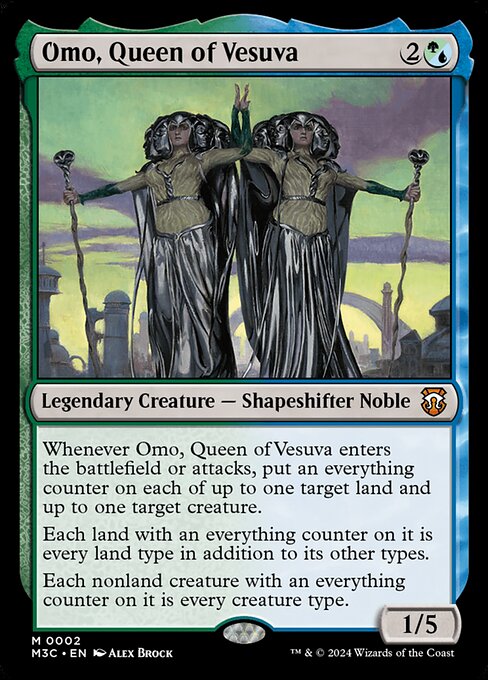
Modern Horizons 3 Commander gave Omo, Queen of Vesuva a deck about land types, then filled it with lands that arrive too late to use them. That is a narrower complaint than the usual precon one, because the card quality here is genuinely high. The box ships Dark Depths, Thespian's Stage, Uro, Titan of Nature's Wrath, Ramunap Excavator and Dryad of the Ilysian Grove, which is a better rare sheet than most decks at this price manage.
What it does not ship is a reason for a third of its mana base to enter tapped.
100 cards, 43 lands (7 basic), 25 creatures, average mana value 3.09. Mana sources: 29 blue, 34 green.
No Game Changers and no mass land denial, so it sets no bracket floor. How brackets work →
What are the best Tricky Terrain upgrades?
In buying order, if you would rather pick up three cards than thirteen. Prices are TCGplayer market for the default printing, checked the day this page was written.
- Azusa, Lost but Seeking, $12.55. Five cards in the box trigger on a land entering. Azusa turns one of those triggers a turn into three, and the deck is already holding the lands to do it.
- The four untapped duals, $7.84 for the set. Botanical Sanctum, Waterlogged Grove, Hinterland Harbor and Barkchannel Pathway replace the taplands in the cut list that were not buying a type.
- Lotus Cobra, $6.29. Ramp that arrives on turn two and gets better every time a land lands, which in this deck is often twice a turn.
- Heroic Intervention, $15.96. The most expensive card here, and the one that stops a wrath from undoing an hour of land drops. It also protects Marit Lage.
- Nissa, Who Shakes the World, $4.09. The box already runs Yavimaya, Cradle of Growth, which makes every land a Forest. Nissa reads that as every land tapping for two.
- Rapid Hybridization, Reality Shift and Krosan Grip, $2.98 together. Interaction, which the box has four pieces of.
- Oracle of Mul Daya, $2.35, and Tireless Provisioner, $3.76. Both convert surplus lands into something, which is what a 43-land deck needs most.
The box ships a 20/20 and never mentions it
Dark Depths and Thespian's Stage are both in this deck. With both on the battlefield and two mana spare, Thespian's Stage copies Dark Depths, arrives as a Dark Depths carrying no ice counters, and immediately sacrifices itself for Marit Lage: a 20/20 flying indestructible token. No other cards required.
The box is better set up for this than it looks. Vesuva and Copy Land can each enter as a second Thespian's Stage. Expedition Map and Sylvan Scrying fetch either half. Ulvenwald Hydra puts a land onto the battlefield when it enters and Hour of Promise puts two. That is six cards supporting a two-card line, in a deck whose packaging is about land types.
It changes how you mulligan. A hand with either piece and any of those six is a keep even when it is light on business, because every other closer in the deck costs six or more.
It does not change the bracket. The floor a decklist can prove is Bracket 1: no Game Changers, no mass land denial, nothing infinite. Marit Lage is one enormous creature rather than an arbitrarily large loop, so it sits inside Bracket 2 comfortably. Say so before the game anyway. A turn-five 20/20 flier reads as a much stronger deck than the box promises, and the surprise is what starts the argument.
The colour screw that isn't
On the printed list the mana looks shaky. Green has 30 sources against the 33 it wants for double green on turn four, which puts Avenger of Zendikar and the rest at 86.9%. Blue has 27 against 36 for double blue on turn three, at 76.4%.
Both numbers are real. Neither is worth acting on, for two separate reasons.
The first is that the deck fixes itself. Yavimaya, Cradle of Growth makes every land you control a Forest, so all 44 produce green. Dryad of the Ilysian Grove goes further and makes every land every basic type, which means every land taps for either colour. Omo does the same to one land per trigger. Any one of the three erases both shortfalls, and the box runs all three.
The second is that the turn-three blue figure is measured against a turn this deck never wants. The four cards demanding double blue are Curse of the Swine and Finale of Revelation, both X spells you cast late; Summary Dismissal, a counterspell you hold; and Evacuation, which is in the cut list below. None of them is a turn-three play, and pricing them as though they were is what makes 76.4% look alarming.
The mana base does not need more sources. It needs the ones it has to be available the turn they arrive.
Five lands that are tapped for nothing
Here is the census that decides which taplands stay. The cards in this deck that count land types care about four of them:
- Gates, three: Simic Guildgate, Talon Gates of Madara and Basilisk Gate. Basilisk Gate pumps a creature by the number of Gates you control, and Sage of the Maze turns a land into a creature twice that size.
- Deserts, five: Lazotep Quarry, Hashep Oasis, Lush Oasis, Desert of the Indomitable and Desert of the Mindful. Hour of Promise wants three and Desert Warfare wants five, so the box sits exactly on the line for its own payoff.
- Locus, three: Cloudpost, Glimmerpost and Trenchpost. Cloudpost taps for one colourless per Locus on the battlefield.
- Urza lands, the Mine, Power Plant and Tower, which pay six mana between them once assembled.
Planar Nexus is every one of those at once, which is why it is the best land in the box.
Then there are four Caves: Sunken Palace, Hidden Cataract, Hidden Nursery and Volatile Fault. Nothing in the hundred counts Caves. The closest thing is Wonderscape Sage, which cares only that a land has some nonbasic type, and nineteen lands here already satisfy that. Volatile Fault earns its slot on its own text, since it blows up a land and leaves a Treasure behind. The other three are tapped lands whose type is decoration.
They go, along with Thornwood Falls and Quandrix Campus, which have no nonbasic type at all and enter tapped to gain one life or to offer a scry that costs four mana.
The nine taplands I keep all buy something. Cloudpost is the Locus payoff. Simic Guildgate is a third of the Gate count. The two cycling Deserts hold the Desert count at five, which is the number Desert Warfare needs. Simic Growth Chamber makes two mana and re-triggers landfall on the way in. Temple of Mystery and Lumbering Falls are the close calls, and they are the two I would revisit before touching the Deserts.
One oddity worth naming: Lair of the Hydra reads "if you control two or more other lands, this land enters tapped", which is the reverse of the usual wording. It comes in untapped on turns one and two, then tapped for the rest of the game. In a 43-land deck that is a tapland with extra steps. It is also the only land here that can attack unaided, and Omo wants attackers.
Eight spells that cost more than they do
The top of this curve is where the deck's value went. The box runs a ten-drop, an eight-drop and a seven-drop, and its average mana value of 3.56 is high for a list that wants to be attacking with a three-mana commander by turn four.
Apex Devastator at ten and Terastodon at eight are the easy ones. Cascading four times is a wonderful thing to do and you will not do it. Hydra Broodmaster and Mana Reflection both cost six and then ask for six more before anything changes.
Evacuation bounces every creature including your own Plants, Insects and Marit Lage, which makes it a five-mana way to undo your own turn. Replication Technique costs five to copy one permanent and hands an opponent a copy as well. Acidic Slime is five mana for something Krosan Grip does at three, and Krosan Grip cannot be responded to.
March from Velis Vel is the last one. It pumps a single creature and grants it every creature type, which sounds like it belongs here until you notice that Omo already does the creature-type half for free, every time she attacks.
The seven-drop, the six-drop and the five-drop that stay
Avenger of Zendikar costs seven, which is exactly the sort of card the rest of this page is cutting. It also makes a 0/1 Plant for every land you control, which here is a dozen or more, and grows all of them each time a land enters. It is the best top-end card in the box by a distance.
Ulvenwald Hydra is six mana for a creature whose power equals your land count, so roughly ten, with reach. More usefully, it searches a land onto the battlefield when it enters, and one of the lands it can find is Thespian's Stage.
Hour of Promise costs five, puts two lands onto the battlefield tapped, and makes two 2/2 Zombies if you control three Deserts. The box has five. It is a ramp spell with four power attached that can also assemble half the combo.
What the swaps buy
Thirteen out, thirteen in, $55.82 at market.
The land count goes from 44 to 43, and the shape underneath moves further than the total suggests. Unconditional taplands drop from 14 to nine, untapped lands rise from 28 to 30, and conditional lands go from two to four. Average mana value falls from 3.56 to 3.09. The curve loses its ten-drop and one of its eight-drops and gains three cards at one and two.
Spot removal goes from four, under the five to ten a deck this size wants, to six. Ramp stays at eight and card draw at eleven, both already fine.
Green sources go from 30 to 34, taking double green on turn four from 86.9% to 91.9%. Blue goes from 27 to 29 and double blue on turn three from 76.4% to 80.4%, which still reads short and still does not matter, for the reasons above.
The bracket floor is unchanged at 1. Deck value goes from $147.44 to $192.51.
Three cards I looked at and did not buy
Exploration at $33.63 and Burgeoning at $32.94 both do what Azusa does, for two and a half times the money. Buy Azusa first. If the deck becomes your main one, Exploration is the next land-drop effect worth owning.
Crucible of Worlds is $35.34, and the box already runs Ramunap Excavator, which is the same ability on a body that can block. A second copy of an effect is not worth a third of the deck's value.
Field of the Dead is $27.64 and enters tapped, which is the tax this whole page is written to reduce.
The upgraded decklist
The hundred cards after the swaps. Hover any card name to see the card and its current price.
“Load into the deck builder” opens this list in your account, pinned to the printings the box shipped, ready to edit or save. “Copy decklist” gives you plain text for Moxfield, Archidekt or Arena — no account needed.
Commander 1
- Omo, Queen of Vesuva


Creatures 24
- Avenger of Zendikar
- Azusa, Lost but Seeking
- Dryad of the Ilysian Grove
- Elvish Rejuvenator
- Floriferous Vinewall
- Fog Bank
- Hydroid Krasis
- Jyoti, Moag Ancient
- Lotus Cobra
- Magus of the Candelabra
- Oracle of Mul Daya
- Poison Dart Frog
- Rampaging Baloths
- Rampant Frogantua
- Ramunap Excavator
- Sage of the Maze
- Satyr Wayfinder
- Scute Swarm
- Skullwinder
- Tatyova, Benthic Druid
- Tireless Provisioner
- Ulvenwald Hydra
- Uro, Titan of Nature's Wrath
- Wonderscape Sage







Planeswalkers 3
- Nissa, Steward of Elements
- Nissa, Who Shakes the World
- Vivien Reid
Instants 11
- Arcane Denial
- Beast Within
- Drown in Dreams
- Eureka Moment
- Growth Spiral
- Heroic Intervention
- Krosan Grip
- Pongify
- Rapid Hybridization
- Reality Shift
- Summary Dismissal
Sorceries 8
- Aggressive Biomancy
- Curse of the Swine
- Finale of Revelation
- Harmonize
- Hour of Promise
- Sylvan Scrying
- Treasure Cruise
- Urban Evolution

Artifacts 7
- Arcane Signet
- Chromatic Lantern
- Expedition Map
- Mirage Mirror
- Oblivion Stone
- Seer's Sundial
- Sol Ring
Enchantments 3
- Copy Land
- Desert Warfare
- Propaganda
Lands 43
- Barkchannel Pathway // Tidechannel Pathway
- Basilisk Gate
- Blast Zone
- Botanical Sanctum
- Cloudpost
- Command Tower
- Dark Depths
- Desert of the Indomitable
- Desert of the Mindful
- Dreamroot Cascade
- Flooded Grove
- 4× Forest
- Glimmerpost
- Hashep Oasis
- Hinterland Harbor
- Horizon of Progress
- 3× Island
- Lair of the Hydra
- Lazotep Quarry
- Lumbering Falls
- Lush Oasis
- Overflowing Basin
- Planar Nexus
- Simic Growth Chamber
- Simic Guildgate
- Talon Gates of Madara
- Temple of Mystery
- Thespian's Stage
- Trenchpost
- Urza's Mine
- Urza's Power Plant
- Urza's Tower
- Vesuva
- Vineglimmer Snarl
- Volatile Fault
- Waterlogged Grove
- Yavimaya Coast
- Yavimaya, Cradle of Growth
FAQ
Is 44 lands too many for Tricky Terrain?
It is well above the 35 to 38 a two-colour Commander deck normally wants, and I still only take it to 43. Five cards in the box are paid when a land enters, and the swaps make it seven. The count was never the problem. A third of them arriving tapped was.
Which land types does this deck actually count?
Gates, Deserts, Locus and the Urza trio. The box runs three Gates, five Deserts, three Locus and all three Urza lands, plus Planar Nexus, which is every nonbasic land type simultaneously. It also runs four Caves, and no card in the hundred counts Caves.
What bracket is this deck?
Bracket 1 is the floor a card list can prove, because there are no Game Changers, no mass land denial and nothing infinite. In play it behaves like a Bracket 2 deck, since Dark Depths plus Thespian's Stage is a 20/20 flier for two mana. That line does not move the floor, but it is worth mentioning at the table.
Does the deck fix its own colours?
Almost entirely. Printed, it is three sources short on double green and nine short on double blue. Yavimaya, Cradle of Growth turns every land into a Forest and Dryad of the Ilysian Grove turns every land into every basic type, so drawing either one closes both gaps by itself. That is why nothing on this page is bought to fix colour.
How do I actually win?
Marit Lage is the fastest route and six cards in the box support it. Failing that, Avenger of Zendikar, Scute Swarm and Rampaging Baloths all convert land drops into a board, and Sage of the Maze can turn a land into a creature twice the size of your Gate count. Nothing on this page touches any of those.
What does this upgrade cost?
$55.82 for all thirteen cards at market prices for default printings. The four replacement lands are $7.84 of that and the three removal spells are $2.98, so a little over half the total is Azusa, Lost but Seeking and Heroic Intervention.
Would Tatyova be a better commander for this list?
She is the safer one. Tatyova, Benthic Druid draws a card on every land drop from the command zone, which is more reliable than anything Omo does. But the Gate, Desert and Locus counts only scale because Omo hands out every land type at once, and without her a third of the box stops making sense.